
The Week Ahead
March 8, 2026

Here is the president of the United States, wearing a white ball cap at the dignified transfer of American soldiers who died on his watch, in the unnecessary war that he started. Trump’s niece, Mary L Trump, posted on Substack Notes, “With all of the horrors he's unleashing on the world, I know this is not the biggest deal, but he is such an unspeakable disgrace.”

It’s not just any white ball cap. This one, with the gold letters “USA” embroidered across the front, comes from “The Trump Store,” which benefits, you guessed it, Donald J. Trump. You can find the hat there for just $55, and in case you want to know more about the many items you could purchase to line the president’s coffers, there is plenty of merchandise, as well as links to Trump Hotels, Trump Golf, Trump International Realty, and Trump Winery. Apparently, if you’re Donald Trump, nothing says great opportunity for pushing your merchandise like bringing home fallen soldiers. Mary is right. It’s disgusting.

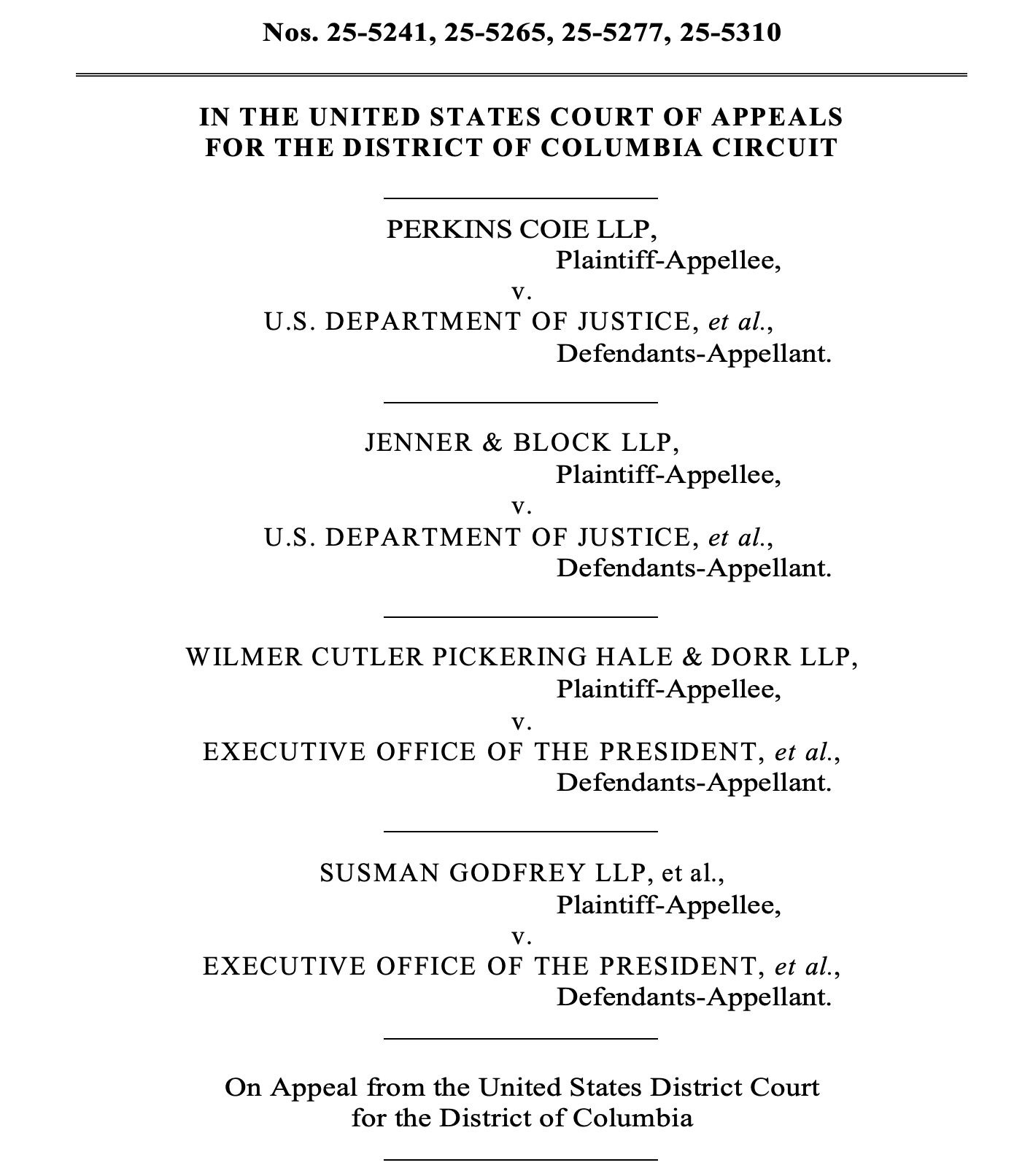
Trump has also been busy using the presidency to wage war against his enemies—not just abroad, but also at home. He continues to attack federal judges, even though they are part of a coequal branch of government that the Constitution and his oath of office require him to work with. On Friday night, the government filed its brief in its on-again, off-again defense of Trump’s executive orders against four law firms that provoked his ire for things like having once counted Bob Mueller among their partners or offering pro bono legal advice to Jack Smith.
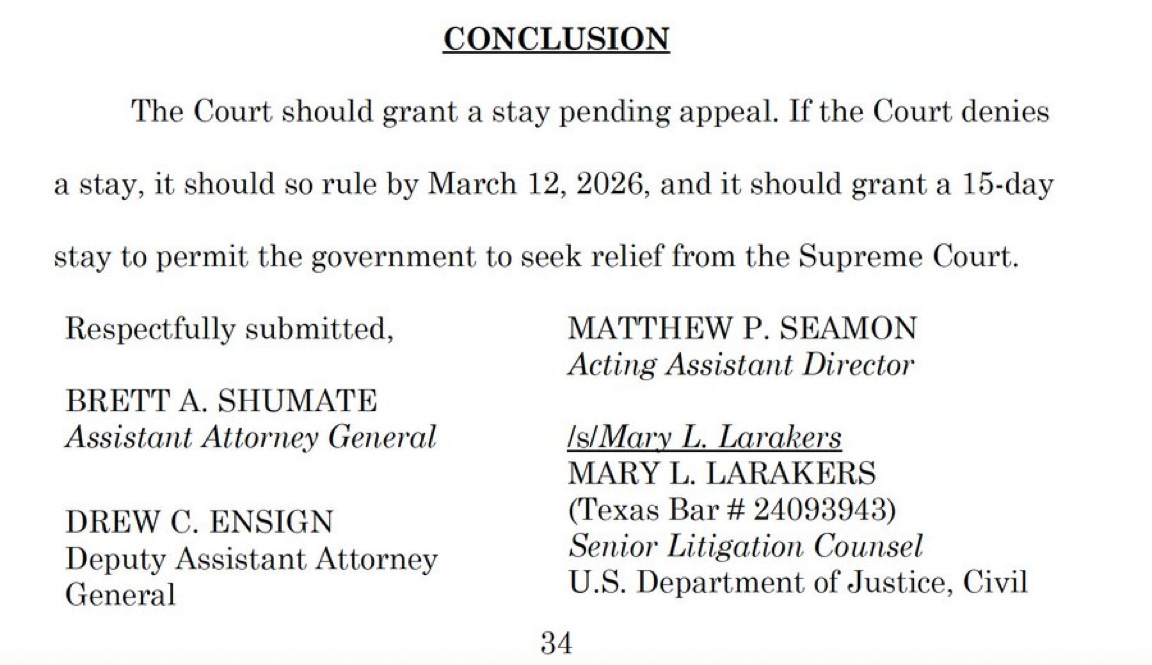
The government’s brief begins like this: “Courts cannot tell the President what to say. Courts cannot tell the President what not to say. They cannot tell the President how to handle national security clearances.” It’s almost as though the government’s lawyers don’t know there’s a Constitution out there, a rule of law that both assigns power to and constrains the exercise of power by the executive branch of government, which is one of three branches of government in this democratic Republic, and not an all-powerful dictator.
“Ignoring those constraints, the district courts below bent over backwards to facially invalidate every section of four Executive Orders without considering their plainly constitutional aspects and applications. This appeal of those sweeping decisions is not about the sanctity of the American law firm; it is about lower courts encroaching on the constitutional power of the President.”
And there we have it. As with virtually everything we’ve seen in Trump 2.0, this is about creating an all-powerful presidency, and trying to bulldoze over anyone, federal district court judges included, who stand in Trump’s way. It is a far cry from the Founding Fathers’ vision of a government by, for, and of the people, designed to prevent the accumulation of too much power in any one branch of government, because they were trying to avoid a return to the rule of kings, or more pointedly, the rule of a despot.
The government doesn’t just object to the decision made by each of the four judges who considered the issue that Trump’s executive orders exceeded his powers. They characterize it as “grave error” in their brief and say the judges are “encroaching on the constitutional power of the president.” Utterly amazing since just days ago, the government told the court of appeals it wanted to abandon its lawsuit.
This is absolutely one of the top cases to watch right now. It will take some time for it to be fully briefed and argued in the court of appeals, and the big show will happen when the losing party there takes it to the Supreme Court. The Court can either let the lower court’s decision stand or agree to take the case. That would be, at the earliest, during the next term of Court, unless both the court of appeals and the Supreme Court move remarkably fast.
But we will see briefs from the lawyers representing the four law firms soon. They’ve certainly gotten under the president’s skin here, and he has apparently demanded that “his lawyers” at the Justice Department pursue what they likely believe, along with the rest of the legal community, is a stone-cold loser of a case. Trump doesn’t have the power to put law firms, or any other private companies, out of business to take revenge on them for personal grievances. That, almost by definition, is how a dictator operates, not a democratically elected president whose power comes from the people.
Normally, I’d expect to see a case like this handed by the Justice Department Civil Division’s appellate section. Instead, we have the Associate Attorney General, the number three official in the Department—he supervises the Civil Division—on the brief, along with one of his deputies. No word on whether they decided to take the case over or whether the experienced career lawyers in the Civil Division declined to participate. Both the earlier brief abandoning the appeal and Friday’s brief were signed by Abhishek S. Kambli, one of the Deputy Associate Attorney Generals. According to his Federalist Society biography, prior to his appointment at DOJ, Kambli was the Deputy Attorney General at the Kansas Attorney General’s Office, but he also has experience as both a federal prosecutor and a JAG officer. In other words, this is someone who understands the fight he is picking with the federal judiciary.
Trump also seems to be intent on using the Justice Department to execute his foreign policy. Trump and others have been talking this weekend about Cuba, suggesting that the days of its current leaders are numbered. Late last week, reminiscent of the use of a federal indictment to go into Venezuela and arrest its president, there was a report that the U.S. Attorney in Miami is running a “multi-agency working group” whose goal is to prosecute leaders of the Cuban government or Communist Party in the U.S.
One of the fundamental rules of being a federal prosecutor is investigating crimes, not people. Here, it’s shocking (I don’t use that word lightly when it comes to Trump) to have an announced foreign policy and learn that the Justice Department is being used to execute it. Federal agents and prosecutors only open an investigation when they have at least reasonable suspicion that a crime has occurred.
But MS NOW’s Carol Leonnig and Jake Traylor reported that, “roughly a month ago, White House officials privately discussed their concern that they did not believe they could remove Cuba’s leadership in the same way they removed Maduro, due to the lack of a clear criminal charge, according to a person familiar with those discussions. The working group was created after that concern was raised.” That approach stands any notion of justice and fairness on its head and turns our criminal justice system into a political tool to be used by a president who can now tell prosecutors to go get his enemies.
Today, it’s Cuban leaders. Tomorrow, it could be Democrats or anyone else the president doesn’t like.
Last Wednesday, a federal judge in Boston ordered the government to stop deporting people to countries to which they have no connection. Judge Brian Murphy ruled that the Trump administration’s policy of sending immigrants to nations other than their countries of origin is unlawful.
“This case,” Judge Murphy wrote, “is about whether the Government may, without notice, deport a person to the wrong country, or a country where he is likely to be persecuted, or tortured, thereby depriving that person of the opportunity to seek protections to which he would be undisputedly entitled. The Department of Homeland Security has adopted a policy whereby it may take people and drop them off in parts unknown—in so-called ‘third countries’—and, ‘as long as the Department doesn’t already know that there’s someone standing there waiting to shoot . . . that’s fine.’”
He told the government, “It is not fine, nor is it legal.”
Predictably, the government has gone to the First Circuit Court of Appeals for an emergency stay, so it can continue deporting noncitizens to third countries with as little due process as possible, despite the danger it is placing people in. "The Supreme Court twice stayed the district court’s sweeping nationwide, classwide preliminary injunction," the government argued, suggesting that the judge was trying to "evade" prior decisions by higher courts. We discussed the origin of this case here.
The government has advised the court that if the First Circuit denies the stay, it will go directly to the Supreme Court for a shadow docket ruling on its request for an injunction. There could be a lot of action in this case this week.
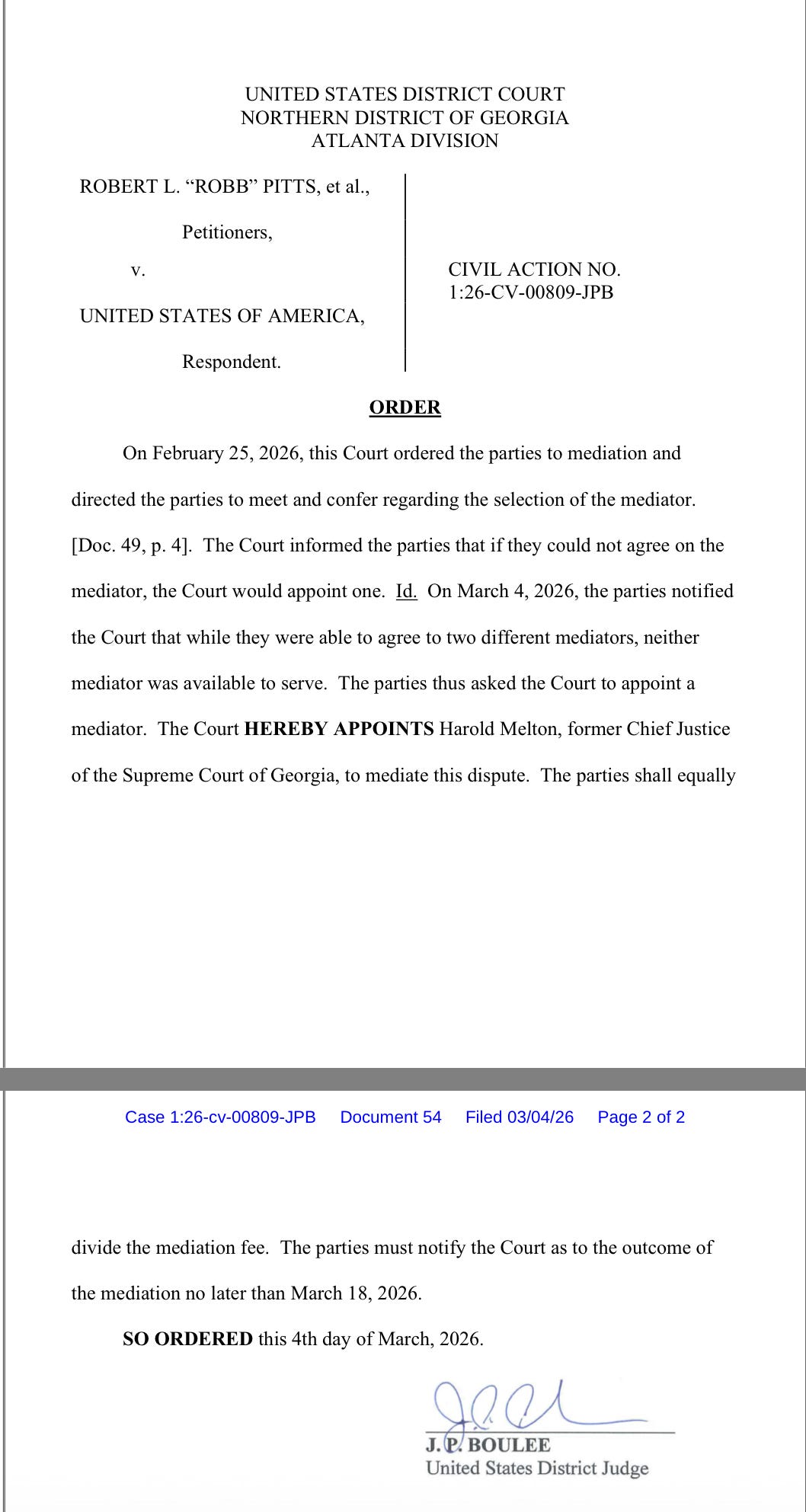
Finally, in Georgia, a mediator is on board to decide whether Fulton County is entitled to get its ballots and voting records back from the FBI. That mediation will have to happen quickly. The Judge has ordered the parties to advise him whether they are able to reach an agreement by March 18.
In mediation, a neutral arbiter (the mediator) helps the parties to a lawsuit arrive at a mutually acceptable settlement to avoid trial. Mediation can be faster, cheaper, and less adversarial than a courtroom process. Here, the Judge reminded the government that it could keep copies of the documents it returned to the County, and suggested that agreeing to do so could avoid more extensive fact-finding in court. We discussed why the government might want to attempt mediation here, although this Justice Department seems to be able to do precious little to help itself out in a case where Trump is involved. Mediation proceedings are conducted in private.
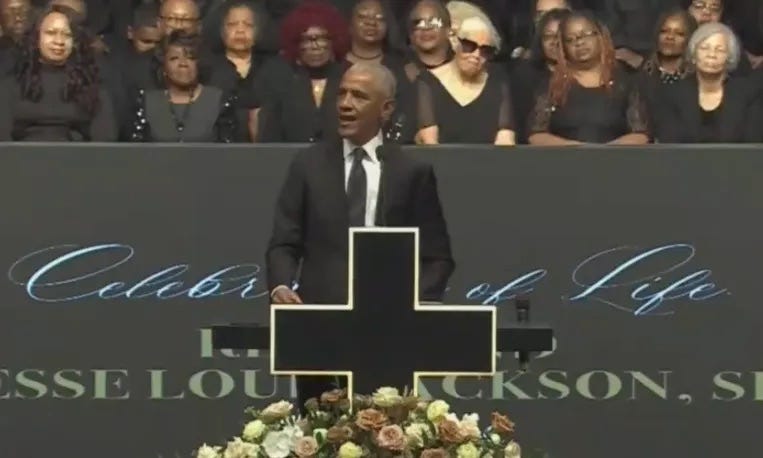
On Friday, at the Reverend Jesse Jackson’s funeral, Barack Obama spoke:
“Each day we wake up to some new assault on our democratic institutions.
Another setback to the idea of the rule of law. An offense to common decency. Every day you wake up to things you just didn’t think were possible. Each day we’re told by those in high office to fear each other and to turn on each other, and that some Americans count more than others, and that some don’t even count at all.
Everywhere we see greed and bigotry being celebrated, and bullying and mockery masquerading as strength. We see science and expertise denigrated, while ignorance and dishonesty and cruelty and corruption are reaping untold rewards. Every single day. We see that, and it’s hard to hope.”
The stark contrast between the former president and the current one is unavoidable.
Giving up hope, as my book says, would be unforgivable. We owe staying in this fight to Reverend Jackson and to other leaders who have fought to make this country better. We owe it to the foot soldiers who marched across the Edmund Pettus Bridge 61 years ago in Selma, Alabama, and to everyone who marches today. Giving up is not an option
We’re in this together,
Joyce
Joyce. I appreciate you and your analysis but hope is hard today. 7th US service member killed. Girls in school. Today is a hardnday.
My Dad was a USAF officer and Vietnam vet who passed away 8 years ago. If Donald Trump had showed up at his funeral wearing a baseball cap, my then 88-year-old Mom, hardcore Republican that she had always been, would have tried to knock it off his head, but because she was pretty bent over would have wacked him somewhat lower than the head and then cackled all the way back to the Army Residence Community.