
DOJ Changes Course

Last night, I wrote to you about reporting that the Trump administration would stop defending the clearly illegal executive orders the president issued last March. There was a lot of reporting on that story last night, and apparently Trump got wind of it because there is an update tonight.
After last night’s news broke, the Justice Department changed its mind. Perhaps, although we don’t know for certain, it would be more accurate to say Trump told his Justice Department to change its mind. Suffice it to say it’s enormously unusual for the government to one day file a motion to voluntarily dismiss its appeal on these cases and the next morning to say, “Nope, our bad, we’ll go ahead and defend those appeals after all”—which is precisely what happened this morning.
That’s how you get to the cumbersome title of today’s pleading, filed by the Associate Attorney General, the number three official at DOJ, just below the Attorney General and the Deputy Attorney General. This morning, he filed a “Motion To Withdraw Motion To Voluntarily Dismiss Appeals.”
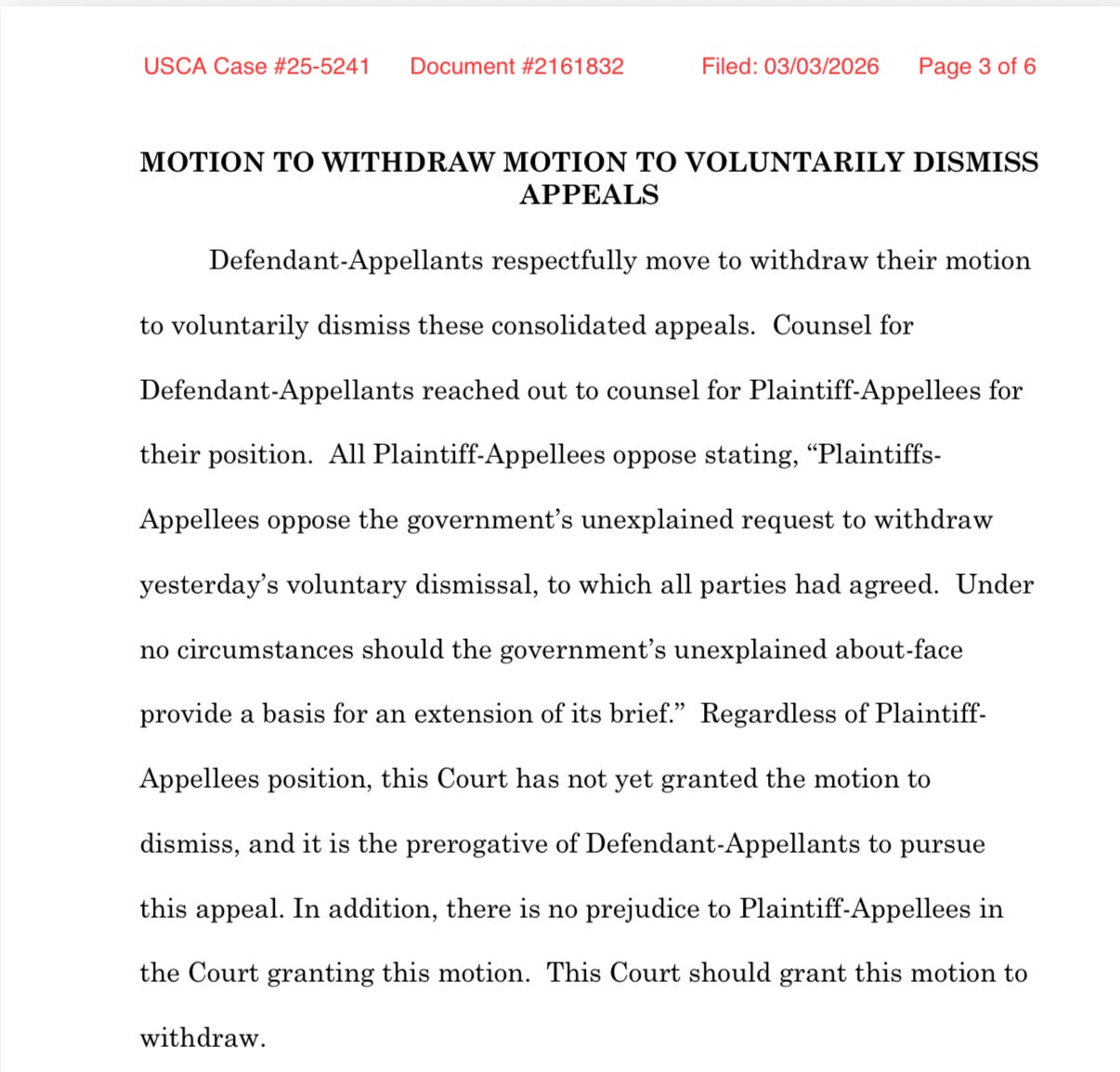
The law firms opposed the motions to withdraw the motion to dismiss. A little legal terminology to keep everything straight here:
The law firms each filed a lawsuit to challenge the executive order against them, so they are the plaintiffs.
Trump and his cohort were the defendants in each case.
The law firms won in the lower court, and it’s the government defendants who are (and apparently still are) challenging their loss, so on appeal, they are the appellants and the law firms are the appellees.
The four individual law firm cases are currently consolidated in front of the Court of Appeals for the District of Columbia. That’s how the government was in a position to ask the court to dismiss the case, and of course, the plaintiff/appellee law firms were only too happy to agree.
The Justice Department’s opening brief in the case is due this Friday. Granting or denying its appeal/motion to abandon the appeal/motion to reinstate the appeal is within the discretion of the court, and although the sequence is highly unusual, there’s no real reason the court shouldn’t let the government proceed. We can expect a ruling soon, given that the brief is due at the end of the week.
But in many ways, the government would likely be better off letting this case fade away while most of the country is focused on the president’s war in Iran. It is very likely to be an embarrassing loss in both the Court of Appeals and in the Supreme Court (if it even gets there). It’s a weak case that reveals embarrassing personal weakness in a president who persistently abuses the power of his office as a tool for personal revenge. The New York Times Editorial Board put it like this earlier today, “This withdrawal of the administration’s withdrawal is amateurish, and it does not change the likely outcome of the fight. Judges — appointed by presidents of both parties — have repeatedly ruled that the executive orders were illegal.” We discussed last night that the four judges who ruled on the law firms’ cases, two Republican appointees and two Democratic ones, unanimously held that Trump’s executive orders were out of bounds.
There is also a fifth case, filed later, involving Mark Zaid, a lawyer who handles whistleblower cases. The administration tried to take away his security clearance, which would have made it virtually impossible for him to do his work. District Judge Amir Ali, a Biden appointee, characterized that action as “retribution” for Zaid’s work representing clients with complaints about the government. That case is not, at least as of yet, consolidated with the other four, and the lawyers in those cases have argued that the court should keep it that way because the issues are distinct. Consolidation would slow the matter down, and there is plenty of reason for the law firms to want to move forward quickly, especially given the strength of their case against Trump.
As for the Justice Department, it has again cheapened its position. Instead of pursuing cases in a principled way, based on the facts and the law, it has again made clear that it serves the whims of the president. That can’t help but make a mark on how the courts view the credibility of DOJ. We’ve talked before about the presumption of regularity, which courts have applied for decades to take as a given, in the absence of evidence to the contrary, that government lawyers do their duty and conduct themselves with integrity. Many judges have argued that it no longer applies.
This morning, in the combined habeas cases hearing before Judge Jeffrey Bryan that we discussed in The Week Ahead column last Sunday, the Judge advised Trump’s U.S. Attorney for Minnesota, Daniel Rosen, that although he didn’t want to use it, he had “not ruled out the consequence of imprisonment” if he found that the government was still in contempt of the court’s ruling that agents must return property seized from immigrants who were detained. Later in the day, he admonished an ICE supervisor, as she testified, that “aliens” are “people ... not space aliens.” At the end of the day, the Judge took the matters before him “under advisement” and will issue a ruling shortly. As with the executive orders case, the whole matter is a bad look for the Justice Department.
You would expect the Department’s leadership there to be doing everything possible to restore their credibility with the courts. Instead, they are seemingly content to continue to fritter it away in service of the president, having forgotten that their client is the American people. One of the places where that is most apparent is with the Epstein Files. Despite the Transparency Act, the DOJ has still withheld approximately 3 million documents, claiming it doesn’t have to produce them, even as there are demonstrably inappropriate exclusions and highly questionable redactions in what they have made available to Congress and the public.
This morning, outgoing North Carolina Republican Senator Thom Tillis told DHS Secretary Kristi Noem he thought she should resign. In today’s oversight hearing, he lambasted her for killing her dog. She wrote in a memoir that she had to shoot the dog because he was “untrainable.” She also shot a pet family goat. Tillis, a dog lover, said she had bad judgment, comparing her personal behavior and the lack of judgment the shootings showed to the way the agency she leads has carried out its work, including the shooting deaths of Renee Good and Alex Pretti at the hands of federal agents.
It’s about time Congress starts doing its job and holding federal law enforcement accountable. They have the tools to do it, with Tillis threatening to put a hold on DHS nominees if he didn’t get answers to questions he posed to Noem. We need more of the energy and candor of a retiring Republican senator in congressional dealings with this administration. Congress is going to have to police the Justice Department, too—it seems incapable of policing itself.
There’s a lot of noise out there about the law right now. My goal here is to slow things down, read the sources carefully, and explain what they actually mean. If that’s valuable to you, becoming a paid subscriber is the best way you can support my work.
We’re in this together,
Joyce
Trump tells DoJ … but who’s telling Trump? If it isn’t drapery or crypto or donations, he doesn’t care … nor even understand.
You are a truth machine. Your insights are invaluable to putting it all in legal perspective. Thank you for your fine work.