
The Week Ahead
June 14, 2026

Sunday was the president’s birthday, which meant cage fights on the South Lawn of the White House. The weigh-ins at the Lincoln Memorial Saturday night were atrocious. The fights were scheduled to start shortly after I finished up this piece. I had no intention of watching the spectacle, so I headed out to dinner with a girlfriend. My phone blew up the whole time. But it was too nice of a night to ruin by watching Trump’s birthday Hunger Games now, so I’m going to do the last edit and send this off to you without watching the show. I apologize in advance for the length, but this piece should catch you up on the most important issues and get you ready to stay up to speed this week. I’ll catch up in the morning, but I do hope they had bad weather for the cage fights.
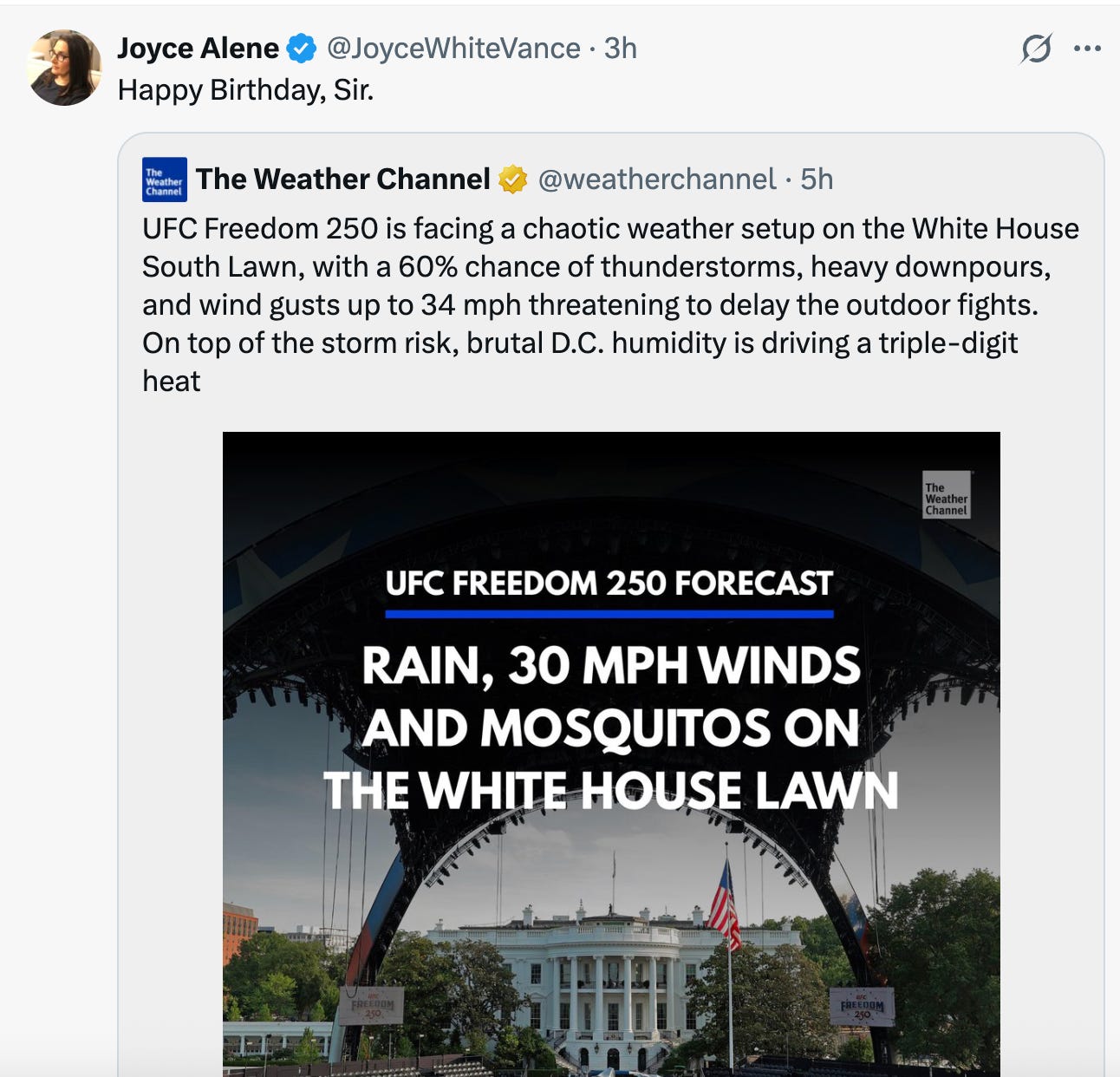
Never forget that much of the performative nonsense, like desecrating the White House lawn and the Lincoln Memorial with cage fighting, is all about distraction. This president has plenty to try and distract us from, starting with the fact that he’s the oldest president to ever hold office. His 80th birthday today highlights that. He falls asleep in meetings and at Knicks games (to say nothing of jinxing the team). He babbles nonsense. He has become a laughingstock to other world leaders. Even his numbers domestically are low enough to suggest he’s finally losing some of the support long believed to be immovable—the people who would give him a pass even if he shot a man on Fifth Avenue. I’ll just say again, Trump’s success is not inevitable. Keep questioning, keep thinking, keep planting seeds even with people you think will not come around, because people are, in increasing numbers.

But there’s obviously far more to distract from.
The Epstein Files are top of that list. I haven’t forgotten that last December, Marjorie Taylor Greene claimed Trump called her on the phone to yell at her about signing the discharge petition that got the transparency act across the finish line. According to Greene, Trump told her he opposed releasing the files because some of his “friends will get hurt.” Could that include his “friend” John Barron? There are plenty of unanswered questions. Cage fighting seems like just the solution.
After reporting emerged last week about a Situation Room meeting about the files that excluded Trump but included Todd Blanche, his nominee to be Attorney General, the survivors issued a statement that said in part:
“We are deeply disturbed to learn so many senior members of the Trump administration gathered in the Situation Room to discuss the release of the Epstein Files as a reputational problem, rather than an opportunity to pursue investigative leads and try to figure out what actually happened. … we are separately concerned Todd Blanche was at that table. Blanche has consistently minimized legitimate concerns about how the files have been handled, including problematic redactions and the exposure of survivors’ personal information.”
The reporting further underscores the sense that the release was queued by the Justice Department in a way that protected powerful people, not as an attempt to get to the truth. There’s still a lot we don’t know about people who possibly could be, but aren’t being held accountable for the abuse of girls and women. Trump supporters thought he would release the files, not protect the well-connected people in them.
There’s also the war in Iran, which is either over or not over, depending on when you’re checking. Even if there is an exit strategy, numerous commentators have pointed out it doesn’t seem very different from the one President Obama got, the deal Trump has relentlessly criticized. The House has already passed its part of a concurrent resolution that would invoke the War Powers Act and require Trump to stand down. The Senate still has to consider the measure. Under the special rules in play here, the concurrent act doesn’t require Trump’s signature. But there are open questions about enforceability, with the White House certain to claim that this is an unlawful incursion into presidential power.
The Trump administration will be back in court this week. They’ve filed their brief in Trump v. IRS, which they’ve styled as: “PLAINTIFFS’ RESPONSE TO THE COURT’S MAY 29, 2026 ORDER AND IN FURTHER OPPOSITION TO THE MOTION OF THIRTY-FIVE FORMER FEDERAL JUDGES FOR RELIEF FROM THE ORDER OF DISMISSAL.” This relates to Trump’s slush fund, and it’s a bit confusing at this point because there are multiple cases.
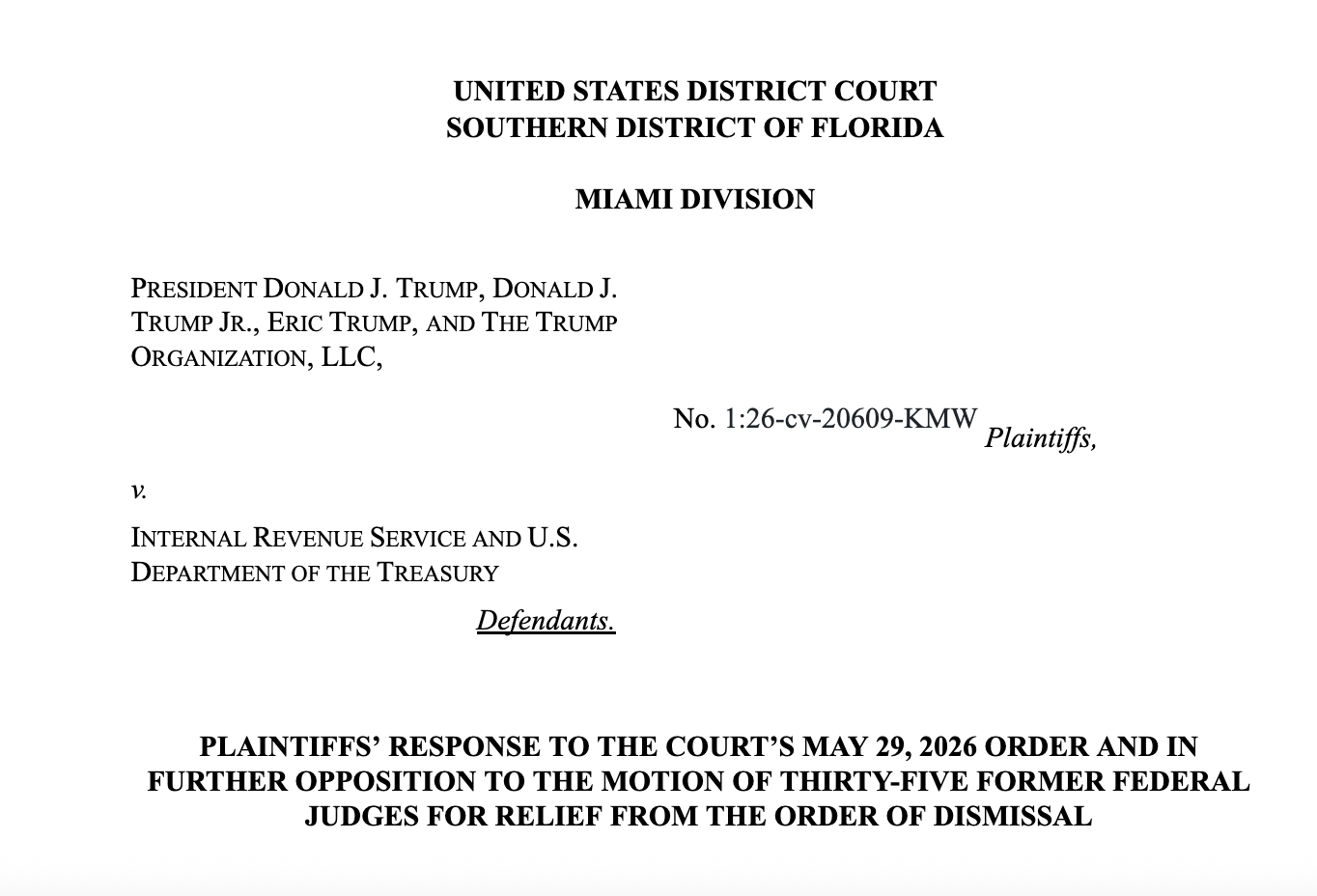
The brief we’re looking at tonight was filed in the Florida case, the one Trump filed seeking damages from the government after a contractor with the IRS released his (and about 399,000 other people’s) tax returns. A proposed “settlement” of the case came to light that had nothing to do with damages resulting from that incident, the slush fund, which was subsequently challenged in the two different cases that we’ve been discussing for the last few days, one in Virginia (where a judge enjoined the slush fund from going into operation) and one in the District of Columbia (where a judge held that taking any action would be premature).
The issue in the Florida case is different. It’s whether Judge Kathleen M. Williams was misled by the Trump plaintiffs when she dismissed the case, as a brief from a bipartisan group of 35 retired federal judges argues. It’s complicated, but also critically important. Before we discuss the new brief filed by the Trump plaintiffs, let’s briefly review how we got here, and I’ll link to the earlier posts in case you want a refresher:
Kleptocracy, May 19. We looked at the original lawsuit Trump filed, its potentially fraudulent nature with Trump on “both sides of the v” since he controls how the IRS handles the case, and early news about the possible settlement. “When everything is bad, nothing is bad. People get desensitized. They can no longer keep track of it all. It’s all so awful that none of it gets processed anymore. So I need you to hear me when I say tonight: This is bad. Really, really bad. … Here’s the bottom line. Donald Trump wants to take $1.8 billion dollars of money that taxpayers like you and me have paid to the government, and he wants to give it to his most hardcore followers, the people who stormed the Capitol on January 6.”
It got worse the next day. Almost as good as a pardon, May 20. “DOJ posted a settlement document on its website in the case. It was unexpected, because we’d already seen a settlement agreement in this case, the one we looked at last night. There was no reason to expect anything additional would be forthcoming. When it showed up, the addendum came without any title, just a date at the top … a remarkable one-page document bearing the acting Attorney General’s signature.
It’s a pardon on steroids for Trump, Trump’s family, and Trump businesses. The government agrees in this document, signed by Blanche, that it will never prosecute or pursue any civil claims against any of the Trumps, ‘whether presently known or unknown’ that could have been brought as of the date of the settlement agreement. That date is yesterday. The IRS is ‘forever barred and precluded’ from pursuing ‘examinations’ of Trump, ‘related or affiliated individuals,’ and related trusts and businesses. Any proceeding over ‘tax returns filed before the effective date’ of the settlement is now off limits. Any crimes committed before Monday, whether prosecutors were aware of them or not, are off the table. It’s a virtual get-out-of-jail-free card, and also a get-out-of-debt one.”
Two days later, Todd Blanche, who wants to be the next Attorney General, claimed that the public supported Trump’s slush fund plan. Todd Blanche Says We Support Trump’s Slush Fund, May 22. We do not, of course. “There’s nothing to be outraged about,” Blanche claimed in a TV appearance. But there was, and at least one judge agrees.
On May 25, we looked at who the people Trump wanted to reward from his slush fund are: From Pardons to Payoffs: “Then, there are the details of what those who were pardoned—and can now apply for 1776 fund rewards—did on January 6: ‘according to reporting compiled by NBC’s Ryan Reilly, the January 6 defendants were captured on video brandishing and using firearms, stun guns, flagpoles, fire extinguishers, bike racks, batons, a metal whip, office furniture, pepper spray, bear spray, a tomahawk ax, a hatchet, a hockey stick, knuckle gloves, a baseball bat, a massive Trump billboard, Trump flags, a pitchfork, pieces of lumber, crutches, and even an explosive device during the attack on the Capitol. More than 140 police officers were injured, and members of Congress fled the building in fear for their lives.”
By the following Sunday, May 31, Judge Williams had dismissed the case, as the law appeared to compel her to do. But the issues surrounding the settlement and whether it was a fraud on the court were complicated, and she put down a marker in her order, noting there was not a settlement deal on the table when she was asked to dismiss, and also dropping a couple of key footnotes, which we dissected. We discussed what all of it meant in The Week Ahead.
Here’s the table of contents in the brief the Trump folks filed. (Predictable difficulties formatting properly. We’ve come to expect that.)
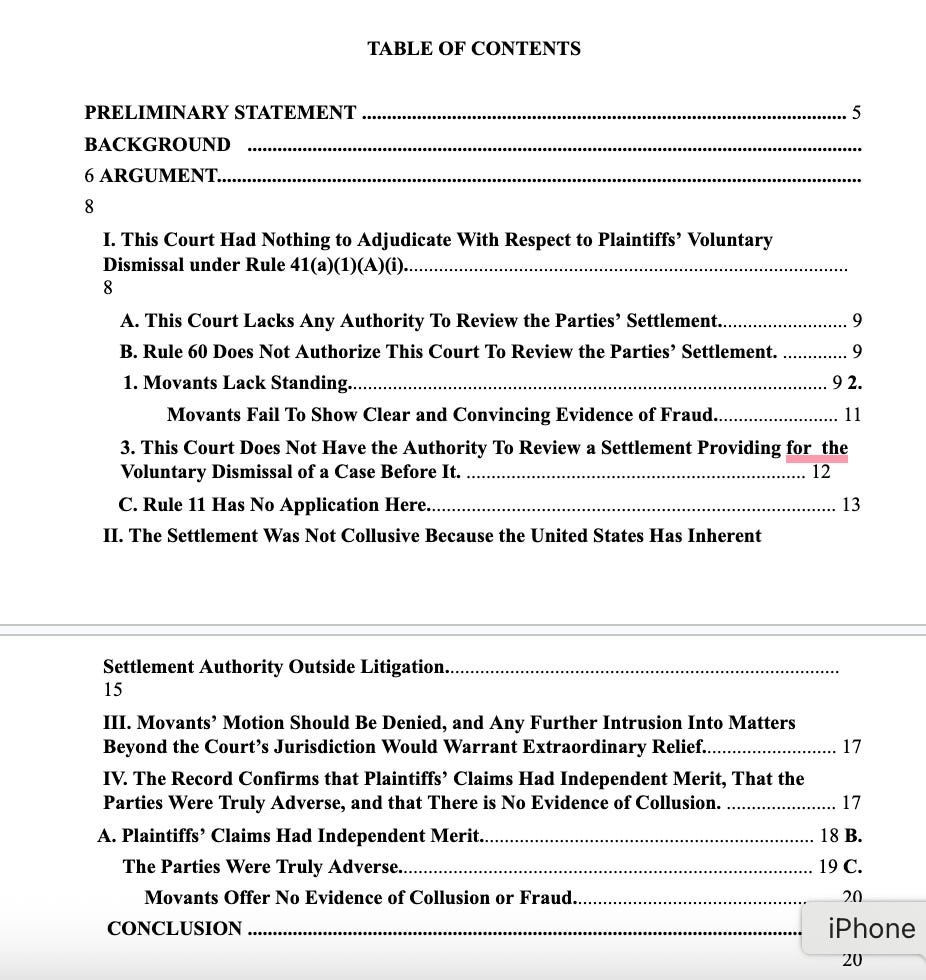
It starts out like this: “We write to respond to a baseless motion to reopen a case that was lawfully and properly dismissed. The fact that Movants are former federal judges only makes their frivolous motion all the more damaging to our rule of law,” before arguing that because the plaintiffs voluntarily dismissed their lawsuit, there was nothing left for the court to do but grant the dismissal. As we discussed at the time, that’s a correct statement of the law, which generally permits a plaintiff to dismiss a lawsuit they’ve filed before the defendants file an answer.
But this situation is a bit different, because of the point made in the judges’ brief, which we discussed, is that the settlement was collusive (a point that is reinforced by the enormous slush fund and the expansive forgiveness—“almost a pardon”—that the Trumps receive under it) and that permits the court to look further than it usually would.
The Trumps argue: “Movants ask this Court to do something that no federal court has the power to do, or has ever done—to reopen a case terminated by a self-executing Rule 41(a)(1) notice, at the behest of strangers to the litigation, in order to scrutinize an Executive Branch settlement that this Court does not have any jurisdiction to review. Movants misread the one decision on which their standing theory rests, misunderstand what was actually ‘before’ this Court, and wrongly presume that the Court has the power to review a government settlement not before it, contrary to decades of settled federal practice.”
That’s not an unreasonable argument. It’s the rule in the typical case. The question here will be whether Judge Williams will view this situation as atypical in a legally significant way. As the judges group explained in their brief, “under Federal Rule of Civil Procedure 60, a judgment can be set aside and the case reopened if the judgment results from a fraud on the court. ‘The purported ‘settlement’ that the parties never placed before this Court raises profound questions about the parties’ candor toward the Court and manipulation of the judicial system, which threatens to undermine confidence in the administration of justice.’” They continue, pointing out that “in ‘extraordinary circumstances,’ a non-party may raise a challenge of fraud on the court through Rule 60 even when the non-party’s interests are not directly affected by the judgment.”
It’s a problem similar to what we see in the standing cases: this is a situation where Trump or his administration has done something that is clearly wrong—tearing down the East Wing, adding his name to the Kennedy Center, take your pick. The problem is, it’s hard to find someone with legal standing to challenge it. Here, it’s a related problem, one we’ve seen in the Florida case involving release of Volume Two of Special Counsel Jack Smith’s report: the plaintiff and defendant are both Trump or entities he controls. In the absence of a truly adversarial proceeding, there is no one to speak up for the American people’s interests. Here, the judges group has tried to do that.
If ever there was a case with extraordinary circumstances, it’s this one. And Judge Williams seemed willing to consider that view, noting she could consider both the argument the judges made, as well as her power under Rule 11 to sanction frivolous legal actions. The tone of the Trumps’ argument is remarkable for the way it attempts to order the court not to act, rather than marshaling arguments that lead to that conclusion. But tone aside, this is not a clear cut case. Judge Williams will have to be persuaded that this is an exceptional situation where the Trump plaintiffs’ efforts to deceive the court warrant reopening the case to consider next steps. It’s not a slam dunk, by any means.
In their brief, the Trump plaintiffs argue there was no fraud on the court, that the judges group can’t intervene in a case they aren’t a party to, and that because the judges didn’t raise Rule 11, Judge Williams can’t proceed under it. They are clearly concerned about the Rule 11/frivolous proceedings argument. But they counter that although it “is the recognized collateral mechanism that survives a Rule 41 dismissal and does not depend on subject-matter jurisdiction over the merits,” it can’t be used here because it can only “be invoked … by a party (or by the court sua sponte under a procedural posture that does not exist here), and it carries a 21-day safe-harbor requirement.” The argument they make is not unreasonable; it will be a close call. But Judges don’t like to be told what they can and cannot do by parties before them, and that is the entire tenor of this brief, which admonishes the Judge, “The Court’s own initiative fares no better: even a sua sponte sanction is barred here.” The idea, if you’re a party before a judge, is to persuade, not command, and the Trump plaintiffs struggle to do that here.
The judges have until June 19 to respond, so we can expect to see that later this week, with Judge Williams’ decision to follow.
There are a number of other developments in cases to look forward to this week:
On Wednesday, Jay Clayton, who is currently the U.S. Attorney in the Southern District of New York, will have his confirmation hearing to be the Director of National Intelligence. Certain to be on the agenda is whether he meets the job requirement: experience in national security. But there seems to be a collective sense of relief among some Democrats, who have strong feelings about getting Bill Pulte out of the position as quickly as possible. That, and the need to renew the now-expired FISA law that lets the intelligence community collect critical information for protecting American interests, point toward confirmation unless something unusual surfaces between now and then, or, in the hearing.
The Georgia legislature goes into special session on Wednesday. Expect an effort to gerrymander and big protests, as the session spills over into the Juneteenth holiday. We’ll follow developments there closely.
And, of course, there is the appeal as Trump tries to keep his name on the Kennedy Center. Also, new news that the “Trump Kennedy Center” apparently ignored its contract with the Washington National Opera, not only violating it but also refusing to return $17 million of the opera’s funds, perhaps even spending some of them. We’ll learn more about the details as this new lawsuit gets underway. The grift is real.
Finally, the U.S. attorney in Chicago, Andrew Boutrous, continues to face fallout for his office’s ethical failures, including the “Broadview 6” case. We’ll keep a watch on further developments during the week.
That’s a lot for one week, but we will stay on top of key developments as they happen. On a personal note, my family had decided to be Team Curacao in the World Cup. We were sorely disappointed by their 7-1 loss today. I hope your teams are all doing better.
Thank you for reading and for being part of this community. Civil Discourse has always been about making careful, fact-based legal analysis available to everyone who wants it. If you'd like to support that mission and help sustain this work, becoming a paid subscriber is the best way to do it.
We’re in this together,
Joyce
I went to my gay nephew's wedding reception this weekend. The affair was a beautiful, multi-cultural, white, brown, black, straight, gay celebration full of caring and loving people. This is what the USA is about. This is what makes this nation great. The Christofascist, White Nationalists will NOT win. Love does trump hate!
Joyce, I'm ever amazed at your work ethic. I can't imagine if the person living in the White House had the same or even a fraction of your work ethic. This country would be in a far better place. It's disgraceful what we have seen this weekend on the White House grounds.
Thank you, again, for all you do. Your work is so very much appreciated.