
From Pardons to Payoffs
Trump and his faux-patriots

Observing our rapid decline into kleptocracy is not the way to honor people who served in the military, as we do in this country on Memorial Day. But for those of us who didn’t choose this president, paying attention to that decline, refusing to stick our heads in the sand and ignore what’s happening, is perhaps the most important observance we can engage in.
The 1776 Slush Fund—that’s the most fitting name, since Trump chose to designate $1.776 billion in taxpayer funds for his personal discretionary use to reward those who “suffered” from “weaponization”—marks an appalling moment in American history. It is our duty to notice, to comment, to object, and to ensure he is not permitted to move forward with this travesty of justice.
Why does 1776 matter so much in this context? It’s because of the way January 6 protestors invoked it to justify their efforts to interfere with the certification of the 2020 presidential election and overrunning the Capitol. Rioters and key speakers that day frequently framed their actions as akin to the Revolutionary War. They were the patriots seeking to overthrow tyranny—because Trump losing the election, in their view, wasn’t the democratic process at work, it was interference with the divine right of kings, their king, Trump.
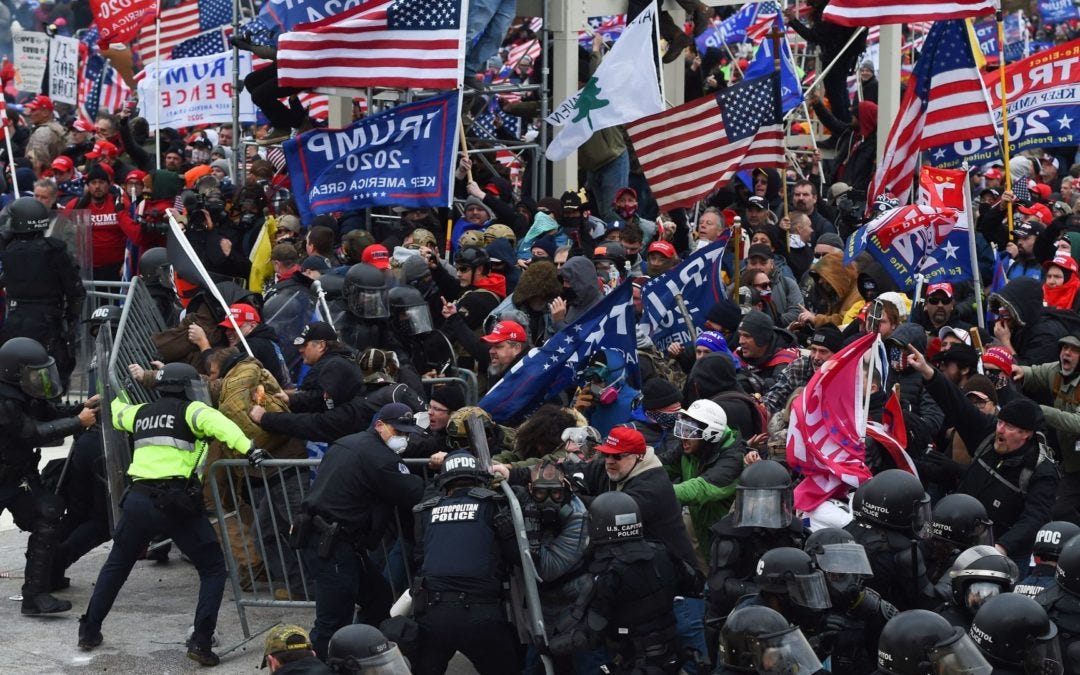
A piece in the LA Times, just weeks after the insurrection, put it like this: “By wrapping his lies in the cloak of patriotism, Trump fueled the view that a violent assault on the Capitol, which resulted in five people dead, was a legitimate action — similar to the actions of the American founders in 1776. In fact, the mob seemed to believe the insurrection was their ‘1776 moment.’ Many returned home after the attack expecting celebration of their actions rather than condemnation.”
For Trump’s supporters, including some in Congress, it seems to be regrettably easy to erase the past, as we discussed last night. That makes it important to continue sharing images from January 6, even as they are indelibly etched in so many of our minds, with others for whom time may have lessened the intensity of the moment.
Equally so, as Trump attempts to pay off his supporters (without using his own money), perhaps for the past, perhaps toward the future, it’s important to ignite the sense of outrage these events deserve. The reality is, Joe Biden’s White House didn’t weaponize justice—the people Trump wants to compensate may have been investigated and charged by the Justice Department, but they were convicted by juries of their peers, and in many cases, pled guilty with constitutional guarantees of due process in place. The comparison to the weak cases we’ve seen this administration attempt, cases that have been dismissed early in the process or refused indictment by grand juries, is apparent. The prosecutions Trump now protests were the epitome of a functioning, politically neutral, criminal justice system in every way that his revenge docket of cases that his attorneys general have pushed at his direction are not.
The proposal to pay off his “patriots” is only Trump’s most recent step towards carving out a place in history for himself that he does not deserve. Because you can be certain that what he is doing is not about others, it’s about him. Some leopards never change their spots. Before there were payoffs, there were pardons, which at the time seemed like a tremendous indignity to justice. And yet, it’s because they were normalized over time that Trump now has the opportunity to attempt this further walk away from democratic values.
Legally, Trump’s ability to pardon could not be questioned because of the broad power the Constitution assigns to the president in this regard. It was up to the court of public opinion to condemn them. And that did happen. Members of Congress and pundits alike, but only those aligned with Democrats, did so vociferously. As Trump’s second inauguration day gave way to DOGE and its parade of horribles, their voices were drowned out by the clamor of MAGA excitement at Trump’s steady rollout of Project 2025.
In advance of his inauguration, I wrote that pardoning January 6 defendants would be an endorsement of the insurrection, which is precisely what it turned out to be—a renewed attack by Trump on democracy. As I reviewed that piece from January 21, 2025, it occurred to me that the details surrounding the pardons are worth revisiting, both because they remind us of the importance of doing our best to block or at least expose Trump at every turn to keep him from taking the next steps, and also because they make clear how purely anti-democratic Trump’s plans are. It is not about country. It’s not even about party. It’s about Trump.
I wrote: “On the campaign trail, Trump described the January 6 rioters as ‘political prisoners,’ conveniently forgetting the fact that those progressing through the criminal justice system were charged by grand juries and convicted by either juries or federal judges. He calls them ‘great patriots,’ even opening his first campaign rally in Waco, Texas, with ‘Justice for All,’ a song recorded over the phone by imprisoned insurrectionists, set to the tune of the ‘Star Spangled Banner.’”
I had forgotten about that detail—music provided on the campaign trail by a recording of imprisoned insurrectionists.
Then, there are the details of what those who were pardoned—and can now apply for 1776 fund rewards—did on January 6: “according to reporting compiled by NBC’s Ryan Reilly, the January 6 defendants were captured on video brandishing and using firearms, stun guns, flagpoles, fire extinguishers, bike racks, batons, a metal whip, office furniture, pepper spray, bear spray, a tomahawk ax, a hatchet, a hockey stick, knuckle gloves, a baseball bat, a massive Trump billboard, Trump flags, a pitchfork, pieces of lumber, crutches, and even an explosive device during the attack on the Capitol. More than 140 police officers were injured and members of Congress fled the building in fear for their lives.”
Trump also discussed and ultimately granted clemency to and is now trying to erase the seditious conspiracy convictions of members of the Oath Keepers and Proud Boys. During a sentencing in one of those cases, Judge Amit Mehta, who sentenced the Oath Keepers’ leader, Yale Law School graduate Stewart Rhodes, to 18-years in prison for seditious conspiracy, said, ‘The notion that Stewart Rhodes could be absolved is frightening — and ought to be frightening to anyone who cares about democracy.” Unusually strong language for a federal judge.
The failure to successfully condemn Trump for abusing the pardon power has had tremendous consequences. Here is more of what I wrote that January before Trump issued the pardons:
“The key to Trump’s pardons is that they are not about people and their communities. They are about personal loyalty to him. Trump summoned these individuals to the Capitol to support him and now he will pardon them to complete that transaction. Trump will use the pardon power to make it clear that violence and violation of the law can be forgiven in service to himself.”
Subsequent events have fully borne that out.
Few of the defendants showed remorse and some displayed outright defiance, like Ryan Grillo, who said, “Trump’s gonna pardon me anyways,” after Judge Royce Lamberth sentenced him. Trump’s pardons were a morale boost for the white supremacist domestic terror groups that participated in January 6. The pardons undercut the deterrent effect of the laws that criminalized their conduct, making it easier to envision a recurrence if Trump were thwarted in the future. And isn’t that the concern here, with the 1776 fund, that it could be preparation for the future?
I concluded back in January of 2025 that “Pardoning the rioters is a grotesque misuse of the pardon power because, cloaked in the appearance of lawful authority, it would put the presidential seal on crimes that go to the heart of an attack on our democracy, an effort to undo the will of the voters and seat a man who lost an election as the country’s leader.” Now, Trump is trying to rewrite history and do just that, transforming criminals into patriots. But there could be worse still to come. “By advertising his willingness to pardon the people who supported him rather than the Constitution, Trump is sending a message to the people he is counting on to support him this go-round: If they protect him, he will take care of them. It’s a message fit for a would-be authoritarian.”
Democracies are not lost all at once. They erode piece by piece while people convince themselves that what they are seeing cannot really be happening. Careful reporting, clear legal analysis, and a commitment to preserving the factual record matter more than ever when a president is trying to rewrite history in real time. If you value that kind of work, you can support it here at Civil Discourse by becoming a paid subscriber if you aren’t one already.
We’re in this together,
Joyce
“A people that elect corrupt politicians, imposters, thieves and traitors are not victims... but accomplices”
--- George Orwell
"The world will not be destroyed by those who do evil, but by those who watch them without doing anything."
--- Albert Einstein
Due process — something the Jan 6 rioters got, the “illegal” immigrants don’t.