
Forgetting About Jeffrey Epstein

Donald Trump is playing the distract and delay game again. It’s a game he frequently plays with success. Jeffrey Epstein, Trump’s relationship with him, and allegations that were made about Trump’s own sexual misconduct posed the most significant, sustained threat his presidency has seen. Then we went to war in Iran.
Epstein is no longer front page news. But he should be.
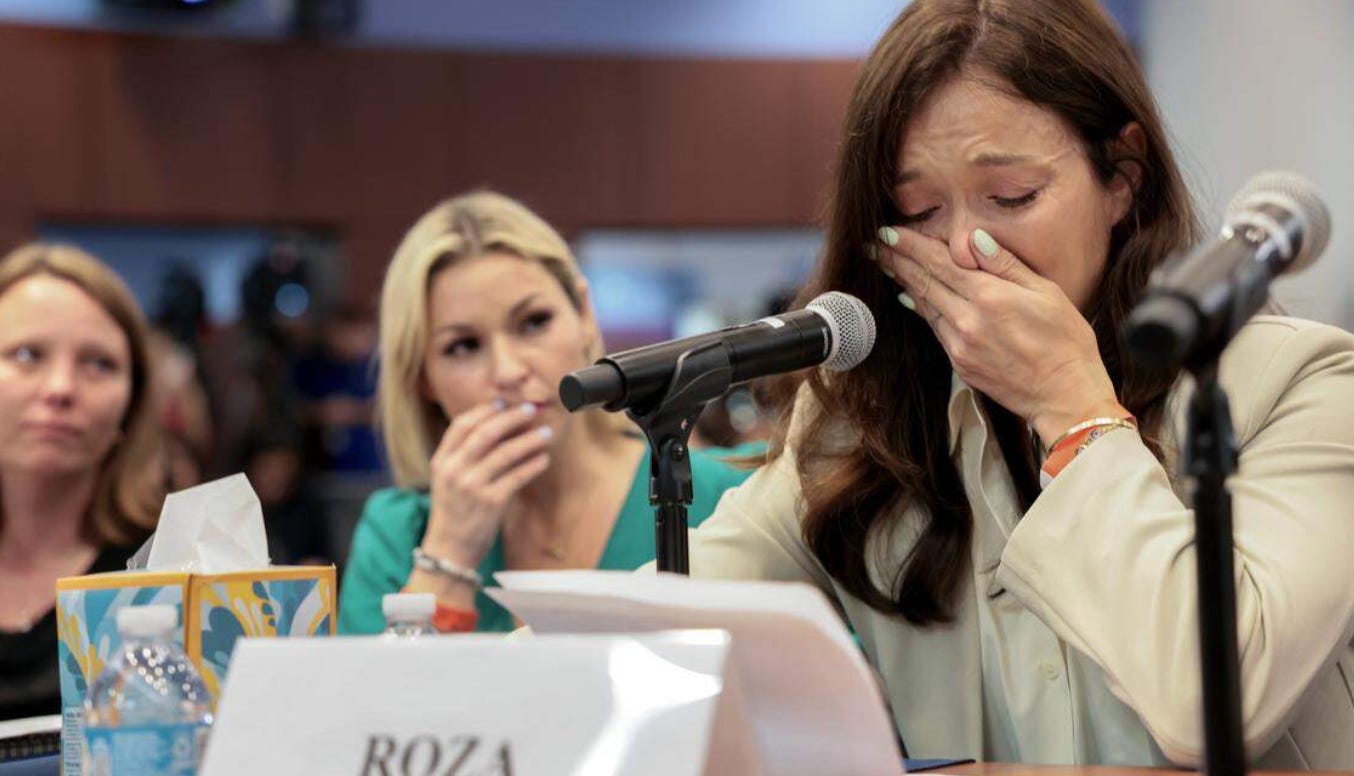
Earlier this week, Epstein survivors and advocates held a "shadow hearing" in West Palm Beach, Florida, in an effort to restore focus. The powerful testimony focused on the failure of the criminal justice system to protect the victims, even as it continues to protect the powerful people who abused them or were complicit in their abuse. The hearing was put on by Democratic members of the House Oversight Committee, even as Republican control prevents them from conducting the full oversight hearings on the matter they have tried to introduce.
Washington Democrat Emily Randall put it best when she told Danielle Bensky, a survivor who has spoken publicly but testified she never expected the DOJ would release unredacted information about the specifics of the abuse she endured and the names of others who have not identified themselves, “you deserve an apology from your government.” Of course, that apology has not been forthcoming. Friend of Civil Discourse Katie Phang has been doing excellent coverage of the Epstein survivors’ efforts and has an interview with Danielle here.
But there has been some action in the House, though Republicans seem to move only when compelled to do so by public outrage. Yesterday brought the release of transcribed testimony from closed-door hearings involving two important figures. The first is Trump’s Commerce Secretary and longtime friend Howard Lutnick. The second is Ghislaine Maxwell’s ex-boyfriend, Ted Waitt. Their testimony is significant for entirely different reasons, and for what it tells us about the House Oversight Committee’s willingness to act as a backstop for the President here.
There was a sustained push to obtain Lutnick’s testimony because of inconsistencies in his public explanation of his past relationship with Epstein. He’d said he was so disturbed after a 2005 visit to the Manhattan home of Epstein, who was his neighbor at the time, that he severed all ties. But there is evidence of continued contact, even after Epstein’s 2008 guilty plea in Florida. The standout is the 2012 lunch on Epstein’s private island, Little St. James, that Lutnick, accompanied by his wife, his children, and their nannies, sailed in for. Lutnick has never explained the discrepancy.
As a prosecutor, as in life, one learns that people don’t always tell the truth. That happens for lots of different reasons. One is bad memory of long ago events. But that doesn’t appear to be the case here; Lutnick has recounted his recollection repeatedly, although he has pled bad memory in regard to other aspects of his relationship with Epstein, like why he put his whole family on a boat and took them to lunch on Epstein’s island. Sometimes the truth is embarrassing, so people lie about it. Lutnick was given the opportunity to backtrack, but didn’t. He hasn’t offered a satisfactory explanation of the inconsistencies, although Republicans on the Committee have characterized his testimony as “forthcoming.”
According to Lutnick, what disturbed him during the 2005 visit was a moment on a tour of Jeffrey Epstein’s Manhattan townhouse when Epstein showed him and his wife a massage table. Epstein responded to a question about why he had a massage table in the middle of his house by saying, according to Lutnick, that he got massages every day, “and the right kind of massage.”
Lutnick testified that he met Epstein only three times and described the encounters as “inconsequential.” Democrats confronted him with evidence showing later contacts, including the 2012 lunch on Epstein’s private island and later business dealings. Lutnick's response was to concede later interactions, but he maintained there wasn’t a close relationship. The question remains, why lie?
The most significant fallout from Lutnick’s testimony so far is that it deepens, instead of resolving, inconsistencies in his story. The question now is whether it can revive the story after Trump’s apparent successful distraction. And it’s important to note that this isn’t a question of whether Lutnick himself did anything improper—no evidence of that has been introduced—it’s a question of the massive cover up that protected Epstein for decades, apparently, in which powerful people turned a blind eye so Epstein could continue to traffic girls and women.
Waitt’s testimony is different. He says he only saw a curated public-facing version of Maxwell and Epstein, the real estate business side. The insinuation is that if the sex trafficking was successfully concealed from even Maxwell’s boyfriend (it was apparently a very serious relationship; he paid her $7.2 million in “alimony” when they separated), no one else can be held responsible for missing it. That line of argument could offer protection for plenty of other prominent people whose names have surfaced and could explain why Republicans agreed to bring him in.
The timing of the two interviews is also interesting. Waitt’s interview took place on April 30, 2026. Lutnick’s occurred just last week, on May 6, 2026. So it’s telling that the transcripts were released together. Lutnick, because of the glaring inconsistencies, had to be called if the Republicans on the Committee didn’t want to be accused of cover up. But Waitt “draws the sting,” as prosecutors like to say, providing a cover story for Waitt, and potentially for others. The cover story doesn’t have to be credible as long as those people can offer it with a straight face.
It should be impossible to ignore the fact that Epstein’s crimes continued because powerful people looked away. Some of them rationalized what they saw or decided proximity to wealth and influence mattered more than protecting vulnerable girls. Some people participated. Some helped conceal it. Some kept showing up at Epstein’s side after there was plenty of reason to know better. The survivors have had to live with the consequences and the absence of accountability for decades. And the consequences were serious: One woman testified this week that Epstein repeatedly raped her while he was already serving his Florida house arrest sentence.
The sentence in the Florida case was a joke. And the prosecution failed to stop Epstein; it failed to protect the victims of his crimes, even after the FBI and state law enforcement knew more than enough about what he was doing to make it compulsory for them to do so. Trump campaigned on promises to release the Epstein files, but his Justice Department and his White House have gone silent. They’re hoping it will all just go away again, just like it did before.
Until there is a full accounting of who enabled Epstein and why the system failed so catastrophically, this cannot be treated as yesterday’s scandal. Until the full truth is made public, more girls are at risk from people like Epstein and Maxwell. Revealing the truth is the first, essential step toward crafting new laws, new practices for law enforcement, and new societal norms that insist abuse like this be exposed and prosecuted in the moment, not decades later.
Thanks for being here with me at Civil Discourse and for your commitment to supporting justice. A lot of new people have joined us this week! If you’re just starting out, we’re a community committed to understanding the truth behind the issues at the intersection of law and politics and understanding that our power as citizens is the driving force for change and for preserving democracy. If you aren’t already a paid subscriber, I hope you’ll consider becoming one, and supporting my work.
We’re in this together,
Joyce
I have not forgotten about Epstein.
DJT & Family's criminality and grift is astounding.