
Trump: Really Big Loser

New week, more losses in court for the Trump administration.
In Minnesota, there was one you don’t see often. A federal judge quashed grand jury subpoenas, something that’s almost unheard of. Federal prosecutors issue subpoenas on their own authority; they don’t need approval from a judge or from the grand jury itself. Typically, an effort is made to voluntarily obtain information or items before a subpoena is issued, and subpoenas have to be narrowly tailored to obtain relevant information— prosecutors aren’t permitted to go on a fishing expedition. Prosecutors know, and routinely abide by, the rules. Unless it’s a subpoena to an attorney or a member of the media, in which case approval from Main Justice is necessary, prosecutors routinely issue and enforce subpoenas without any interference.
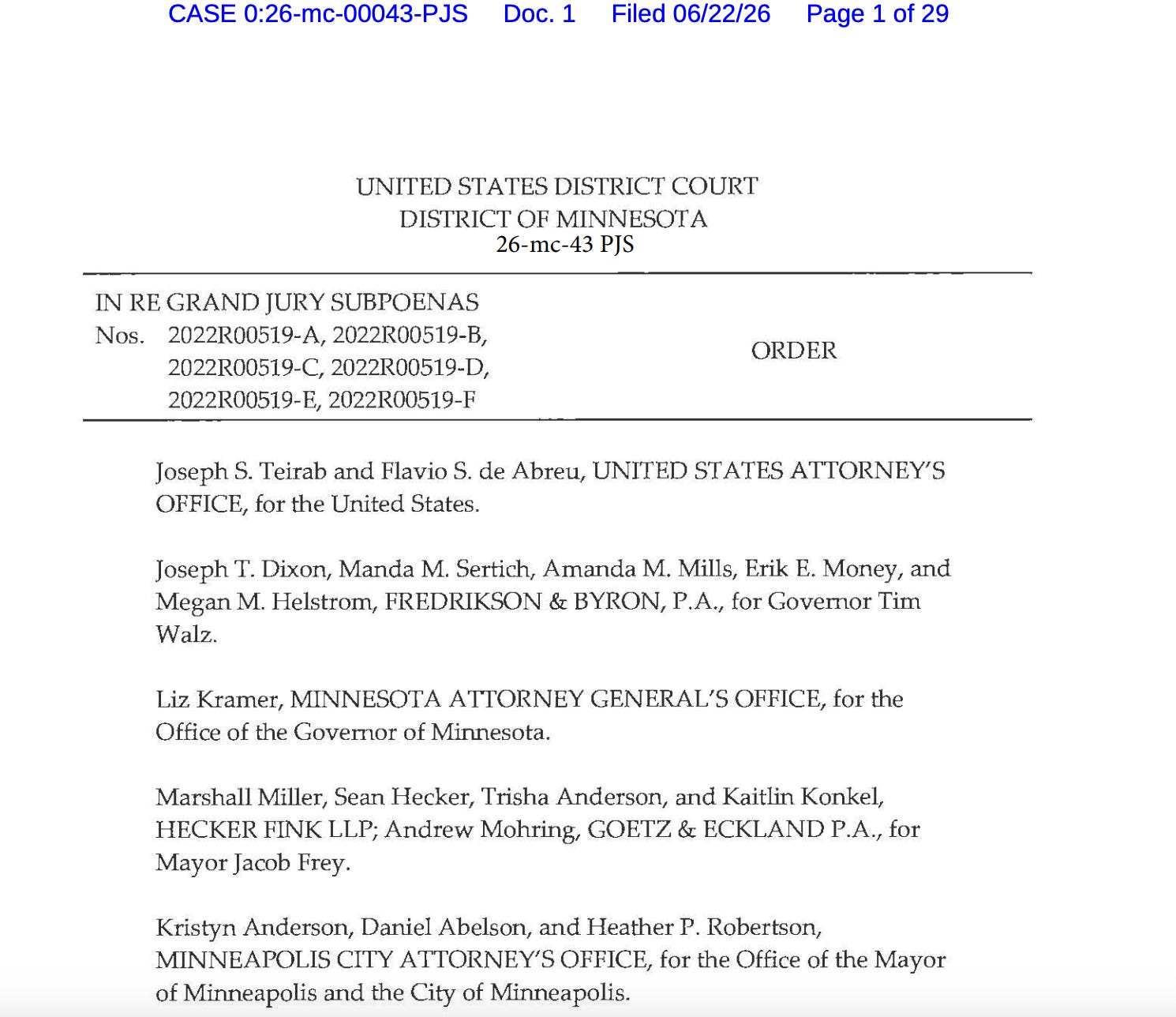
But today, Judge Patrick Schiltz, a George W. Bush appointee who clerked for Justice Antonin Scalia, quashed subpoenas that prosecutors issued as part of an investigation into Minnesota Governor Tim Walz and Minneapolis Mayor Jacob Frey. Judge Schiltz called the subpoenas part of a retaliatory effort because the two refused to assist in executing the administration’s mass deportation policies.
You may recall that Mayor Frey had harsh words for ICE in the hours after Renee Good’s death on January 7, 2026. He called their interpretation of the video of her death, which they characterized as self-defense, “bulls---.” Frey said the agent who pulled the trigger was “recklessly using power that resulted in somebody dying” and made an angry demand in a press conference that was nationally televised that ICE “get the f--- out of Minneapolis.” He told the federal agents, “We do not want you here.”
The subpoenas, which called for the production of records relating to enforcement of federal immigration laws going back to January 1, 2025, were served later in January on:
the Minnesota Governor's office;
the Minneapolis Mayor's office;
the St. Paul Mayor's office;
the Minnesota Attorney General's office;
the Ramsey County Board of Commissioners;
and the Hennepin County Board of Commissioners.
That’s a lot of subpoenas, sent to a lot of different entities, regarding conduct that it’s hard to discern the criminality in. In other words, a classic fishing expedition of the sort that isn’t permitted. The Judge called it “extremely broad categories of records relating to federal immigration enforcement in Minnesota.”
Judge Schiltz’s careful order goes through the history of Trump’s “Operation Metro Surge,” in Minneapolis. “President Trump has repeatedly insulted Minnesota generally and its Somali population in particular,” the Judge wrote, providing examples like telling Representative Ilhan Omar to "go back to your own country," and calling Minnesota a "hellhole."
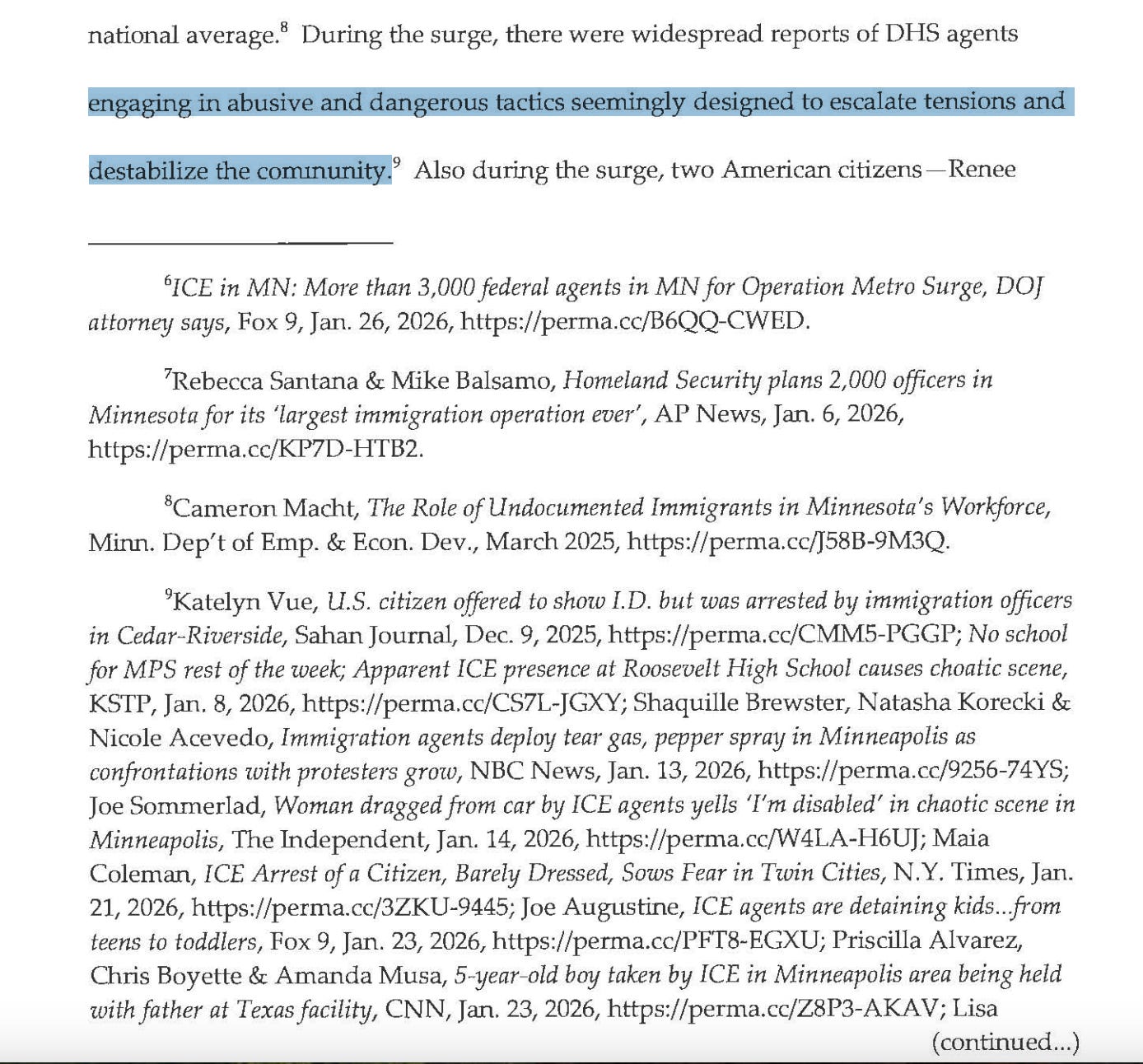
The Judge was to the point in describing ICE’s behavior during the surge as “abusive and dangerous tactics seemingly designed to escalate tensions and destabilize the community.” He noted the deaths of Renee Good and Alex Pretti, who were “killed by DHS agents.”
Eight pages of the 29-page order are devoted to laying out the facts of the surge. They are heavily footnoted with cites to examples of what the city experienced under the federal presence, like this:
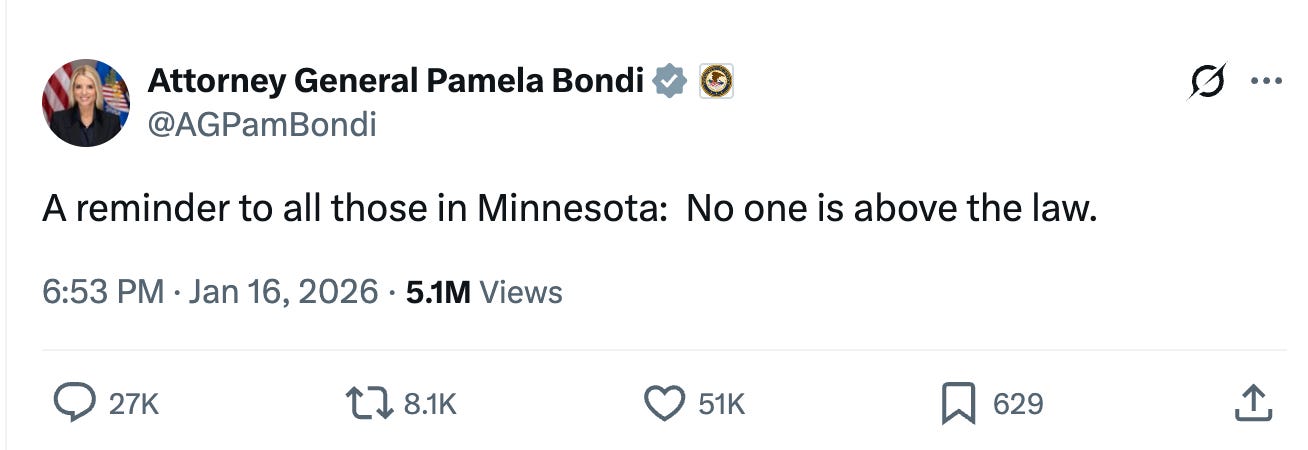
Throughout, it was clear that the audience of one had personal animus towards Minnesota Democrats, including the governor, who was Kamala Harris’ 2026 running mate. The order notes that “On January 14, then-Deputy Attorney General Todd Blanche accused Walz and Frey of ‘encouraging violence against law enforcement’ and vowed that he would stop their ‘terrorism by whatever means necessary.’” What conduct earned them that accusation? Based on the timeline, it appears to have been a lawsuit filed to challenge Operation Metro Surge. Blanche said their conduct was “close to a federal crime” and then-Attorney General Pam Bondi posted on Twitter: "A reminder to all those in Minnesota: No one is above the law."
After the subpoenas were spread across the state, Bondi wrote to Walz directly, in a letter that was reportedly engineered by Trump aides. She told Fox News that “[w]e said [Walz] BETTER support President Trump, the men and women in law enforcement.”
The Judge notes the broad authority of prosecutors, utilizing grand juries, to investigate possible crimes. But, he notes correctly, “The investigatory powers of the grand jury are nevertheless not unlimited.” He explains the limits, including:
“a court may quash a grand jury subpoena ‘if compliance would be unreasonable or oppressive.’”
“grand juries may not ‘select targets of investigation out of malice or an intent to harass.’”
grand juries “are prohibited from engaging in ‘arbitrary fishing expeditions’ and initiating investigations ‘out of malice or an intent to harass’”
Judge Schiltz concludes that “A subpoena may be quashed if its ‘dominant’ purpose is improper, even if it was issued partly for valid reasons,” or if it is “unreasonable or oppressive," even if it seeks relevant evidence. But grand jury subpoenas enjoy the presumption of regularity (that we have been discussing recently because so many judges have concluded this administration is no longer entitled to it), so the burden of showing the subpoenas are legally defective is on the party that wants to avoid compliance. Here, the Judge holds that burden is met:
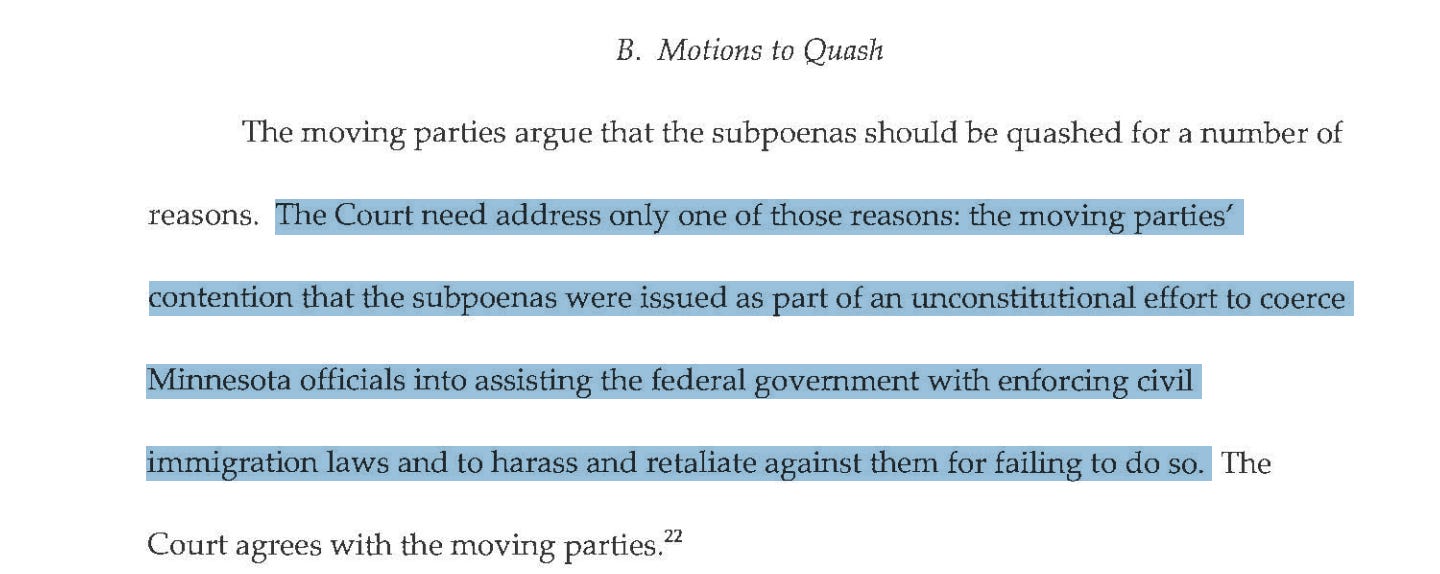
The court agrees that “the subpoenas were issued as part of an unconstitutional effort to coerce Minnesota officials into assisting the federal government with enforcing civil immigration laws and to harass and retaliate against them for failing to do so.” It’s a ringing indictment of the administration.
We’ve discussed the rationale for it before: the anticommandering principle derived from the Tenth Amendment says that states can’t be forced to enforce federal programs—States’ rights, and all those other things Republicans used to say they believed in. Case law clearly prohibits retaliation against states for declining to participate in federal priorities. “Initiating a criminal investigation in order to harass political opponents or to coerce them into taking official action-particularly official action that the federal government cannot directly require those political opponents to take-is a blatantly unlawful and unethical use of the grand-jury process,” Judge Schiltz writes.
It ends up being an easy decision on these facts. “The only question, then, is whether the challenged subpoenas were issued for one of these forbidden purposes. The Court has no doubt that they were.” Judge Schiltz grants the motions to quash because “the dominant purpose of the challenged subpoenas is to coerce Minnesota officials into assisting the federal government with enforcing civil immigration law and to harass and retaliate against them for failing to do so.”
It’s another really big loss in court for the administration, as district judges continue to call out the grotesque misbehavior that high level DOJ appointees have engaged in, in an effort to please the president. Tuesday morning, the Supreme Court announces more of the decisions it has to make before the end of this term of Court, which is rapidly approaching. So far, that Court has done an enormous amount to bolster Trump’s virtually unconstrained behavior. The question is whether his time is coming there too. With cases like Barbara, his effort to write birthright citizenship out of the Constitution, and Cook, his effort to fire a Federal Reserve Governor without cause, even the Supreme Court may rein Trump in. That would be a good development for the rule of law and for all of us.
If you made it this far, you know why I spend so much time reading court opinions. A story like this one can easily be reduced to a headline: Trump loses again in court. But the headline isn’t the story. The story can only be understood in the context of the full opinion, evaluating the careful judicial fact-finding, reading the case cites in the footnotes, and following the judge’s painstaking explanation of why conduct that might once have been dismissed as politics crosses the line into something far more troubling. Hopefully you’re here because you understand the twenty-five years of experience at DOJ, working as a prosecutor, an appellate lawyer, and a U.S. Attorney, gives me an especially nuanced view of what’s important.
My goal in posts like this one isn’t just to tell you who won or lost. It’s to explain what the courts are seeing, what judges are thinking, and how their decisions fit into the larger story unfolding around us. Why all of this matters if we want to remain a democracy. That’s the work that happens here every day. If that kind of independent reporting and analysis is valuable to you, paid subscribers get a seat at the table and help me keep doing this work. We’re a community of readers who understand that democracy depends on citizens who are informed, engaged, and willing to look beyond the headlines. If you aren’t already a subscriber, I’d be glad to have you with us.
We’re in this together,
Joyce
Thank you for this clear explanation of why the judge denied the administration’s prosecution. Although persecution may be a more correct term.
My family and I are very grateful for your in-depth analysis and encouragement in a dark and difficult time. It's a gift to hear you call out the lawless behavior of the current DOJ-- specifically how badly they've crossed the line in service of the corrupt Trump regime. And, judges holding them accountable is very good news indeed.