
The Week Ahead
January 25, 2026

This week is sure to be full of further developments in Minneapolis, and perhaps in Maine, as pressure mounts, even from Republicans, to de-escalate the tension and tragedy ICE has pushed onto American cities.
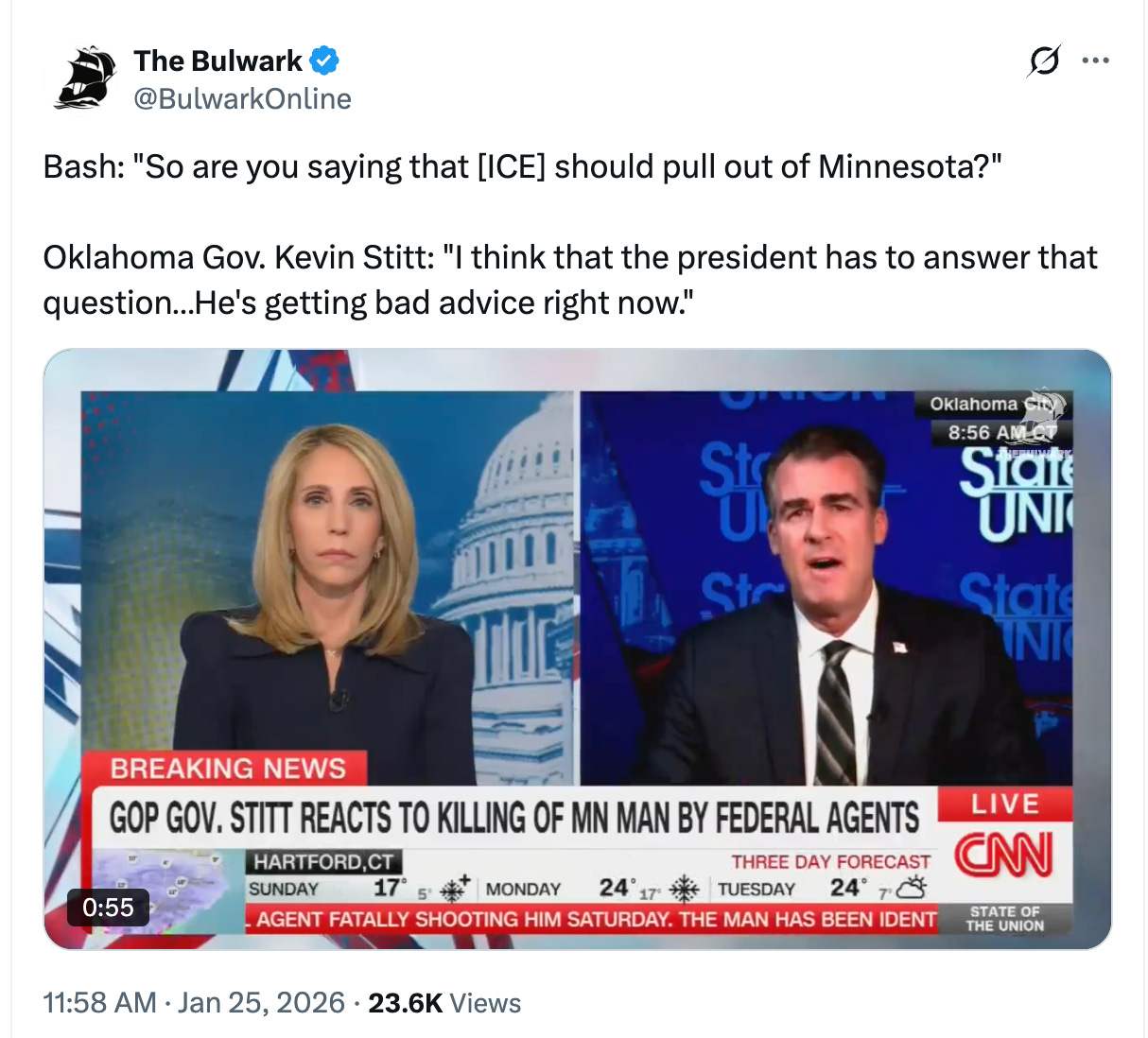
No one should overstate the concern Republicans are expressing—two American citizens have been killed by ICE agents in the last two weeks in Minnesota with no apparent legal justification, the administration has failed to commit to a competent investigation, and at the same time, they’ve frozen out state investigators. So it’s about time for the Republican Party to demand oversight. Nonetheless, the call from House Homeland Security Committee Chairman Andrew Garbarino for testimony from ICE and CBP officials, and concerns expressed by Senators Thom Tillis of North Carolina, Bill Cassidy of Louisiana, Susan Collins of Maine and Lisa Murkowski of Alaska, that more information needs to be made available suggests that the administration cannot hope this will just all go away.
ABC News reported that Senator Cassidy, who faces a primary challenger supported by Donald Trump in his reelection bid, posted on social media that the shooting was “incredibly disturbing” and that the “credibility of ICE and DHS are at stake.” He has called for “a full joint federal and state investigation.”
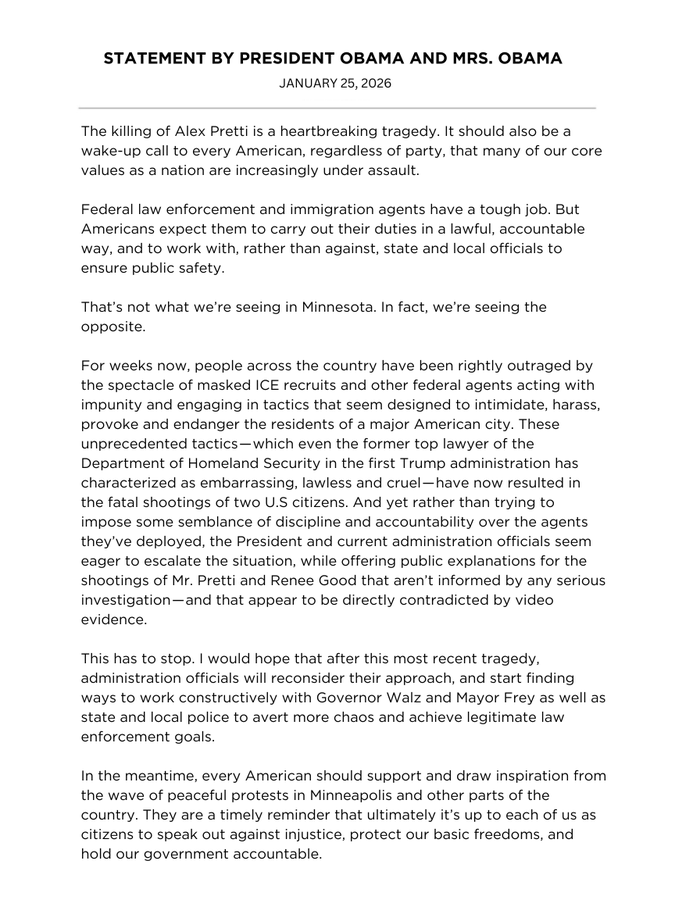
The Obamas issued a statement, saying that the killing of Alex Pretty “should also be a wake-up call to every American, regardless of party.”
The government will shut down this Friday, January 30, if no budget agreement is reached. The White House is still, in a clear violation of the Hatch Act, blaming Democrats for the last shutdown, which happened because Republicans failed to pass a budget despite holding majorities in both the Senate and the House.

As of this weekend, Democrats are going on the offensive with a number of Democrats saying they will not agree to legislation that funds ICE without changes to the way that agency has been conducting itself.
Also this week:
The SAVE Act Is Back
Last year, in April, I wrote to you about the SAVE Act, a massive attack on the ability of eligible American citizens to vote. It passed the House before stalling in the Senate. But now it’s coming back. Last year, we discussed the facts about the Act:
If the SAVE Act becomes law, all Americans will have to provide a birth certificate, a passport, or one of a limited number of documents, such as certain (but not all) military ID cards, every time they register or reregister to vote.
At least 21 million Americans don’t have that kind of proof readily available. Only 51 percent of Americans have passports, which cost adults applying for the first time a $165.00 fee, not to mention assembling the documents you need, getting a photograph of yourself, and making it to an appointment.
The bill would end registration by mail and online because it requires voters to show proof of citizenship to election officials “in person” when they register. That would also make it difficult, if not impossible, to conduct voter registration drives, say, at churches or schools. States that automatically register voters when they turn 18 would no longer be able to do so. And if you move or need to reregister for any reason, this applies to you, too. You’d have to bring your passport or original birth certificate in for inspection every time you do that.
If you’re a married woman who changed or hyphenated her name, you can expect problems if your name doesn’t match your birth certificate.
Trump and his allies are preparing to push Senate Republicans to pass a new version of the SAVE Act. Marc Elias explained last week that although no one knows exactly what will be in the new bill yet, “the idea of a bigger, more aggressive SAVE Act should concern everyone who cares about free and fair elections.”
The SAVE Act doesn’t enhance election integrity. It just makes it more difficult for qualified Americans to vote. It takes on the form of a classic poll tax, forcing people who don’t have it to spend money on more expensive forms of identification as a prerequisite to exercising a right. Public opposition to the bill put an end to it last year. It’s time to gear up again.
Federal Judge Enters An Injunction To Protect Non-Citizens With Temporary Protected Status
In Svitlana Doe v. Noem, Judge Indira Talwani entered an order we discussed on January 10 that prohibited the Trump administration from revoking parole granted to Colombians, Cubans, Ecuadorians, Guatemalans, Haitians, Hondurans, and Salvadorans with family reunification status for 14 days. It was a big loss for Trump.
On Saturday, she entered an order extending that decision.
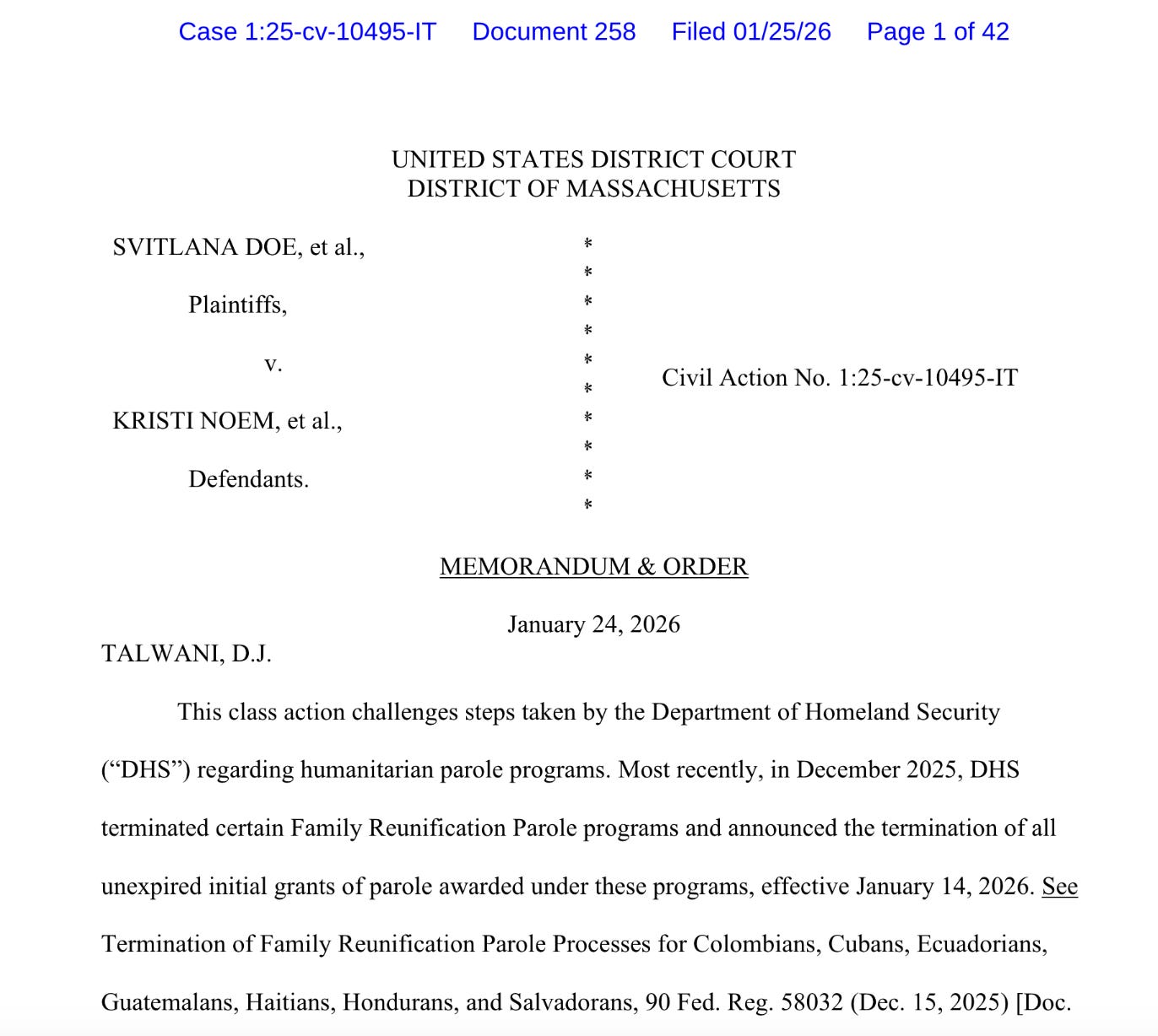
Judge Talwani has now granted the plaintiffs’ Motion for a Preliminary Injunction and/or Stay of En Masse Truncation of Family Reunification Parole. Her order applies to Colombians, Cubans, Ecuadorians, Guatemalans, Haitians, Hondurans, and Salvadorans impacted by the administration’s effort to terminate family reunification processes. That means people are entitled to remain paroled in the U.S. and to retain their work authorization. The Trump administration is not permitted to terminate that status prematurely.
It’s unlikely this will sit well with Trump or his DHS Secretary, Kristi Noem, especially since it means they will not be able to detain these people and count them as arrest statistics. It’s increasingly clear that the administration has set unreasonable goals for deportations, which have had at least two highly deleterious impacts. First, the drive for numbers has led agents to pursue cases involving babies and grandmothers, instead of the dangerous criminals Trump has promised to get off the streets. Last December, the CATO Institute reported that only 5% of the people ICE detained had convictions for violent crimes and 73% had no convictions at all. Second, because the agency is apparently counting arrests, not actual deportations, agents seem to be arresting first and only subsequently checking to see if the detainee is an American citizen or someone who is otherwise permitted to remain in the country.
This is a big loss for the Trump administration. And losing this big pool of people it could have detained and deported, in other words, prospective statistics to satisfy Trump and Stephen Miller, means we’ll likely see the administration try to resurrect this process in the coming week.
Back In Court In Minnesota
Judge Kate Menendez will hold a preliminary injunction hearing on the state’s lawsuit to challenge Operation Metro Surge on Monday. Friday night, in Tincher v. Noem, she ordered agents to stop violating protestors’ constitutional rights, only to have the Eighth Circuit stay that order.
She will be back in court on the case on Monday to hear the plaintiffs’ request for emergency relief, asking the court to order: “a temporary halt to Operation Metro Surge, requiring Defendants to drastically reduce the number of agents deployed in Minnesota.” It’s an unusual request in an unprecedented situation, and whether the Judge believes she has jurisdiction to grant the requested relief remains to be seen.
On Saturday, after Alex Pretti was killed and DHS first refused to permit Minnesota investigators to access the crime scene (only to suddenly abandon it and compromise the evidence), the State of Minnesota sued the feds to stop any additional destruction or alteration of evidence. Today, Judge Eric Tostrud granted their motion for a temporary restraining order and required the federal defendants to stop “destroying or altering evidence related to the fatal shooting involving federal officers that took place in or around 26th Street and Nicollet Avenue in Minneapolis on January 24, 2026, including but not limited to evidence that Defendants and those working on their behalf removed from the scene and/or evidence that Defendants have taken into their exclusive custody.”
Judge Tostrud will hold a hearing on the matter on Monday to determine whether that order should stay in place. Judge Tostrud was nominated to the federal bench by Donald Trump and was confirmed in 2018. Last year, he ruled that a Minneapolis Police Officer who shot and killed a man who pointed a gun at him during a search was not entitled to qualified immunity, possibly providing some insight into how he views police excessive force cases.
Tomorrow, we’ll follow those hearings.
We’re in this together,
Joyce
Can we please not forget the Epstein files?
Maybe Cassidy will grow a spine and join Tillis in full throated opposition to Trump? HCR is right, and we need to focus on this: 16 Republicans could bring an end to funding for ICE, and 23 could impeach Trump if they would join Democrats. We need citizens to make it their job to call and email members of Congress right now, every day when we aren’t out in the streets peacefully protesting. Take the gloves off. Stop being silent to “get along.” We won’t make it to November elections at this rate.