
No Dancing For Paramount and Warner Bros., At Least For Now
Merger deal temporarily sidelined by federal judge

California Attorney General Rob Bonta joined us last Tuesday to discuss the lawsuit filed by a coalition of 12 state attorneys general in a last-ditch effort to block the $110 billion acquisition of Warner Bros. by Paramount Skydance Corporation. The Justice Department has already signed off on the merger. But the state attorneys general believe the deal would mean higher prices for consumers, with less content and lower quality available for film and television, and that it violates antitrust laws.
Attorney General Bonta explained to us that he was seeking a temporary restraining order (TRO), which would prevent completion of the merger in the short term, for a couple of weeks while the court got up to speed on the case, and also a longer injunction that would prevent consummation of the deal while the litigation was ongoing—that could be years. The pause is necessary, he explained, because once the toothpaste is out of the tube and the merger is complete, harm begins to occur and it’s almost impossible to walk it back after the fact.
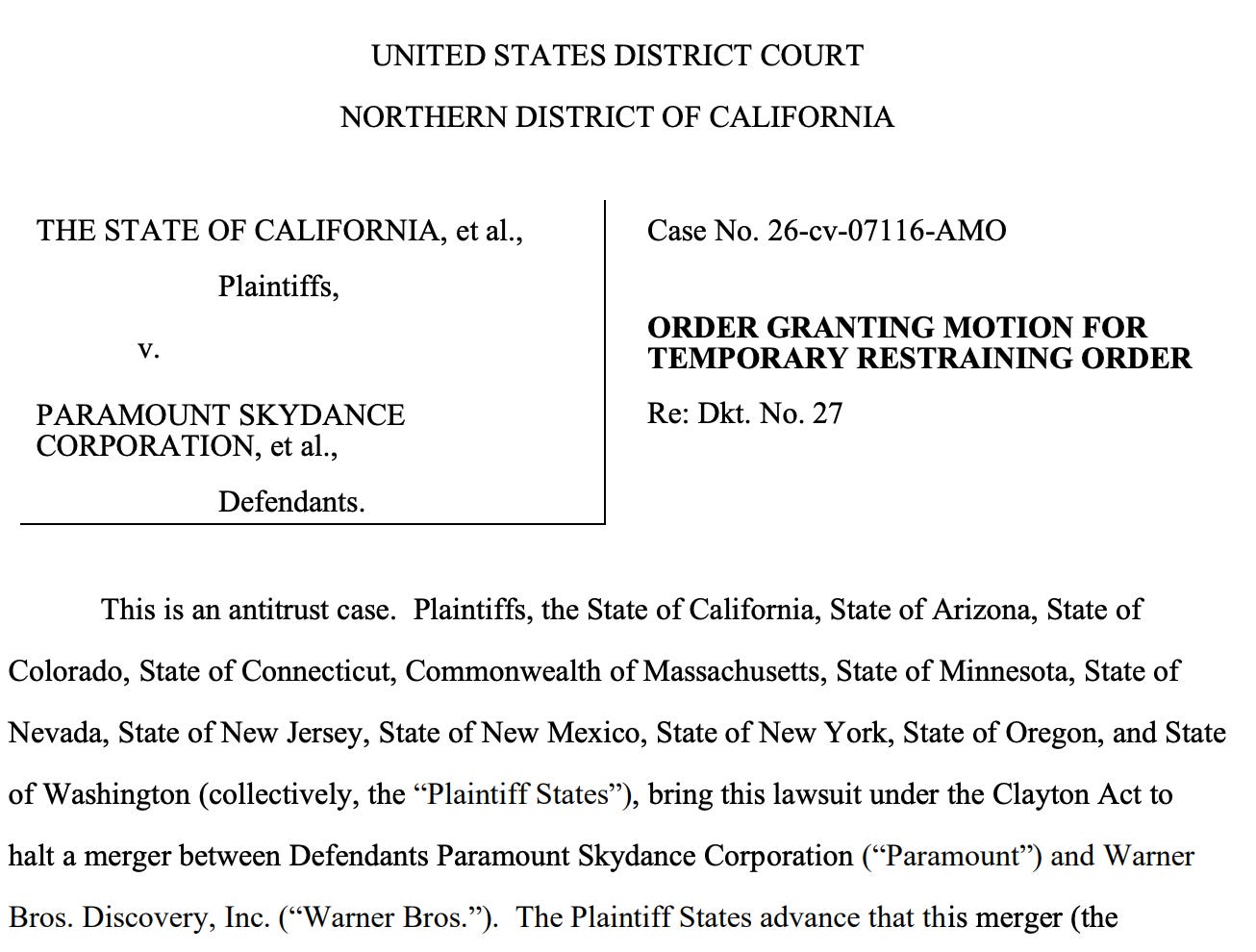
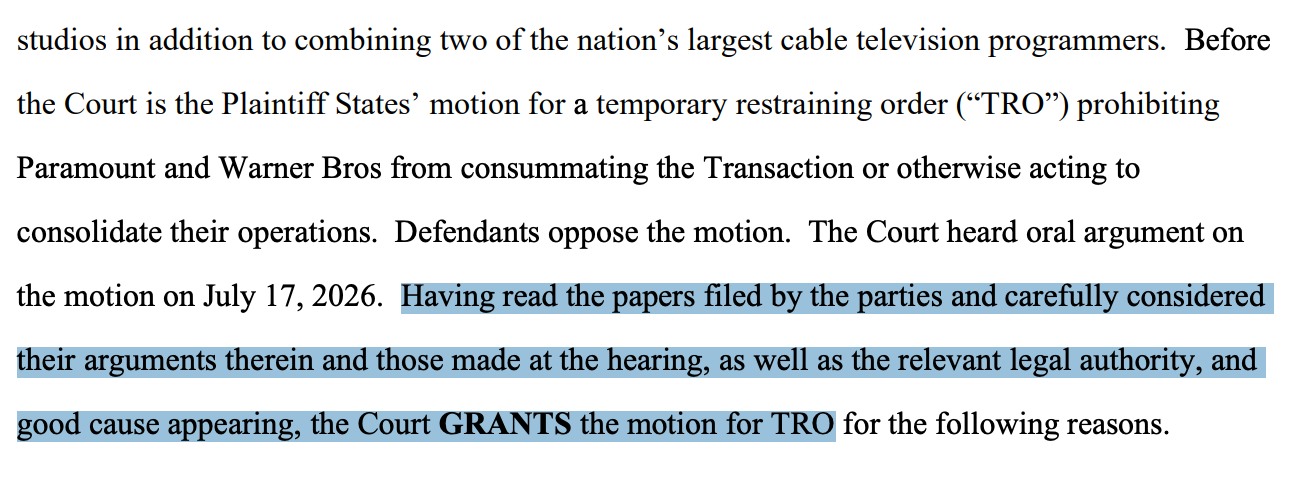
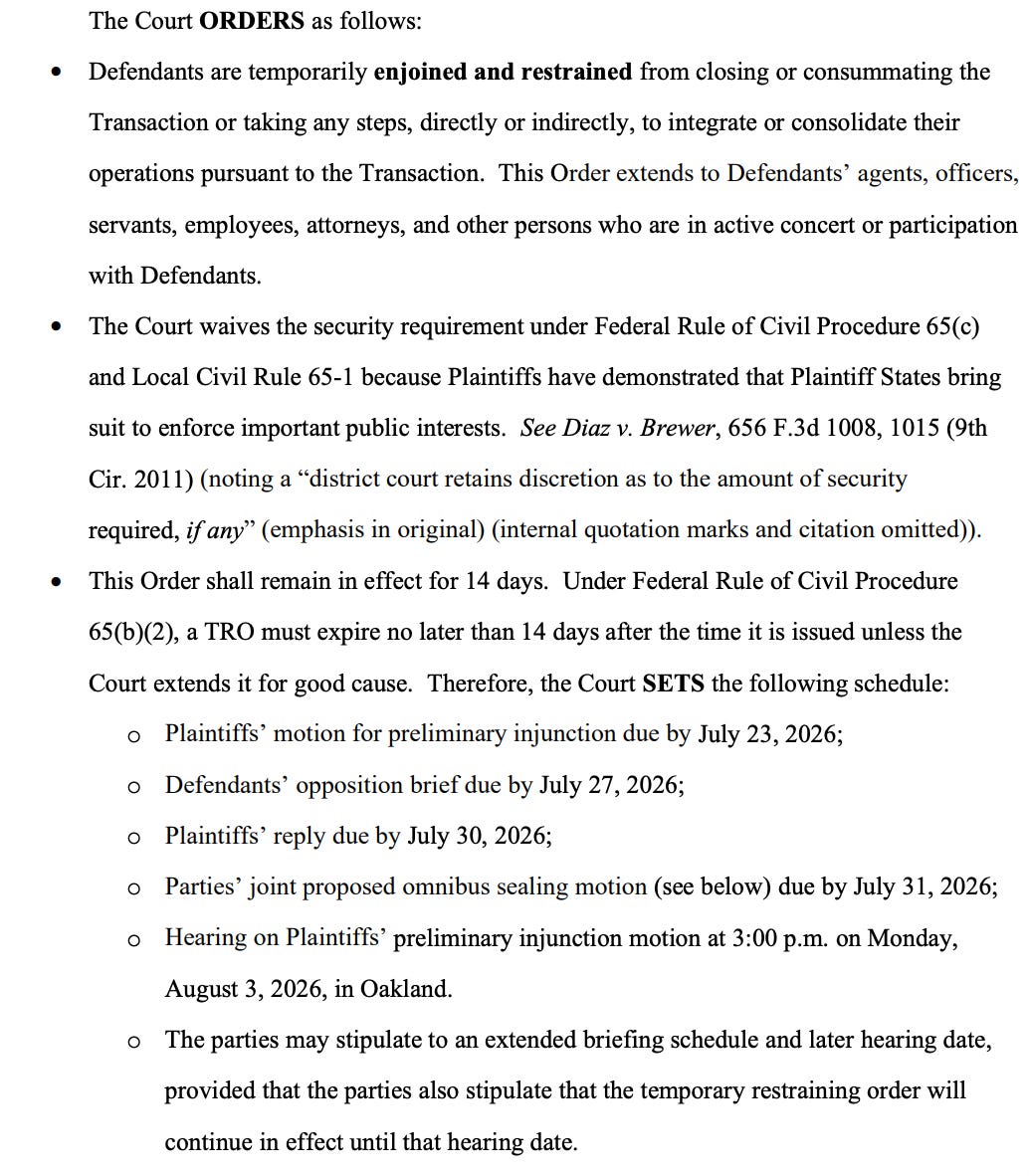
Today, there’s an important update. Judge Araceli Martínez-Olguín of the U.S. District Court for the Northern District of California issued a TRO. It will last for 14 days. But before it expires, on August 3, she’ll hold a hearing to consider a longer injunction that would continue during the pendency of the litigation, until a final outcome is reached.
Paramount Skydance Chairman and CEO David Ellison is relying largely on the financial backing of his father, Larry Ellison, co-founder of Oracle, lead investor in TikTok US, one of the richest people on the planet, and a member of Trump’s circle. The senior Ellison became a Trump confidant by, among other things, participating in conversations about rejecting the outcome of the 2020 election. When Paramount took over CBS, Ellison appointed Bari Weiss as editor-in-chief. She was accused of forcing the newsroom to take a Trump-friendly perspective. She subsequently fired multiple “60 Minutes” correspondents.
When he spoke with us, AG Bonta was confident he would get his injunction. It turns out that his confidence was well placed, at least insofar as the TRO goes. Judge Martínez-Olguín wrote that the states made “a strong showing that the transaction will substantially lessen competition” for widely released movies.
The test the court uses to determine whether a TRO should be granted is the same one it used for deciding a preliminary injunction. Judge Martínez-Olguín explained in her order that “To obtain preliminary injunctive relief, the moving party must show: (1) a likelihood of success on the merits, (2) a likelihood of irreparable harm to the moving party in the absence of preliminary relief, (3) the balance of equities tips in the favor of the moving party, and (4) an injunction is in the public interest.”
In their lawsuit, the attorneys general identify three markets where they allege the merger would violate antitrust law in their judgment: (1) distribution of wide-release theatrical films, (2) distribution of anticipated top-grossing theatrical films, and (3) licensing of basic cable channels to distributors. The Judge writes that they are “entitled to a TRO if they make a sufficient showing in only a single relevant market,” so, presumably in the interests of time, the Judge considers only one of those markets before finding they are entitled to their TRO, the market for distribution of wide-release theatrical films. But she notes in a footnote that “The Court may revisit its reliance on this sole market in evaluating the anticipated motion for preliminary injunction.” In other words, the plaintiffs have two more bites at the apple if this one doesn’t hold up after the parties who seek to merge have more time to explain their side of the case.
The Judge finds evidence of antitrust violations in this one market compelling, however, noting that the new entity would have a 27% share of the market. She points to caselaw that says a 30% market share is presumptively violative of antitrust law and concludes, “On this combined firm market share alone, the Court is persuaded that it can presume the proposed merger is likely to violate antitrust laws.” Overall, she finds that the AGs “make a strong showing that the Transaction will substantially lessen competition.” The defendants’ evidence, she writes, “does not establish that the merger would not substantially lessen competition.” The harm is irreparable in her view; she cites case from another court that analogized like this: “since it is extraordinarily difficult to ‘unscramble the egg,’ ‘it will be too late to preserve competition if no preliminary injunction has issued.’” So, no merger for now.
The New York Times explained the magnitude of the merger from a market share perspective like this: “The merger would unite under one roof two major movie studios, the streaming services HBO Max and Paramount+, and networks including CBS and CNN. David Ellison, the tech scion who runs Paramount, has mounted a monthslong campaign to acquire Warner Bros., ultimately outbidding Netflix after proposing a handful of escalating offers.” In other words, it’s not a theoretical harm, it’s a development that would affect all of us in the coming years.
NPR put it like this: “The $111 billion deal would put under the same corporate roof Paramount's and Warner's movie and television studios, streamers Paramount+ and HBO Max, Paramount's CBS (the nation's most watched broadcast outlet), and 50 cable TV channels, not to mention both CBS News and CNN.”
We used to live in a world where the Justice Department protected consumers from market developments like this. But they signed off on the merger in June, noting in a statement their view that the merger was “not likely to result in harm to competition or American consumers.” DOJ conducted an eight-month investigation and received over two million documents. They did not credit concerns of people in the entertainment and media industries “who believe it will hurt competition by reducing the number of film studios and – most likely – merging two news networks, Paramount’s CBS News and CNN.” And because the Ellisons attempted to curry favor with Trump by changing the tone of the CBS newsroom, for instance, there are lingering concerns about the approval and the future of the news under their control.
Trump has consistently accused CNN of being “fake news.” Last December, he said it was essential for CNN to be sold and placed under new, presumably more Trump-friendly, management. “I think CNN should be sold, because I think the people that are running CNN right now are either corrupt or incompetent,” Trump told reporters. At least for now, a federal judge disagrees.
We spoke with Attorney General Rob Bonta before this lawsuit was on most people’s radar screen so we could understand the legal strategy behind it and what to expect next. Today, the first part of his prediction fell into place; the TRO was granted and we had the background knowledge to understand what it meant. That’s what I hope Civil Discourse is: a place where we don’t just react to the news—we follow important cases as they develop, talk to the people bringing them, and understand the legal filings, not just the headlines. If that approach appeals to you too, I hope you’ll become a paid subscriber to the newsletter if you aren’t already one. Your subscriptions and your support make Civil Discourse possible.
We’re in this together,
Joyce
Incomprehensible! All this to prop up a bitter, petty manchild … and to pave the way for a not-so-benevolent autocracy.
No surprise as once again, democracy is saved by America's judicial system, except of course for our current Supreme Court and DOJ. Aside from the voters, it is the lower courts that will save us from oligarchy, corruption and just plain incompetence. And of course, the likes of Joyce Vance.