

Recap from last night: The Supreme Court said Judge Indira Talwani, in Boston, got it wrong when she enjoined the government from implementing Trump’s executive order on voting. But there was a big caveat. That decision came in the case brought by a group of state attorneys general and did not impact the injunction the Judge had put in place in the case brought by the League of Women Voters (LWV). That means Section 3 of the executive order, which involves the Postal Service (USPS) taking charge of who can receive a mail ballot, is still enjoined. It’s a confusing situation, with multiple cases, two in front of Judge Talwani and more in the District of Columbia. We laid them out here in June, if you want to go back and take a look.
Also, as we noted, the Supreme Court did not weigh in on the legality of Trump’s executive order, which purports to shift control over who can vote in elections from states, as provided for in the Constitution, to the president, as Trump tries to assert in this order. When we got together last night for a Substack Live, Steve Vladeck said he doubted that even the Roberts Court would go along with that.
Now, on to today’s development. This morning, as we discussed in Sunday’s “The Week Ahead” column, the government filed its response to a motion from the LWV plaintiffs in their case. After the Postal Service noticed its intent to publish a “final rule” on how it would implement the parts of the EO that ask it to take authority for ensuring only federal government-approved voters can get mail ballots, the plaintiffs went back to court because that action was a clear violation of the injunction in the LWV case.
So, we’re clear on which case we’re talking about tonight. It’s this one:
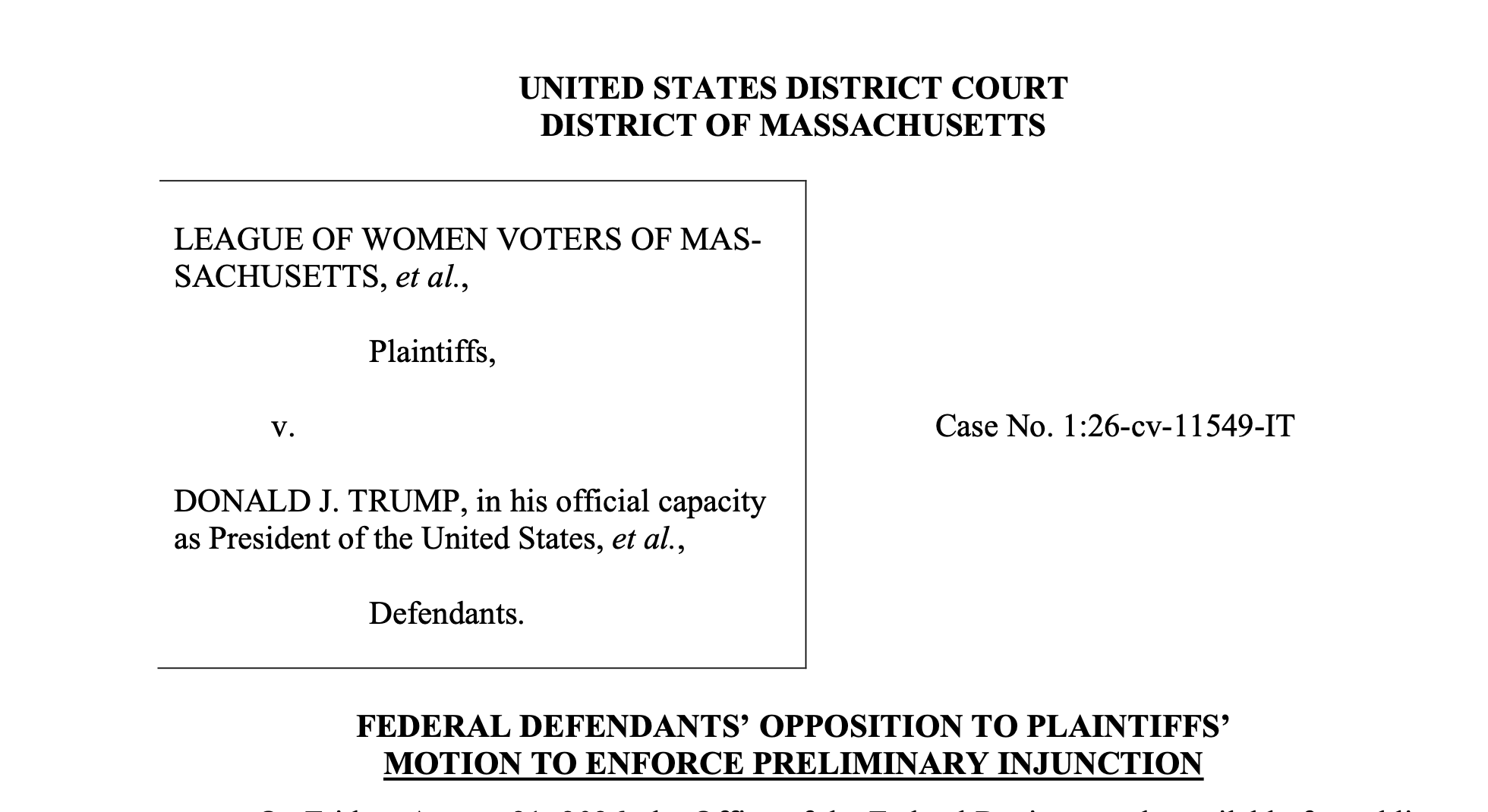
Judge Talwani held that USPS violated her injunction by finalizing rules for mail-in ballots, which her order expressly prohibited them from doing. She characterized the government’s behavior as “feigned complete compliance.”
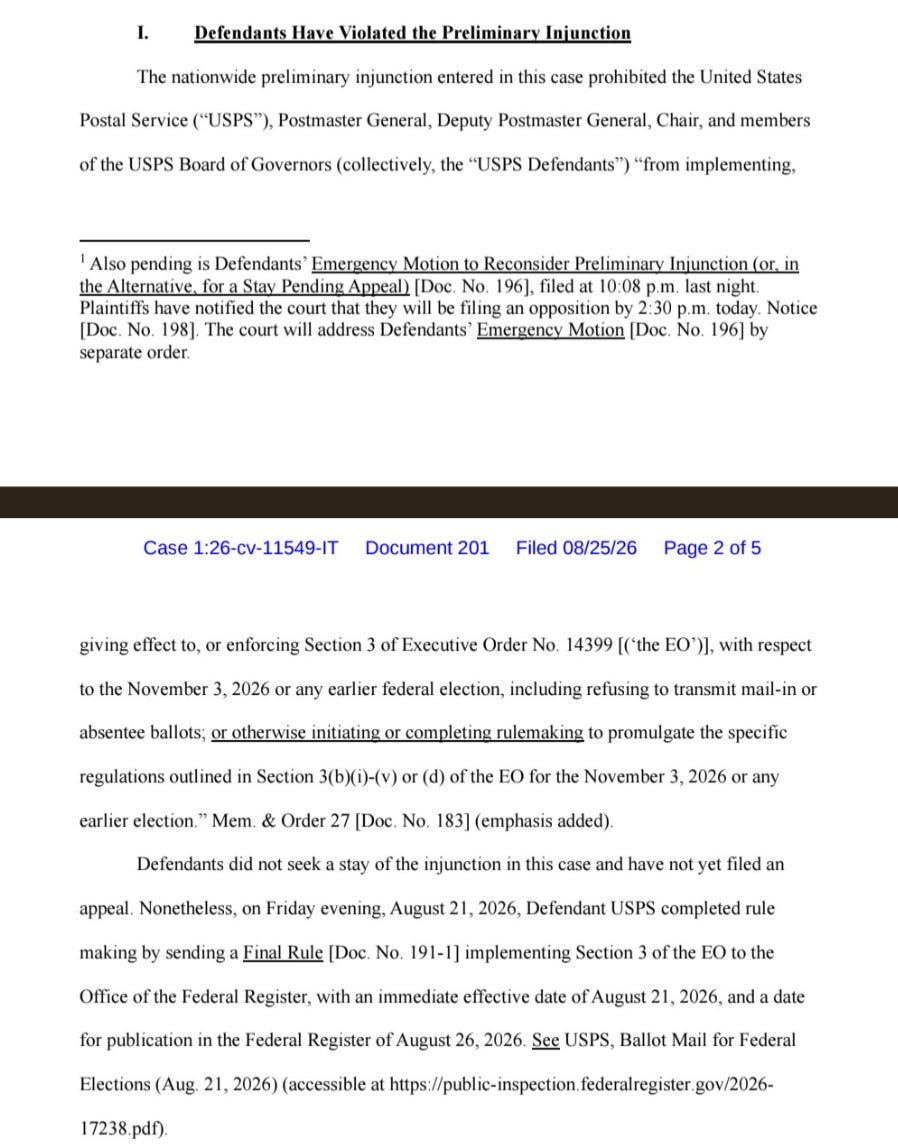
The issue here is different from the one the Supreme Court weighed in on. That Court was looking at whether the government had met its burden of proof for obtaining an injunction to set aside Judge Talwani’s injunction (that stopped the EO from going into effect; yes, I know that’s confusing, so I keep laying it out) in the AG’s case. A big part of the decision was the Court’s assessment that the government was likely to be able to establish that the AGs case wasn’t ripe for a decision when Judge Talwani considered it. They also found the government was likely to show other factors necessary to obtain an injunction, like irreparable injury and a balance of equities in its favor.
Judge Talwani was looking at an injunction in a different case, and she ended up ruling that the government had violated it because her order explicitly forbade them from engaging in steps like rulemaking. And, of course (and for whatever reason, the Court didn’t address this), the government has now torpedoed its own best argument, that the case wasn’t ripe for a court to decide yet because it hadn’t taken steps to implement the EO, by issuing the final USPS rule it intends to publish in the Federal Register on Wednesday.
Judge Talwani’s decision took an interesting tack. She found that the government violated the injunction. But she didn’t issue penalties or contemplate contempt proceedings. Instead, she took a much simpler path, one with fewer appellate complications, suggesting that the plaintiffs could file an amended complaint challenging the new USPS rule now that it has been issued. That tees up more squarely the issue of whether the EO is lawful, an issue the Supreme Court declined to consider at this stage, and an issue that, at least in a normal legal environment, should be a loser for Trump, because the Constitution is clear about who runs elections, and it’s not him.
Expect a flurry of amended complaints in the cases in both Massachusetts and the District of Columbia
The Supreme Court isn’t serious about the Purcell principle, at least not when it’s intended to protect the right to vote instead of being used to suppress it. But we are within months of voting starting in the next election. Some states, like Colorado, vote almost exclusively by mail. The idea that the administration could come up with accurate lists for all 50 states that don’t disenfranchise significant numbers of eligible voters and put in place new procedures in the short period of time left is nonsensical. In fact, preventing something like this from happening is exactly why the Purcell principle exists. It’s hard to imagine changes happening in the upcoming election, at least not based on these lawsuits.
What this is all really about is 2028 and whether the administration can make the case that it should be permitted to do this then. That makes who we send to Congress this year critical. Restoring the Voting Rights Act has never been more important. Protecting our elections has never been more important. Congress has an enormous role to play. Whatever Trump expects to happen, the lawyers in the Solicitor General’s office aren’t expecting to seize control of voting in 2026. There’s always a chance with this court, but it’s too close. They’re not ready. They’re really playing for 2028.
This is a complicated, messy issue, with lots of moving parts. An executive order, multiple lawsuits, a president who is so afraid of the voters that he wants to control the outcome of an election, a Supreme Court that, for whatever reason, refuses to rein him in as early as it could. If reading Civil Discourse helps you make sense of it all, I hope you’ll share it with friends. If you’re already a paid subscriber, thank you, and if you aren’t, I hope you’ll consider becoming one.
We’re in this together,
Joyce
Joyce - You and your #SistersInLaw do us a great service explaining this to us. I fear that the MSM just can't grasp nuance. Most of the coverage today was calling this a win for Trump. I cheer whenever I see one of you getting on a show to give the nuanced interpretation to some of the viewers! Now, if you'all could get on Fox News!
What is particularly disturbing is that the Supremes have a habit of ignoring lower court decisions they find inconvenient (to their rightwing Cause).