
E. Jean Carroll
Is DOJ investigating her, or not?

Yesterday afternoon, CNN reported that the Justice Department had opened a criminal investigation into E. Jean Carroll. The report involved testimony she gave in a civil deposition in her civil case against Donald Trump, where she alleged he defamed her when he said she lied about being sexually assaulted by him. The reporting said her testimony about how her lawsuit was being funded was under investigation for perjury.
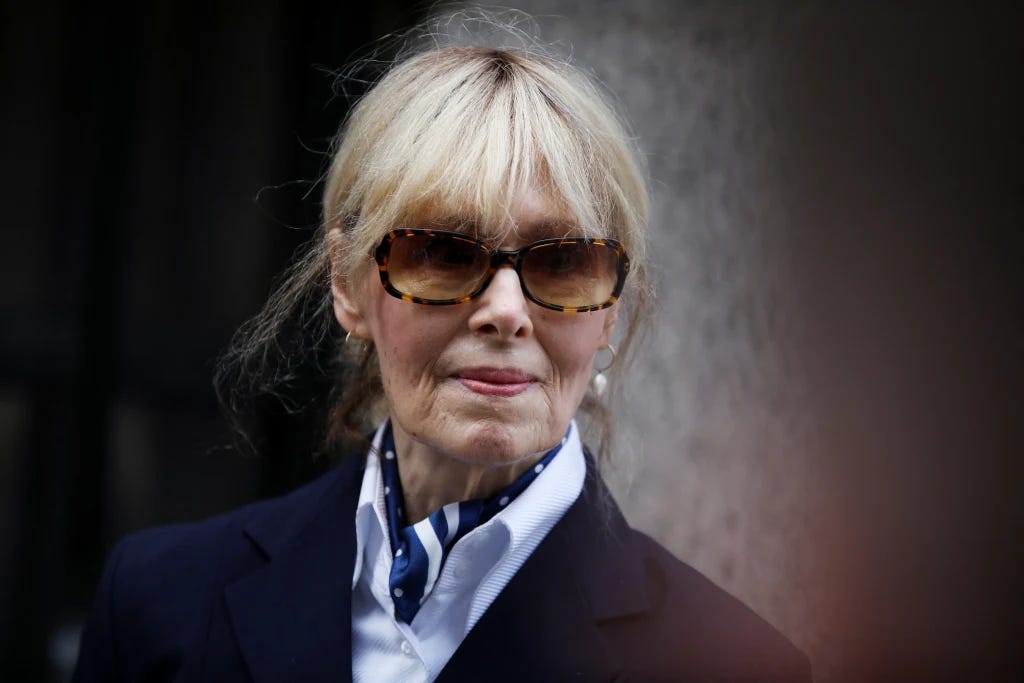
As long time Civil Discourse readers are aware, E. Jean and I are good friends, which I disclose so you are aware of my possible bias in matters that relate to her. But as virtually every objective legal analyst who has weighed in on this matter seems to agree, based on what has been reported, there is absolutely no basis for investigating, let alone indicting, Carroll here. And the situation got even more complicated this afternoon, when the U.S. Attorney in Chicago, Andrew Boutros, where the matter was reportedly under investigation, denied it was the case. The carefully worded statement claimed that his office “has not opened—and has never opened—a criminal investigation into E. Jean Carroll. Any claim to the contrary is categorically false.”
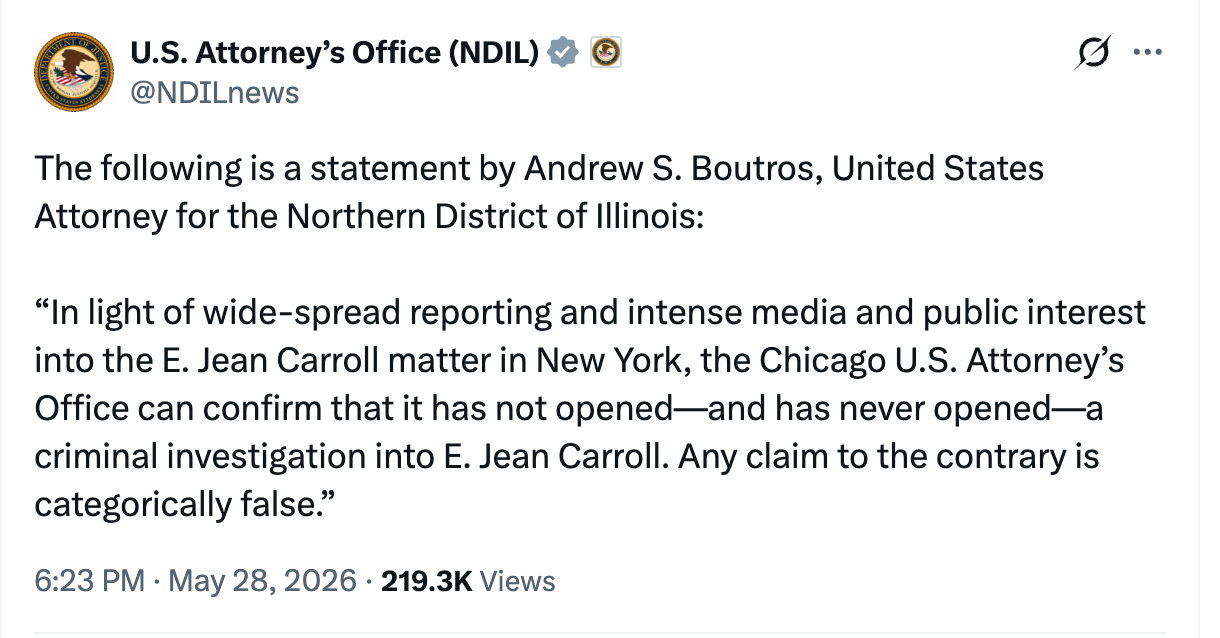
What should we make of that? There seem to be three options:
The original report was incorrect.
The original report was correct, but the government backed down in the face of the criticism of the investigation as a meritless effort to harass and intimidate Carroll because there was no basis for indicting, let alone prosecuting her.
The Boutros statement, which was carefully worded to say the office had not “opened” a case “into” E. Jean Carroll, was consistent with a case being opened against another subject and Carroll’s conduct being scrutinized as part of that investigation.
The last option would be consistent with some reporting later in the day from CBS’s Sarah Lynch, which suggested an investigation was opened into Reid Hoffman. Hoffman, who served as PayPal’s chief operating officer and founded LinkedIn, is a billionaire venture capitalist. By the end of the day, media outlets like Reuters were reporting the Chicago U.S. Attorney’s office was looking into whether a non-profit Hoffman operates, American Future Republic, committed money laundering and obstruction of justice offenses by offering some funding to Carroll’s lawyers so they could pursue her case.
Carroll testified in her deposition that her lawyers took the case on a contingency basis, which means she paid them nothing, but they would be entitled to a share of the damages awarded to her if she won. Although Carroll’s lawyers had mentioned to her that Hoffman was covering some portion of their expenses, that didn’t change her agreement with them, and when she was asked about how she was paying for her lawyers a couple of years later in the deposition, she explained they had it on a contingency basis.
It wouldn’t be unusual in a situation like this for prosecutors looking into a case against a “big fish” to identify a “little fish” with some exposure, and offer them a deal for testifying against the “big fish.” But that doesn’t make any sense here, where, at least based on what we know publicly, there doesn’t appear to be criminal conduct: Hoffman could support Carroll’s lawyers if he wanted to. The problem is that he supported a case in which the target was Donald Trump.
An investigation is just an investigation. Not all of them lead to indictments. But this one is unique because it involves the Justice Department targeting the participants in a civil lawsuit for investigation, because that lawsuit led to one of Donald Trump’s most embarrassing losses in court ever. Carroll became the woman who held Trump accountable when others couldn’t, winning first a $5 million verdict, and then a second one for $83.3 million, with a jury confirming it believed her when she wrote that Trump sexually assaulted her in a Manhattan department store. Trump denied it.
Given that background, an effort to go after Carroll and others involved in the lawsuit makes sense in a Trumpian fashion. It’s another revenge case, and likely an effort to intimidate the woman who stands to collect an enormous sum from the president once the appeals in these matters are complete. An investigation like this can happen under this administration, because top officials at the Justice Department have been willing to operate more like Trump’s personal law firm than the people’s lawyers. Todd Blanche, who represented Trump personally in the Carroll case, has said he is recused from this matter, but it’s difficult to imagine an investigation of this magnitude being opened without some awareness, at least enough to recuse, on his part.
DOJ doesn’t typically investigate perjury in a deposition in a civil case that doesn’t involve the government. Perhaps it might happen in a clear case of perjury (this isn’t; we’ll get there in a minute) where there are substantial federal interests at stake (that’s not the case here; this matter involves Trump’s personal interests). That’s the first red flag about this investigation. It suggests that if Carroll were to be indicted, the matter would be due to be dismissed on selective prosecution grounds, because Carroll is being treated differently than other deponents in civil cases who testify less than truthfully. (One might compare Carroll to Donald Trump’s deposition in this same case, where he made a number of speculative claims, including declining to confirm his affair with his second wife, Marla Trump, during his marriage to his first wife, Ivana, although it was widely reported in tabloids at the time. That might offer at least as much of a basis for investigating claims of false testimony being offered in a deposition as the reporting about the investigation into Carroll’s testimony, but Trump is clearly not under investigation here.)
But there are other serious flaws apparent on the surface here.
At the outset, a major flaw is where the case is being investigated: Chicago; the Northern District of Illinois. Carroll was deposed in the Southern District of New York. That’s the District with jurisdiction to bring charges in a matter like this. DOJ’s own Criminal Resources manual confirms that: “Venue for perjury charges generally lies in the district where the false oath was made. If the perjury is committed in an ancillary proceeding, perjury charges may also be brought in the district in which the parent proceeding is pending.” So even if there was a solid charge against Carroll, the appropriate U.S. Attorney, in the appropriate district, would have to bring it.
Then there are the elements of a perjury charge. The government has to prove that a statement is actually false—that depends on the precise language of the question that was asked, and here Carroll was discussing her arrangement with her lawyers, not whether they had outside arrangements. They would also have to show that any false statements were intentional and that they were material. The government has an insurmountable hill to climb here, because the Second Circuit Court of Appeals has already considered Carroll’s testimony in this regard. They found as follows:
“Ms. Carroll plausibly represented that she had forgotten about the limited outside funding counsel obtained in Sep 2020 when this question was 1st posed to her in [Oct] 2022.”
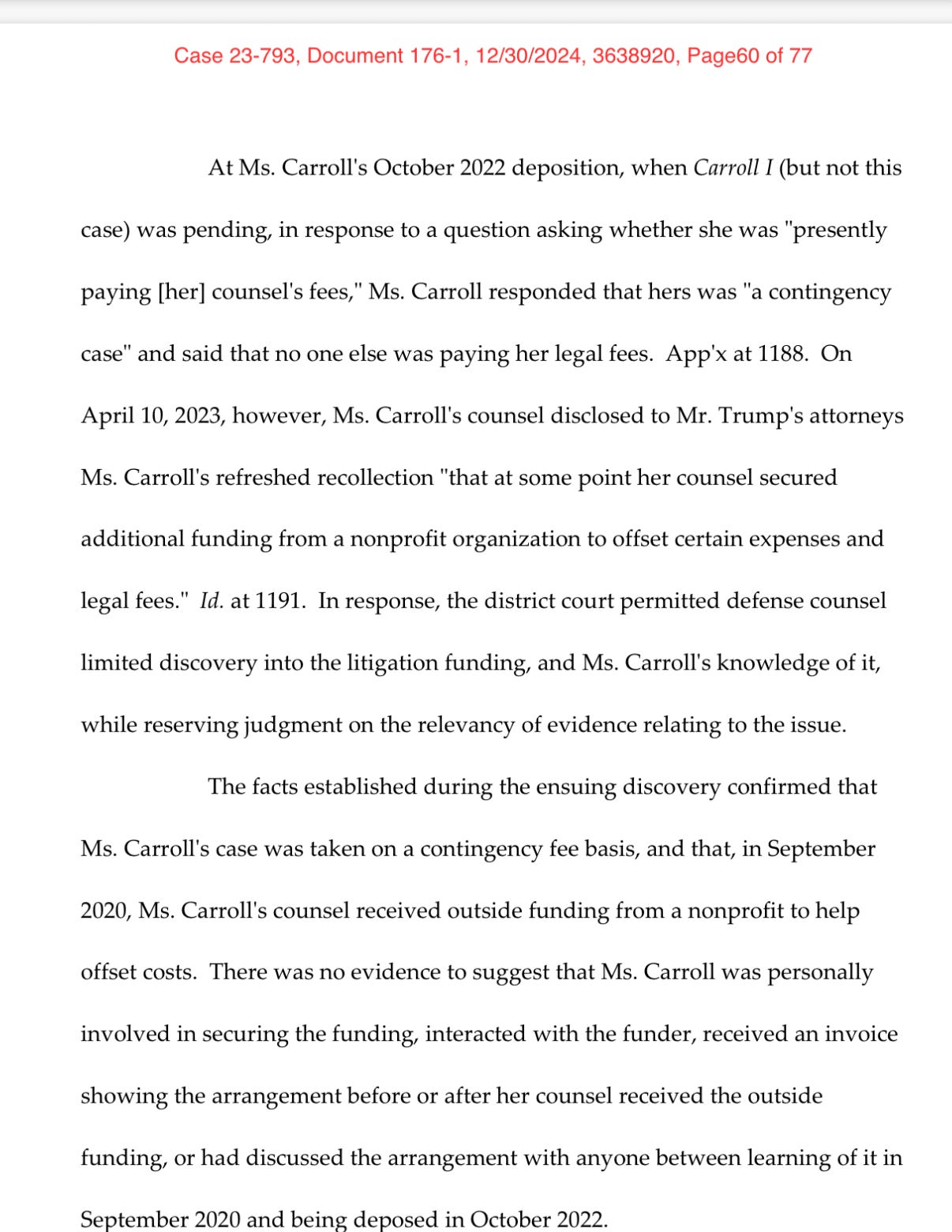
The court’s explanation included the following details: “The facts … that Ms. Carroll's case was taken on a contingency fee basis, and that, in September 2020, Ms. Carroll's counsel received outside funding from a nonprofit to help offset costs. There was no evidence to suggest that Ms. Carroll was personally involved in securing the funding, interacted with the funder, received an invoice showing the arrangement before or after her counsel received the outside funding, or had discussed the arrangement with anyone between learning of it in September 2020 and being deposed in October 2022.”
Based on this finding by a court, the government cannot prove that Carroll, beyond a reasonable doubt (or at all), made an intentional false statement. And because the government would be obligated to provide this information to a grand jury and accurately explain the law, they could not legitimately obtain an indictment of Carroll. Given that all of this is known at this stage, there is no legitimate basis for investigating Carroll, which may be why the government has backed off. But as noted above, it’s unclear whether the U.S. Attorney's statement constitutes a disavowal of an open investigation, perhaps focused on Hoffman, with Carroll as collateral damage. Given Trump’s often repeated hostility for Carroll, it’s hard to imagine something DOJ could do that would be more pleasing to the audience of one.
All of that explains why my reaction to the news last night was to dismiss the possibility that Carroll would be indicted as a result of any investigation.
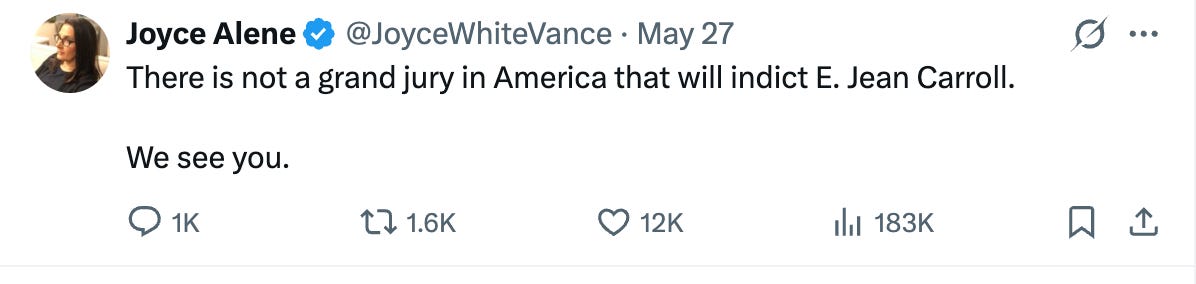
That view isn’t grounded in my friendship with E. Jean or even with my dislike of the corruption that’s increasingly apparent in Trump’s Justice Department. It’s because the known facts make it impossible for DOJ to establish, beyond a reasonable doubt, that Carroll committed perjury in her deposition testimony. If there was an indictment, the case would immediately jump the line of DOJ’s revenge prosecutions and present the strongest case for dismissal on both vindictive and selective prosecution grounds.
If you thought the judge was stern with the government in the Abrego Garcia dismissal on vindictive prosecution grounds, you could expect a bloodbath here. And beyond the situation surrounding Carroll, the Chicago U.S. Attorney’s Office has already drawn serious criticism from a federal judge for unethical grand jury conduct in the Broadview Six case, which involves a group of activists that includes progressive politicians and organizers who were indicted on felony conspiracy and misdemeanor charges following a September 2025 demonstration outside an ICE facility. The U.S. Attorney’s Office dismissed the felony charges and proceeded only with the misdemeanors. The Judge reviewed grand jury transcripts before trial and found a variety of serious errors, including prosecutors who had improperly vouched for the strength of the evidence in the case, dismissed grand jurors who didn’t support the government, and initially provided the judge with misleading, redacted transcripts. Given that background, an indictment of Carroll, given the facts, would provoke careful scrutiny of grand jury proceedings.
Trump is currently trying to get the Supreme Court to review the jury’s award of damages to Carroll. The case has been sitting on their docket for some time, and they haven’t bitten yet. There appears to be little reason for them to do so—no novel legal issues are involved—unless there are sufficient votes to give Trump special treatment. An investigation could have been viewed as setting the stage for Carroll to agree to relinquish some of her claims to avoid criminal consequences. There is no reporting to that effect, but there have been other questionable investigations, like the one into Federal Reserve Chair Jerome Powell, during which he stated that the probe was a politically motivated pretext orchestrated by the White House to pressure the central bank into lowering interest rates. Anyone who might have thought Carroll could be cowed doesn’t understand her incredible strength and commitment to seeing justice done, however.
We’ll follow this situation to see whether there is any indication of an ongoing investigation into Hoffman. That would fit the pattern of DOJ’s revenge prosecution portfolio. Axios reported that Hoffman “has donated millions to Democratic causes and the party over the years and is a longtime Trump critic. The president previously alleged Hoffman is a funder of ‘radical left’ groups that promote political violence.” But “enemy of Trump” is not a federal crime and federal judges are increasingly suspicious and willing to dismiss cases that are being wrongfully pursued. As we’ve frequently noted, simply subjecting a person to investigation is harmful; it’s costly, it’s stressful, and there can be reputational damage whether there is ultimately an indictment, let alone a conviction, or not.
These developments clearly demonstrate the importance of having an independent Justice Department, not one that acts at a president’s whim. If you appreciate this sort of careful, insider assessment, then Civil Discourse is the right place to be. Thanks for being here and for reading the newsletter. Your paid subscriptions make it possible for me to devote the time and resources it takes to write the newsletter, and I’m grateful for your support.
We’re in this together,
Joyce
Thank you for such detailed information and explanation… you’re going to have to take off tomorrow and just show the chickens 😊
Thank you Joyce for the detailed explanation— it’s maddening and unfair to our beloved E. Jean. I have Ben writing about this all day since I heard.
E.Jean is a national treasure and deserves none of this dreck from donold and corrupt blanch. Blech.