
Bulletproof No More

Pete Hegseth: “I watched that first strike live. As you can imagine at the Department of War, we’ve got a lot of things to do. So I didn’t stick around for the hour to two hours, whatever, where all the sensitive sight exploitation digitally occurs. I moved on to my next meeting. A couple hours later I learned ...”
That was the Secretary of Defense’s attempt, during today’s Cabinet meeting, to distance himself from events he has previously boasted of.
The Wall Street Journal is reporting that Hegseth was the TEA for the operation. TEA stands for Target Engagement Authority and refers to the person in the chain of command with the authority to approve the use of force and fire upon a target. The TEA can also stop the action—for instance, giving an order to hold fire to prevent a war crime from being committed. There is always a specific commander with this responsibility, and the WSJ says that here that it was the Secretary. If the reporting is correct, that makes the claim that he was too busy to “stick around” for the first use of lethal force in the Trump administration’s self-proclaimed war on narcoterrorism tough to believe.
In an Op Ed on Tuesday, titled “Shooting The Wounded On Drug Boats,” the Editorial Board at the conservative leaning Journal weighed in to say “The charge of deliberately killing the defenseless is serious enough to warrant a close look from Congress. That includes Mr. Hegseth giving an account under oath. The Administration so far seems to think it can ride out the story with ritual denunciations of the media.”
Conservative columnist George Will, writing in The Washington Post, did not mince words. Hegseth, he wrote, “seems to be a war criminal.”
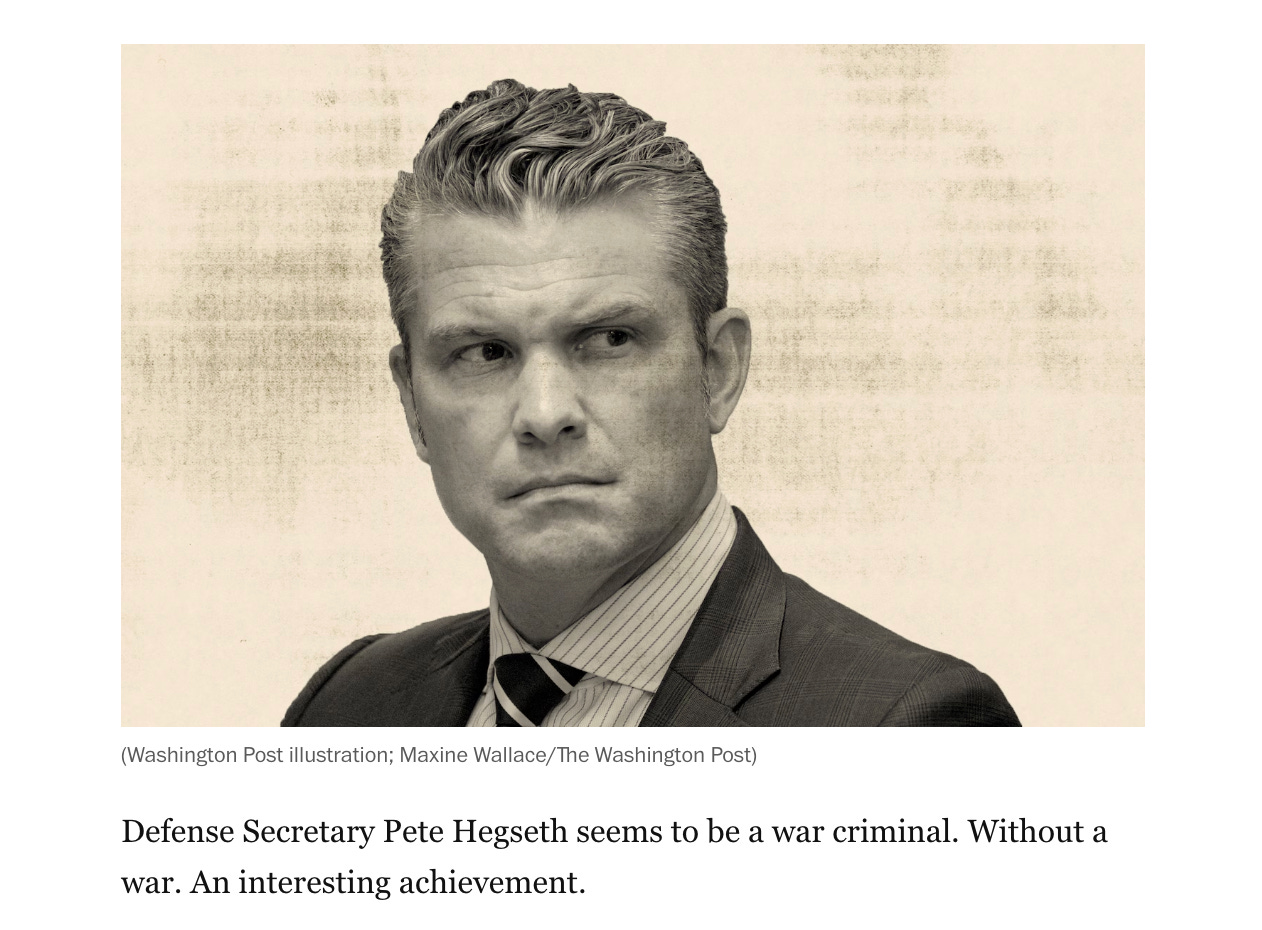
While experts debate whether the original “kill order” The Washington Post says Hegseth delivered ahead of the strike, directing that everyone on the boat should be killed, was legal or not, it’s clear that the “double tap,” the order to kill the two survivors of the first strike, was not. If we were at war, it was a war crime. If we were not, it was murder. We discussed this in the immediate wake of the Post’s report: The Moment To Pick A Side Has Come.
Hegseth might want to consider, in the words of MAGA, lawyering up. His comments today in the gold-streaked Oval Office may end up haunting him:
Q: So you didn’t see any survivors after that first strike?
HEGSETH: I did not personally see survivors. The thing was on fire. This is called the fog of war. This is what you in the press don’t understand. You sit in your air-conditioned offices and plant fake stories in the Washington Post
Q: On the second strike, you said it happened more than an hour after the first?
HEGSETH: I couldn’t tell you the exact amount of time
The military has a strong tradition of truth-telling in the most difficult circumstances. So information about who issued the order, why no one stopped it from being carried out despite the clear guidance in the Department of Defense’s Law of War Manual, and so forth, is all coming out. It’s only a matter of time. It’s clear that there are already people inside of the Department, the military, or both who want to make sure the story becomes public, or we wouldn’t know about it. Among the compelling reasons for congressional investigation is that military records of the strike, the documentary evidence of what in fact happened and who was involved, can be collected and an accurate picture of the events and who is responsible will emerge. Trump’s first impeachment happened because of the effort to hide the record of his not-so-perfect call with Ukraine’s president and the response of Lt. Col. Alexander Vindman, who put his own career in jeopardy to tell the truth.
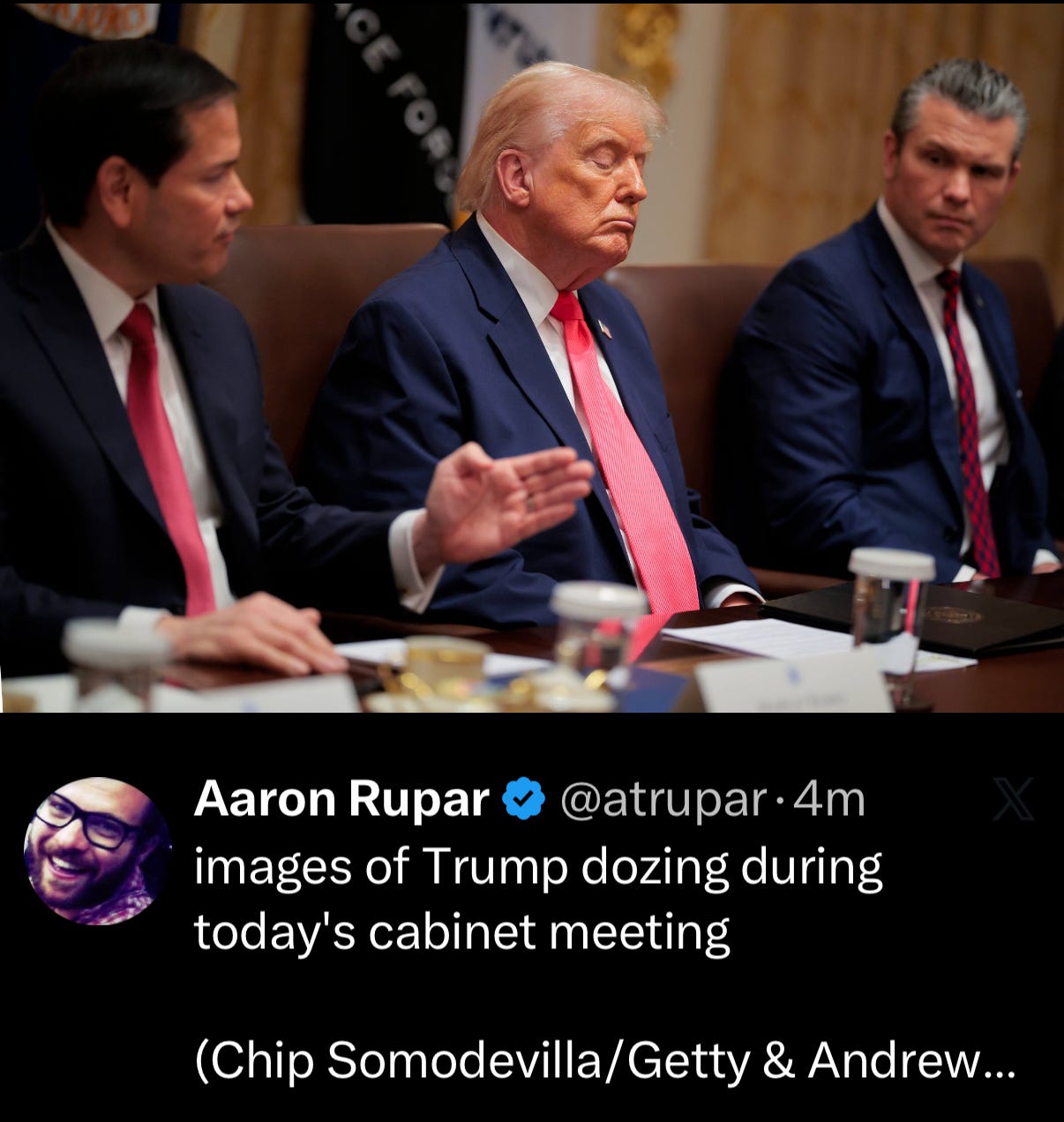
Trump dozed off at his Cabinet meeting today, as Hegseth and Secretary of State Marco Rubio looked on. Aaron Rupar shared that news and this image on social media. (If you don’t already follow him, he’s essential reading.)
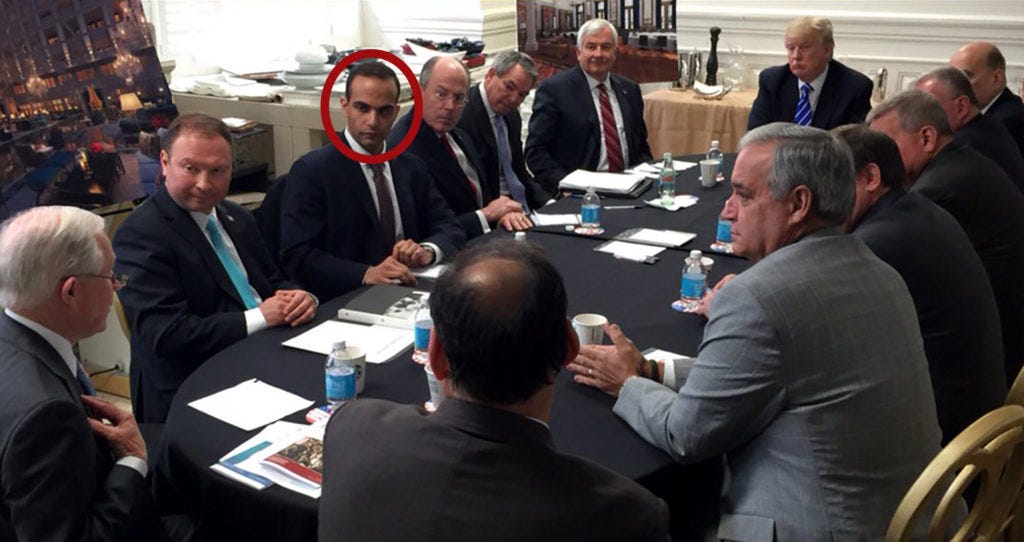
Trump told reporters who were present at the meeting that he wasn’t consulted in advance of the strikes, and even though they occurred back in September, he still hasn’t been fully briefed on them. That’s simply not credible. The echoes of first-term Trump distancing himself from people like George Papadopoulos, the aide Trump dismissed as a mere coffee boy, despite photographic evidence to the contrary, after he entered a plea deal during the Mueller investigation. “I have no idea who that guy is,” Trump said when that happened. Covfefe.
Trump painted a similar picture in regard to the strikes today. “I didn’t know about the second strike. I didn’t know anything about the people,” he said. “I wasn’t involved, and I knew they took out a boat, but I would say this, they had a strike.”
Here is the Truth Social post Trump made the day of the strike, accompanied by video of the first strike itself.
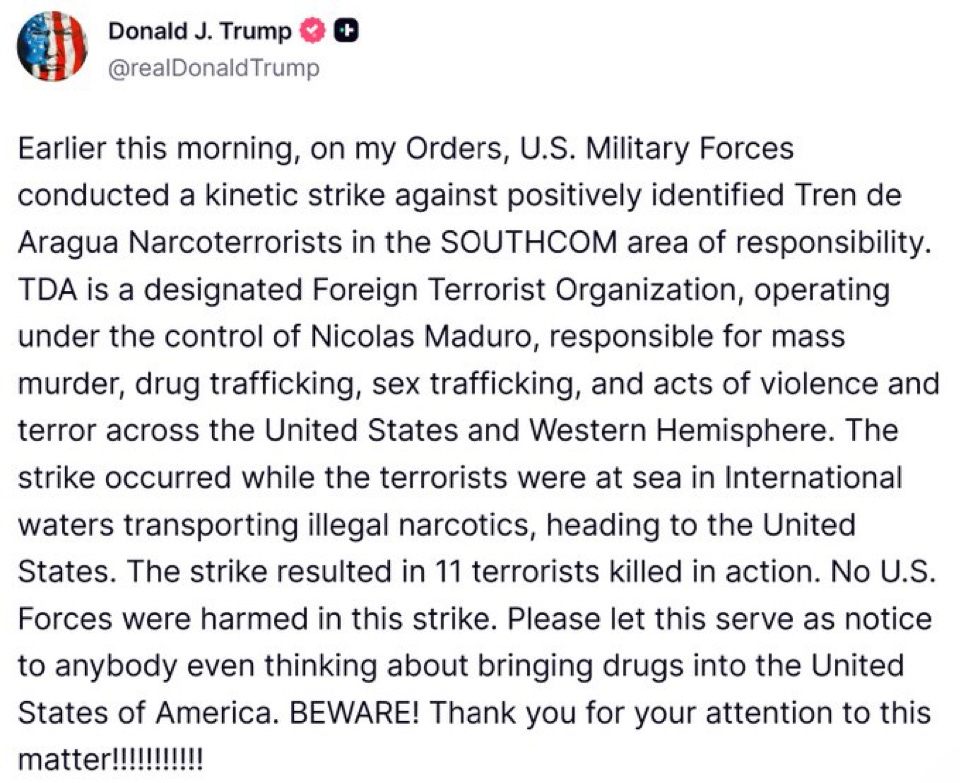
But Trump isn’t as serious about fighting against narcoterrorism as that post might suggest. Reuters put it like this: “President Donald Trump, who has cast himself as a relentless foe of illegal drugs, pardoned former Honduran President Juan Orlando Hernandez, freeing him from a 45-year sentence for conspiring to import tons of cocaine into the United States.”
The prosecutors based their case on evidence that from 2014 until his arrest shortly after leaving office in 2022, Hernández aided and abetted smugglers who brought more than 400 tons of cocaine into the U.S. He used the power of his presidency to protect and assist violent cartels, from whom he received millions of dollars that helped him rise to power. At his sentencing, prosecutors said that because of his complicity, Honduras was one of the world’s most dangerous countries.
Who poses more of a risk to the United States? Men on boats? Men who we’ve seen no evidence against, and who in one case were executed, and in a later attack where there were survivors, simply returned home? Our government is skillful at maritime drug interdiction, which often results in taking suspects into custody. Usually that means they are brought to the United States and prosecuted. There are a lot of legitimate questions to be answered about why that isn’t happening here.
All of those questions mean it’s a positive development that Congress is coming back to life, at least on this issue. Let your elected officials know you approve and want them to see it through. Go to their individual websites and email them, or call the switchboard at (202) 224-3121 and ask to speak to your representatives.
One of the most interesting questions regarding this deeply troubling incident is what the political fallout will be. Many experts believe the original order to attack on September 2 was unjustified and illegal. Even if it wasn’t, it’s clear that under international law, the order to kill the two survivors of the initial attack would have been a war crime if we were in an armed conflict, but despite the administration’s protestations, we do not seem to be. We should not expect to see war crimes trials imminently. There is little doubt that if it wasn’t a war crime, the second strike was murder, the intentional killing of one human being by another, without justification. But it’s unlikely that Trump’s Attorney General, Pam Bondi, will file charges. That leaves us with political consequences. Accountability, if it is to come swiftly, is far more likely to come from that direction than from prosecution.
I am reminded that there is a moment where the Republican Party went from supporting Richard Nixon to abandoning him, to demanding and securing his resignation. Trump has been bulletproof so far in the political arena where his own party is concerned. But his position has undeniably eroded over the last few weeks, between his party’s weakness in the off-year election, the Epstein files, and now this. The question is whether that perceived weakness is enough to force him to let go of Hegseth, or whether it might require even more.
Jill Wine-Banks, the only woman lawyer on the Watergate team, tells the story of how three top Republicans, Senator Barry Goldwater, Senator Hugh Scott, and House Minority Leader John Rhodes, went to see Nixon at the White House on August 7. Republicans in Congress had finally come to life. Despite having their support up until that time, the release of information in the White House Tapes, obtained by Jill’s team, had damaged Nixon, both with Republicans in Congress and the public.
The revelation of the contents of the tapes—the special prosecutor’s team had court approval to share grand jury material with the House—resulted in a bipartisan vote to approve articles of impeachment. That was it. The three Republicans went to see Nixon and told him that he would be convicted in the Senate based on the House’s articles and the tapes. Facts mattered. Nixon announced his resignation the next day, on August 8, and it was effective on August 9 at noon.
Nixon left Washington, D.C., on Marine 1 after giving his iconic arm raise. He left his secretary, Rosemary Woods, in tears and Gerald Ford as the new President. One of the details Jill fills in is that Nixon left it to Woods to tell his wife and daughters what was happening, that he couldn’t face them.
We, of course, are not at that point. At least not yet. But history has a way of being illustrative. Trump has dodged accountability in the past, but that doesn’t have to always be the case. Revealing the truth is a form of accountability on its own, and consequences can follow. Right now, it’s about Hegseth, the people in his chain of command, and orders that were given. The prospect that Congress might rise to its constitutional role and engage in oversight is refreshing. It’s what we need in this moment. We must do everything in our power to hold their feet to the fire until it’s done.
We’re in this together,
Joyce
"The fog of war". He's a cruel coward and a liar.
Timmy's mommy: "Timmy, did you eat the cake?
Timmy, standing with his face covered in frosting: "I didn't eat any cake."