
Anthropic Sues the Administration
Here's why Trump wanted to bring firms to heel with his executive orders. Here's what can happen when he fails.

Trump tried to sideline law firms that might be willing to take on his administration with the executive orders we’ve been discussing these past few days, as litigation over them reaches the court of appeals. So far, he’s failed.
Now, in a new lawsuit filed by Anthropic against the government, we’re getting a lesson in why Trump was so determined to take on the firms. WilmerHale, one of those firms, represents Anthropic, an American AI company that developed Claude, one of the best-known large language models.
Anthropic was one of the government’s early AI partners. A recent dispute over how the models could be used in the Defense Department has upset that relationship. The administration balked when Anthropic wanted assurance that its models wouldn’t be used for fully autonomous weapons or domestic mass surveillance. Defense Secretary Pete Hegseth told the company it was obligated to permit “all lawful uses” of Claude. Anthropic filed a lawsuit against more than a dozen federal agencies, including the DOD, the Departments of State and Treasury, and the General Services Administration. In the lawsuit, it noted that: “Despite disagreement on the two use restrictions, Anthropic has continued to reiterate its commitment to providing Claude to serve the United States’ national security interests and to negotiate in good faith with the Department.”
Before the lawsuit, as the relationship was heading into trouble, Trump threw this gasoline onto the fire:
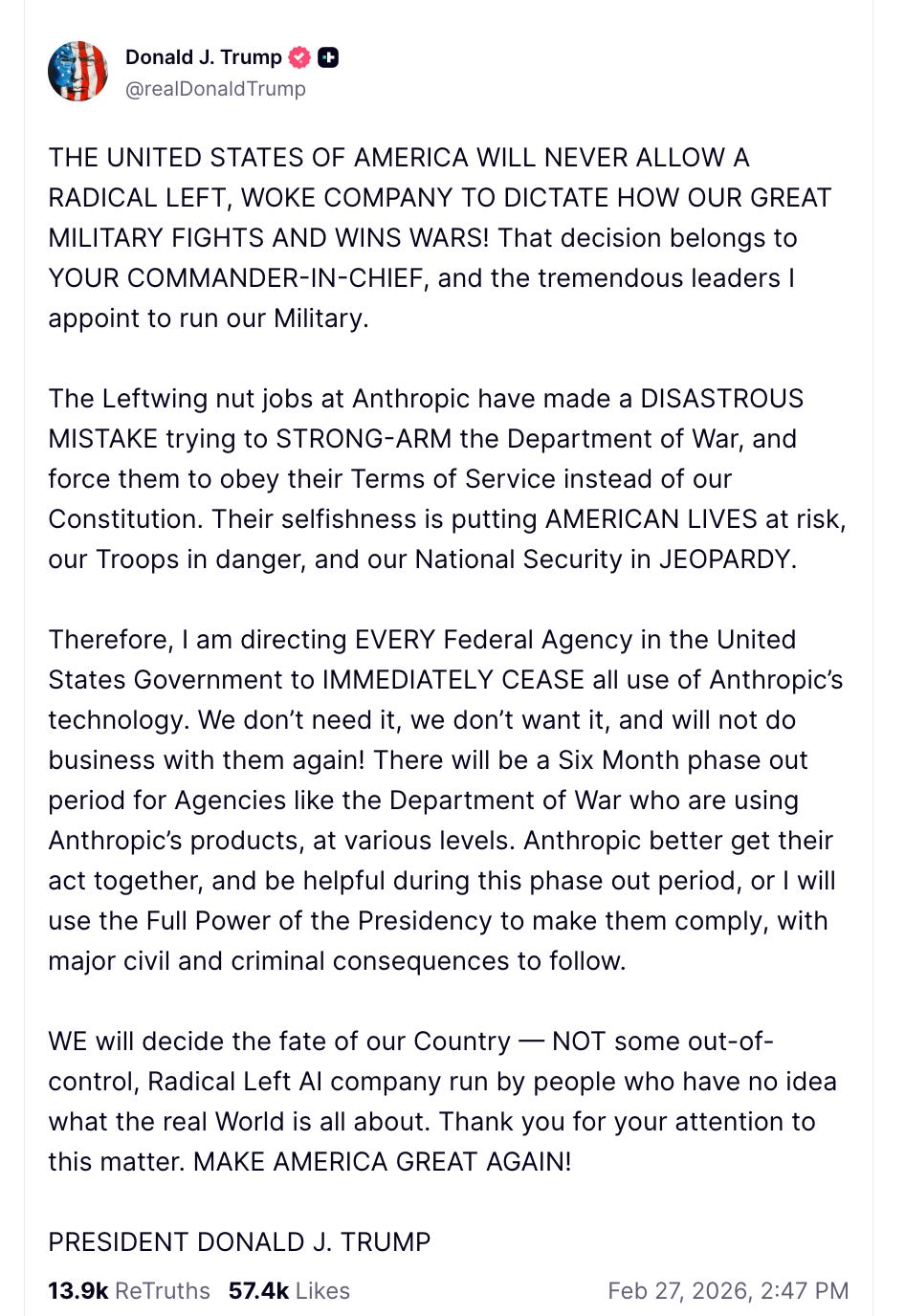
And so, represented by one of the law firms Trump feared enough to try to put them out of business with an executive order, Anthropic headed into court. A lawsuit in the Northern District of California asks the Judge to reverse the Pentagon’s designation of the company as a “supply chain risk,” which essentially puts them on a blacklist that prevents other companies from doing business with them if they want to continue working with government agencies. A second lawsuit was filed directly with the federal court of appeals in Washington, D.C.
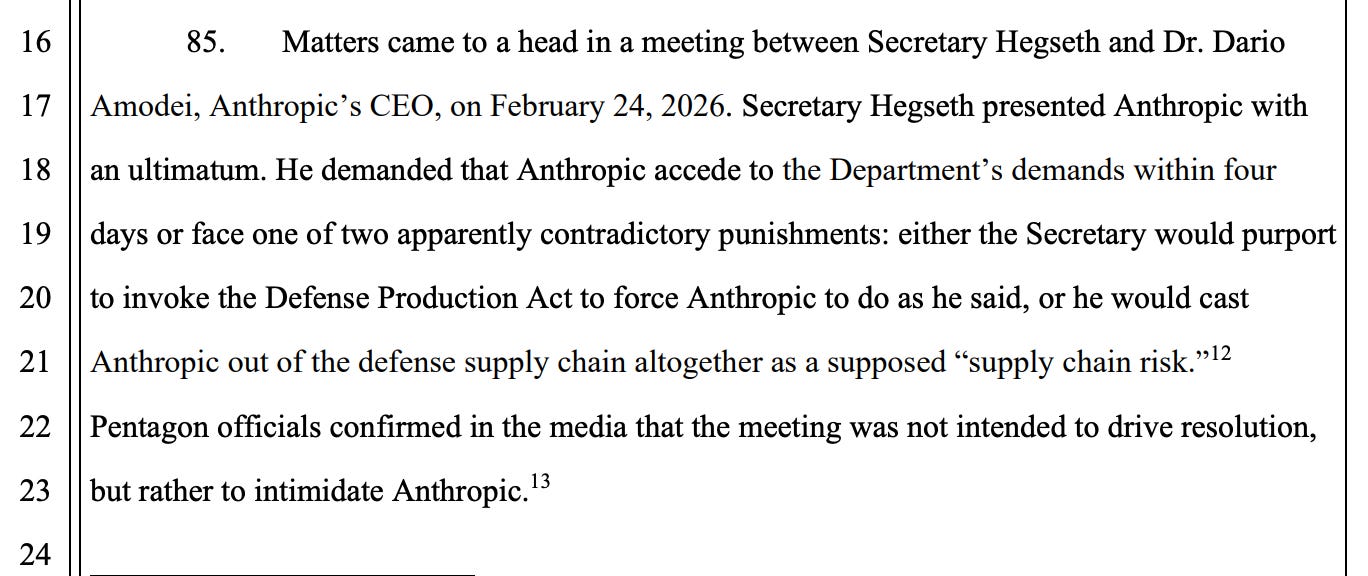
Anthropic notes the heavy-handed tactics used by DOD in its complaint, as in this paragraph:
The lawsuit raises a number of claims, including:
A challenge to DOD’s action against it under the Administrative Procedure Act as arbitrary and capricious, in violation of that law.
A challenge to DOD’s action against it as a violation of Anthropic’s First Amendment rights because they amount to retaliation against Anthropic’s “expressive activities”, including protected speech, protected viewpoints, and protected petitioning of the government.
A claim that the President acted in excess of his authority (“ultra vires”) when he ordered “EVERY Federal Agency in the United States Government to IMMEDIATELY CEASE all use of Anthropic’s technology,” since he has no authority under Article II of the Constitution or any law to do so.
A Fifth Amendment due process violation claim.
A challenge under the Administrative Procedure Act to orders issued to cut off Anthropic’s work with the government by other executive branch agencies because they aren’t authorized by law.
Anthropic asked the court for an injunction and a declaration that “the Presidential Directive exceeds the President’s authority and violates the First Amendment and Fifth Amendment to the United States Constitution.”
Anthropic also filed a petition with the Court of Appeals in D.C., asking it to review DOJ’s designation of it as a supply chain risk under a separate law from the DOD covered-systems designation it challenges in the California lawsuit. That designation, made under the Federal Acquisition Supply Chain Security Act (FASCA) of 2018, has to be challenged in DC and is unusual in that it permits the challenger to go straight to the court of appeals, which is why we have the two lawsuits.
District Judge Rita Lin in California held a status conference in the case before her this morning, and said she would hear the request for a preliminary injunction on March 24, after the government declined to say it wouldn’t continue to take adverse action against the company. Judge Lin, who has strong beliefs about public access to the courts, held today’s hearing on Zoom, a good omen for anyone who believes the public has the right to follow proceedings of interest.
The litigation feels like there’s some karma involved. A law firm Trump wanted to prevent from litigating against his administration has taken on a major case. And the more he posts about it on social media, something he seems to lack the discipline to stop doing, the worse he makes it. This case is going to get interesting fast, especially with the short timeline Judge Lin has put it on.
If this kind of information helps you understand what’s actually happening when lawsuits get filed, that’s one of the goals of Civil Discourse. I read the cases and opinions and explain their significance, based on 25 years of experience at DOJ. Paid subscriptions make this work possible and help to create a community of informed people. If you’re able to, I hope you’ll consider joining us.
We’re in this together,
Joyce
I think WE need the regime change…..
You mentioned that Trump lacks discipline --he also lacks foresight, compassion, self-knowledge good taste, etc.