
The Week Ahead
June 28, 2026

Is it too much to hope that the rule of law could be rebounding as we head into the Fourth of July holiday? So many people have been discussing the doom and gloom of celebrating the 250th anniversary of our country in the midst of the Trump era. But I am seeing a lot to celebrate in the people who are pushing back, the people who advocate for democracy every day. We are the real spirit of America and that is definitely something to celebrate: The people who refuse to give up, refuse to bend the knee just because a bully wants them to.
There has been lots of bad news for the administration as courts, the public, and even some Republican Senators push back.
Late last week, we discussed Katie Phang’s phenomenal win, which requires DOJ to disclose more of the Epstein Files, including some of the parts we’ve been waiting on, like names of possible codefendants and coconspirators, as well as reports of interviews with a victim who claims she was assaulted by Donald Trump. All of that has to be disclosed by July 2, unless the administration is able to get a stay from the appellate court—the trial judge, Emmet Sullivan, declined to give them one. I’m not yet seeing a notice of appeal from the government on PACER, but that’s likely to happen soon.
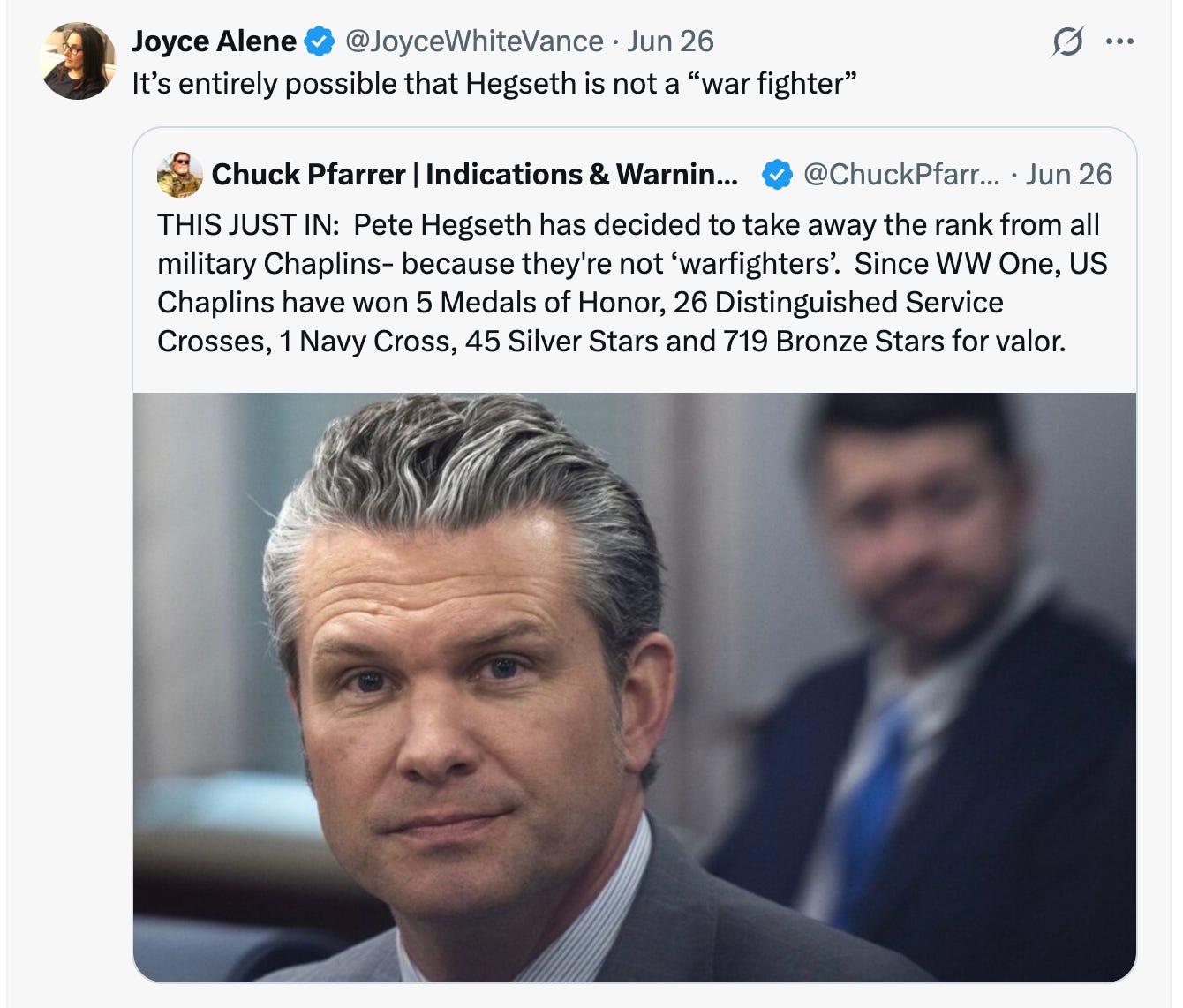
Then there’s Secretary of Defense, the self-styled Secretary of War, Pete Hegseth. Hegseth remains in Trump’s favor largely because of his ability to say yes to anything the boss asks for. His pandering is next level and includes blocking Black and female members of the military when they come up for promotion. He’s after chaplains, the people who know right from wrong. He’s also after…flu shots, ending mandatory shots as “a matter of religious freedom and medical autonomy.” He described the longstanding flu vaccine requirement as an “absurd, overreaching” mandate that had served to “weaken our warfighting capabilities.”
In April, Hegseth ended the 80-year-old requirement that people in the military get a flu shot. By June 18, 160 troops were down with the flu—an odd time of year for the flu to surface. Only about 40% of trainees had been opting to get a flu shot since the requirement was lifted. By June 24, there were 275 confirmed cases and one possible death.
Hegseth was forced to restore the policy he’d rescinded. The jab is required once more. Apparently, science doesn’t bend a knee to Donald Trump.
Trump’s plan to use the postal service to seize federal control over who can vote in the midterm elections was blocked by District Judge Indira Talwani, in Boston. This is the case that was brought by state attorneys general, seeking to put a stop to Trump’s wildly unconstitutional executive order requiring states to turn over their voter rolls to the federal government. Trump’s plan was to permit only federally approved voters to receive ballots through the US mail. Judge Talwani wasn’t alone. One of her colleagues in Boston, District Judge Denise Casper, permanently blocked Trump’s first EO on elections, ending his hope of imposing, via executive fiat, a requirement that, without regard to state law, every person across the country prove citizenship before they can register to vote. It’s been a good week for the right to vote in the federal courts.
There is plenty of reason to be optimistic and to celebrate the people who are trying to move us forward.
Unfortunately, though, the week ahead is bound to include some gloom and doom because we are entering the final days of this term of court at the Supreme Court, and there are some bangers left on the docket. I’ll leave you with a few cases that are still to be decided, in addition to the birthright citizenship case, which we discussed last night.
National Republican Senatorial Committee (NRSC) v. Federal Election Commission (FEC) is a challenge to federal limits on how much money political parties can spend in coordination with their candidates. The bottom line here is that a decision in favor of the NRSC would remove all limits on how much money national party committees can spend on fully coordinated campaign advertising. The case was argued on December 9, 2025, but is one of those cases the Court has held until the end of the term, suggesting a split decision and perhaps one or more vociferous dissents.
Trump v. Slaughter is the case involving Humphrey’s Executor, the longstanding precedent that prohibited presidents from firing people who, like Rebecca Slaughter, served on executive branch agency boards like the Federal Trade Commission (FTC), in her case and in Mr. Humphrey’s case. But the principle extends well beyond that one limit, with the Court in oral argument appearing to have six votes to give the president broad “Article II” authority to fire people just because he doesn’t like them or doesn’t think their views line up with his. The outer limits of that power may well end at the Federal Reserve, where, in a separate case, Trump v. Cook, the Court seemed inclined to invoke greater limits when it comes to Fed Governors. Both of these cases are still on the docket, and it will be interesting to see the interplay between them. The rule should be the same for both entities, but it’s likely it won’t be and we’ll have the opportunity to see what new rules the Court’s conservative majority will create (or what intricate pretzel logic it will use to distinguish the indistinguishable) this time to ensure they can achieve their desired outcome in each case. Trump has argued that restricting the president's power to remove these individuals to situations involving "inefficiency, neglect of duty, or malfeasance in office" is unconstitutional.
Then, there’s Watson v. Republican National Committee, where the challenge to a Mississippi law that permits ballots that are mailed by election day and received within five days thereafter to be counted. The challenge in this case is chilling, claiming that the Mississippi law conflicts with federal laws that establish an “election day.” Canceling the ability to count late received ballots will be bad enough, but it’s the precedent to require all voting to be accomplished on a single day, and the potential to end early voting and other alternatives to showing up on the first Tuesday in November, in person, is disturbing.
Little v. Hecox requires the Court to decide whether laws that require participation in sports to conform to biological sex, rather than gender identity, violate the equal protection clause of the 14th Amendment. It’s been open season on transgender people in this administration, and this is yet another effort, emanating from the administration’s efforts to unify Trump’s base around their common hatred of people who they think are different.
Finally:
On Monday, Tommy Tuberville’s motion to dismiss a case saying he isn’t qualified to run to be Alabama’s governor gets a hearing in state court in Montgomery. Also, I’ll join Norman Eisen for Coffee with the Contrarians at 8:45 a.m. ET.
Former FBI Director Jim Comey was supposed to be arraigned in the seashell threat case in North Carolina on Tuesday, but it has been pushed back to September. That’s an awfully long time between charging and a defendant’s first appearance in court, but it’s consistent with the practice in the Eastern District of North Carolina, so Comey’s request to present his constitutional arguments first is being honored. Even so, it suggests the government doesn’t view Comey as much of a threat, even though he’s charged with making one.
Thursday is 250 years since the Continental Congress voted to declare independence from Great Britain in 1776. (The Fourth of July is the day Congress formally adopted the text of the Declaration of Independence.) The second is also the day much of my family descends for the 4th of July celebration, and we’re planning to kick it out, so expect lighter posting from me over the holiday, but I’ll jump back in if anything important happens.
We’re in this together,
Joyce
The lower federal courts are pretty consistently standing up for the law. The same - tragically - cannot be said for Trump's hand-picked reactionary Supreme Court. They are causing terrible damage to our country ruling after ruling, and there is nothing anyone can do about it. The worst court since Roger Taney's in the 1850s, which gave us the infamous "Dread Scott decision" that led directly to the American Civil War.
As I said here before, the Imperial Court loves to engage in legal sleight of hand and I expect we will see more of that in many of the final major decisions next week or the week after. This Court loves it some strong executive discretion, weak administrative oversight, narrow judicial review, skepticism of federal civil‑rights enforcement and strict textual constraints on modern governance. When historical evidence conflicts with that vision, the Gang of Six conveniently engages in "law office history" (just enough history to support an argument), narrows the statute, or takes it upon itself to reinterpret congressional intent. Also loves to engage in convenient semantic redefinition. To a historian, the question is: What did Congress intend? To Alito & Co., the question is: What meaning can the statutory words bear today, using ordinary semantics? This lets the Court say:“appointed” can mean “completed,” “held” can mean “finished,” and “chosen” can mean “finalized,” even though those meanings were not the historical ones or what Congress, in particular, actually intended, for example, in the Election Day statutes --- the very provisions the RNC relies on in Watson v. RNC. From inside textualism, this is not considered dishonesty --- it’s semantic inference. For most of the rest of us, it’s dishonest semantic redefinition.