
The Week Ahead
August 9, 2026

The military occupation of the District of Columbia hits the one-year mark on Tuesday. On August 11, 2025, our nightly column was titled, When The President Becomes The Police. “It’s deeply concerning that Trump’s predication for seizing control in the District—allegedly out of control crime—is a lie,” I wrote. We had just discussed the fact that crime was actually decreasing in the District of Columbia (a trend that continues, as those of you who read last Friday’s Five Questions with criminal justice expert Adam Gelb saw). But D.C. law allows the president to assert control for 30 days in an “emergency,” and as we’ve seen, Trump has mastered the art of declaring an emergency on baseless grounds, and then trampling on Americans’ rights and shattering our norms.
The facts—they are troublesome things for someone like Trump who wants to do what he wants, when he wants, and damn the rule of law. It was no accident that “alternative facts” became the hallmark of his first administration. Now, we are living through the death of truth, as disinformation is widely disseminated on social media, including at times by the President of the United States. That’s how the unthinkable, the presence of armed National Guard troops on American streets, has continued for a full year.
A couple of days after Trump sent the Guard into D.C., I wrote to you about moving the Overton Window: “The Overton Window is a model that describes the range of policies considered acceptable at a given time by the public and policymakers. It’s the spectrum of ideas that are legitimate, feasible choices, and anything that falls outside of the window is considered too extreme for serious consideration. For instance, the idea of deploying the National Guard, or even the military, on American streets to control the local population is something we would have considered far outside of the Window for decades.”
Although the Supreme Court largely blocked the administration’s efforts to deploy the guard elsewhere, and public pressure was overwhelmingly negative for the administration, different rules for the District of Columbia have allowed Trump to maintain the National Guard’s presence there. And Trump has moved the window and may well be biding his time for other critical moments, having gotten the public used to the idea that he does this.
Looking back on that moment, what stands out is that there wasn’t a compelling justification for militarizing the nation’s capital. Trump just did it.
So what was it all about?
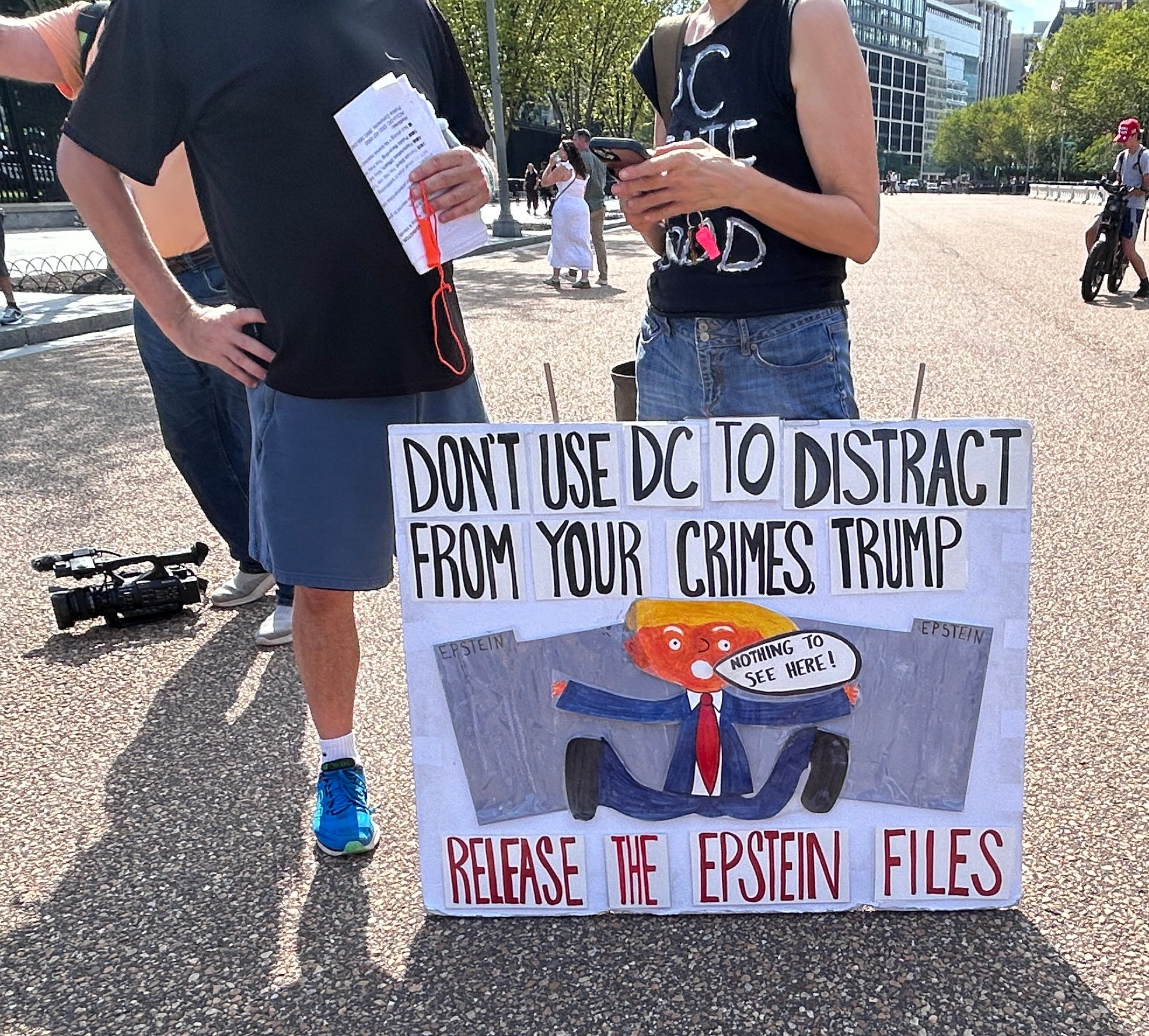
Trump was falling under increasing pressure to release the Epstein files as concerns about his possible involvement, and a lack of clarifying information one way or the other, dominated the news. Although Trump ran on releasing the files and could have done so last August as Ghislaine Maxwell’s appeal ran its course and DOJ said it would not be charging additional defendants, he never actually did it.
He turned to his favorite tactic: distraction.
Trump’s failure to keep his campaign promise fueled the impetus for Congress to pass the Epstein Files Transparency Act late last year. Trump, of course, is still stonewalling, including an embarrassing failure by the Justice Department, in a lawsuit where Todd Blanche, the just-confirmed Attorney General, was sued by journalist/lawyer Katie Phang, to turn over unredacted files to a federal judge. More on that in a moment.
As we approach the first anniversary of Trump’s military occupation of the District, citizens and groups like Free D.C. are calling for actions including:
Calling for D.C. statehood as the path to self-determination and equal rights for its 700,000 residents.
Demanding that every governor serving as Commander in Chief of deployed National Guard troops withdraw those troops from Washington, D.C., immediately.
Urging the federal government to dismantle the “DC Safe and Beautiful Task Force” and the Joint Task Force created to operationalize it, and end the surge of forces in Washington, D.C., as well as putting an end to all ICE, DHS, DEA, IRS, FBI, Park Police, and other federal surge traffic checkpoints, high speed chases, and raids on homes and workplaces.
There are also concerns that Trump will oppose seating D.C.’s new mayor after the election, and activists are speaking out against that in advance. Trump has not been shy about his strong opposition to D.C. Democratic mayoral nominee Janeese Lewis George, a democratic socialist. In June, Trump threatened a federal takeover of Washington, D.C., if she won the general election, even though it would take an act of Congress to revoke D.C. home rule and Trump cannot legally do that on his own. “Threatening Home Rule because you do not like how residents vote is an attack on democracy itself,” Lewis George, a current member of the D.C. Council, said at the time. “The people of D.C. elect the mayor of D.C.”
The calls for D.C. statehood are longstanding and unlikely to be acted on in this political environment. Ending the occupation of D.C. and committing to honor its residents’ ability to elect local officials of their choice should be completely noncontroversial, and the issue needs to be resolved well in advance of the 2028 election.
If you want to revisit the mood as Trump went into D.C, a recent history exercise that I’ve found valuable this past week, here are some of the Civil Discourse columns you may want to take a look at:
Portland and Beyond (about Guard deployments in other states)
Posse Comitatus: The Power of the County (an explainer from earlier in the year about posse comitatus and its intersection with the Insurrection Act)
Only Monday (an explainer of the executive order and other acts Trump took in D.C. and his efforts to normalize militarizing American cities so he could take control) “This administration is on the dictator track.”
Also on the docket for this week:
Trump’s new executive orders on birthright citizenship seem destined for litigation, although we don’t know how quickly that will happen.
Newly confirmed Attorney General Todd Blanche has a date with Judge Emmet Sullivan in the lawsuit over the Epstein files that Katie Phang brought against him on Thursday. In his order setting the “status hearing,” the Judge advised Blanche that he should be prepared to address three items:
“In its Order of July 25, 2026, the Court ordered the Defendant to provide documentation supporting his representation that certain names that have been redacted in the published version of certain documents are the names of victims … The Defendant did not provide such documentation; rather, he asserted that certain redacted text contains the identities of victims or potential victims whose counsel have contacted the government and requested that the persons be treated as victims … The Defendant’s assertions do not comply with the Court’s Order, which requires documentation to support the assertions. The Defendant shall be prepared to discuss what documentation he will provide to support his assertions.”
“In its Order of June 25, 2026, the Court ordered the Defendant to produce the underlying FBI interview notes that formed the basis for certain FD-302 interview reports, with appropriate redactions, or show cause why the notes should not be produced … In response, the Defendant stated that he did not produce the notes for two reasons: they are ‘substantially similar to’ and therefore duplicative of the typewritten reports, and there is a risk of inadvertent disclosure of victim information because the notes are handwritten … The Defendant does not point to a provision in the Epstein Act that contains an exception for ‘substantially similar’ or duplicative documents … and the Defendant has acknowledged publishing ‘substantially similar’ draft indictments … The Defendant shall be prepared to explain why the handwritten notes cannot be redacted manually, or why the redactions cannot be accomplished in another way.”
“The Defendant states that he will comply with the requirement in Section 2(c)(2) of the Epstein Act that ‘[a]ll redactions must be accompanied by a written justification published in the Federal Register and submitted to Congress.’ The parties dispute whether there was a deadline for the Defendant to do so. The Defendant shall be prepared to discuss his timing for complying with this requirement.”
Blanche has already been referred to a bar grievance committee by a federal judge in Florida. His failure to comply with court orders here strongly suggests he’s flirting with a reoccurrence. Bar grievance committees move slowly, partly in the interests of due process for those facing accusations and partly because, well, like much of our legal system, they simply move too slowly, a problem that is especially acute when the need for prompt action is greatest. Judge Sullivan might choose a similar tack here despite that implicit issue with the length of time it takes for accountability.
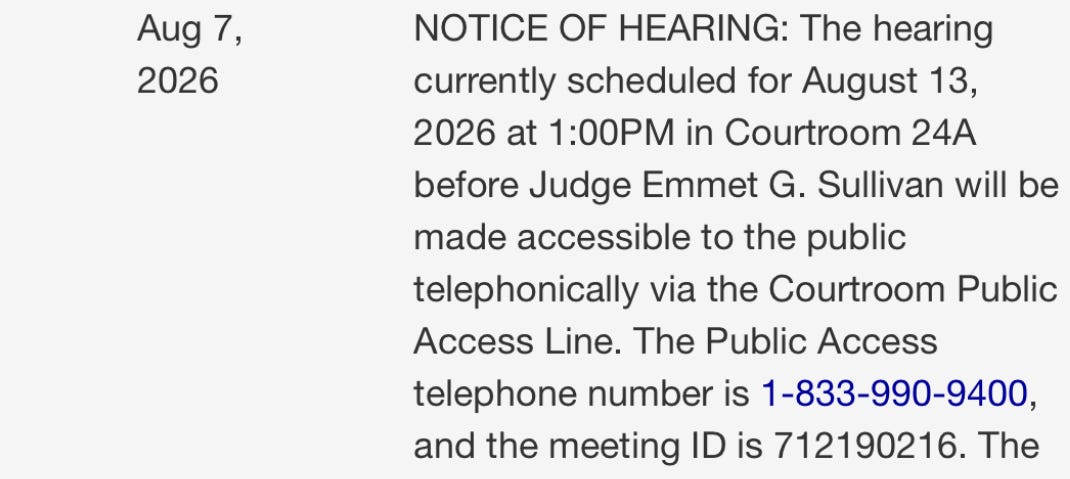
But I’ve quoted extensively from his order above so you can get a sense of how great Blanche’s sins are. Despite the factual tone of the order, make no mistake about it: this is a Judge who is angered by Blanche’s flagrant disregard of his orders. What he is prepared to do about it in the hearing is something we’ll be following closely later this week. You can listen in on the hearing too; the Judge posted a call-in number for the 1:00 p.m. hearing on his docket.
Finally, the D.C. Circuit ruled 2-1 late last week that Trump must stop construction of the White House ballroom, holding it requires congressional approval. But they stayed their decision from going into effect for 14 days so the administration can appeal. Look for some speedy construction during that time. The White House’s primary response has been to focus on the ballroom as a national security feature, which is some weak sauce here. “Each President is a temporary tenant, not the owner, of the White House and its Executive Residence. The President has no—and claims no—constitutionally assigned authority over that property,” the majority wrote. This is a case that goes to fundamental Article I power of the purse that the Constitution vests in Congress and we will watch it closely.
Thanks for being here with me at Civil Discourse. Your support and subscriptions make it possible for me to write the newsletter every night.
We’re in this together,
Joyce
Thanks Joyce— appreciate the review of the upcoming events and the strange things we are living through. No other elected president has caused so much harm to our people and our democracy. It’s horrific.
The citywide drop in crime in D.C. is structural, spanning dozens of neighborhoods and multiple crime categories. It's not limited to the period or areas of the federal surge. Independent data* show the decline is broader, longer-running, and not solely attributable to federal intervention. So yes, crime is down in D.C., but not because of anything Pirro or Trump did alone. Their actions likely contributed to some reductions, but the overall decline is broader, longer-term, and documented independently of their initiative. As for the Blanche referral to the NY Attorney Grievance Committee (AGC), typically the AGC defers to the DOJ Office of Professional Responsibility (OPR) for a first review of the complaint in these situations (DOJ official acting in their federal capacity) and the OPR never announces if a complaint has been filed.
*Metropolitan Police Department’s citywide NIBRS‑aligned (FBI National Incident-Based Reporting System) crime dataset
*Council on Criminal Justice multi-city crime trend analysis
*Criminal Justice Coordinating Council Statistical Analysis Center