
The Week Ahead
June 21, 2026

In court this week:
In the Kennedy Center case
Trump’s name is gone, but the case isn’t quite over.
In a status report filed on Friday, the plaintiff noted that “Defendants’ submission confirms that they plan to turn the Kennedy Center into a lifeless husk by refusing to take any steps to maintain the Center’s operations, and will effectively close the Center as a performing arts venue come July 5, 2026—contrary to the Court’s preliminary injunction order.” The plaintiff, Congresswoman Joyce Beatty, is careful to say she isn’t asking the court to micromanage the shows that will appear on stage, but that the government must not be allowed to violate the court’s prior order.
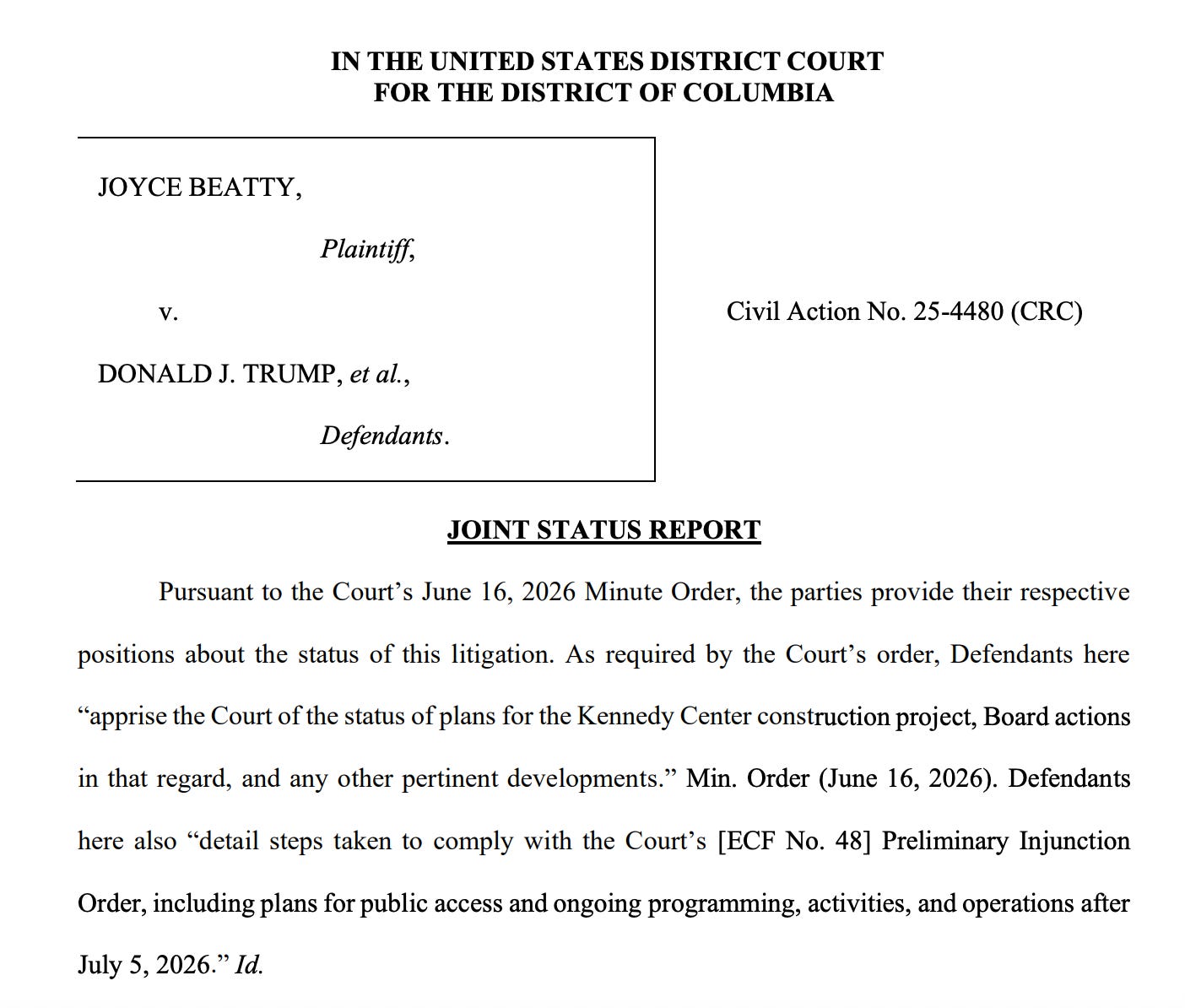
Beatty is also trying to force the government to remove the tarp that’s still hanging on the front of the Kennedy Center, or as she puts it, “Today, the tarp inexplicably remains.” She calls it “a transparent effort to frustrate a return to the status quo that existed prior to the Board’s unlawful vote to rename the Kennedy Center.”
The ball is with the court to determine what happens next this week, now that this status report has been filed.
Ongoing proceedings in Trump v. IRS, in Florida
In the slush fund case, the 35 former federal judges who filed a brief objecting to the closure of the case at Trump’s request after both his slush fund and his “almost a pardon” deal with the government were disclosed, filed their response to Trump’s efforts to keep the case closed. The table of contents outlines the judges’ argument. The key point is that the Trump plaintiffs have perpetrated a fraud on the court, and the court should not let it stand. That’s a highly persuasive argument to any federal judge who intends to protect their integrity. The question is, what does the court have the ability to do about it?
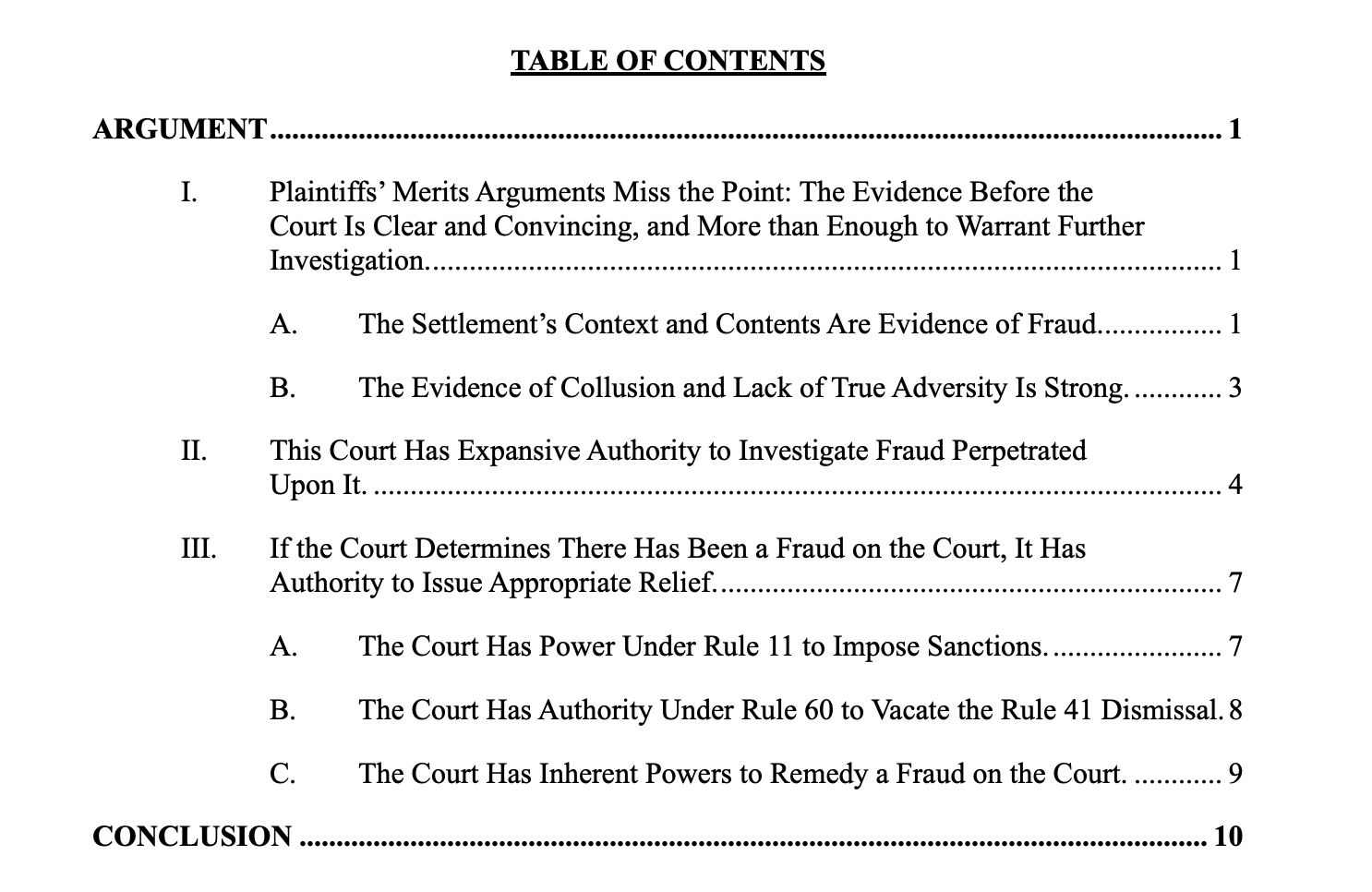
The judges argue that “the Court has ample authority under Rule 11, Rule 60, and its inherent authority to issue remedies.” As we discussed previously, the Trump argument is that because they moved to dismiss the case before the defendant replied, the Federal Rules of Civil Procedure required the Judge to dismiss the case, and once that was done, she has no more ability to act. The judges’ group points out that the Court retains the ability to impose sanctions under a rule barring frivolous proceedings and to reopen the case despite the prior dismissal because of the allegations of fraud that have surfaced. The court has “inherent authority,” according to the judges, to take appropriate action in the face of fraud. “That authority,” they write, “gives courts the power “to punish conduct which abuses the judicial process” and fashion “an appropriate sanction, from dismissal of a lawsuit to an assessment of attorney’s fees.”
The Trump plaintiffs’ position is made worse by DOJ’s refusal to file the sworn declaration it has abandoned its slush fund plans in the case pending in the Eastern District of Virginia. The court ordered them to do so by Friday or face further proceedings. Predictably, they refused to file under oath while complaining about the court violating separation of powers by requiring them to get some legal tooth to their promises in court. Their word, senior DOJ officials say in their brief, should be enough, before claiming that “the Court’s demands are unnecessary.”
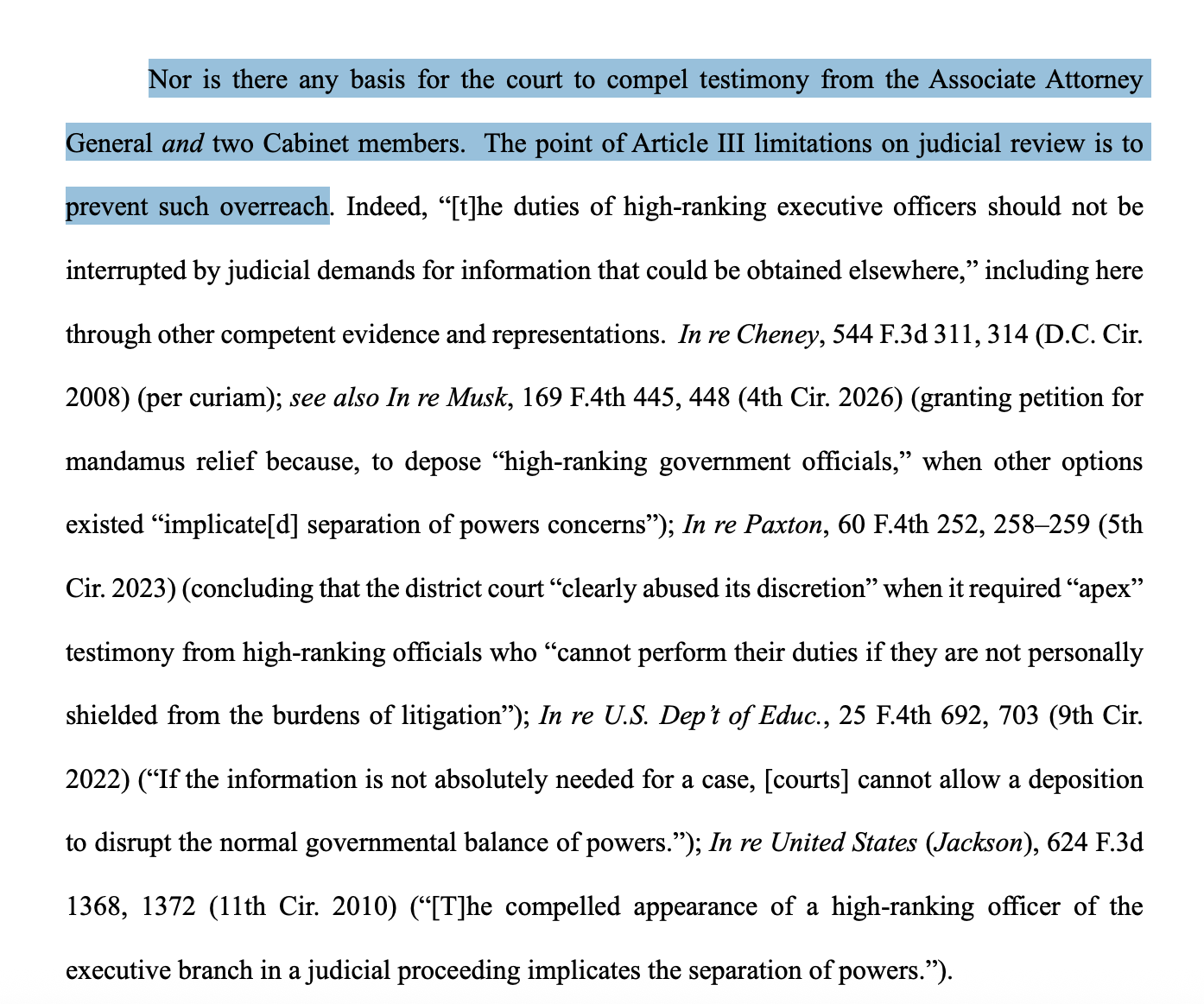
Unfortunately for Todd Blanche, who is one of two cabinet-level officials ordered to certify an end to the slush fund in writing, under oath, the Judge will get the last word on what suffices here. Her view may likely align with that of Rhode Island Senator Sheldon Whitehouse:


Bad Prosecutions in Minneapolis
The presumption of regularity, which used to be routinely employed by judges against meritless allegations of misconduct by federal agents and prosecutors, is not just a whisper from the past. The most recently surfaced allegations of misconduct are jaw-dropping. I don’t say that lightly in an era when so many instances could be characterized this way.
The New York Times reports that a protester in Minneapolis named Paul Johnson was arrested last January at an ICE protest. He was held incommunicado and shackled to his bed. Agents wouldn’t let him call his wife to tell her where he was, and he says when a nurse tried to bring a phone in, they wouldn’t let her. He finally used his foot to snag a land line, calling his wife and telling her to call a lawyer.
Johnson was charged with felony assault on agents. In a sworn affidavit, HSI Special Agent Richard Berger claimed that Johnson had threatened federal officers with a baseball bat and sprayed a Customs and Border Patrol vehicle with a chemical irritant. Berger stated that Johnson used that same spray on agents when they attempted to arrest him. Berger’s veracity came into question in other cases where he was the affiant.
On June 12, Johnson filed a motion to dismiss the prosecution against him “for outrageous government conduct and vindictive prosecution and for an evidentiary hearing.”
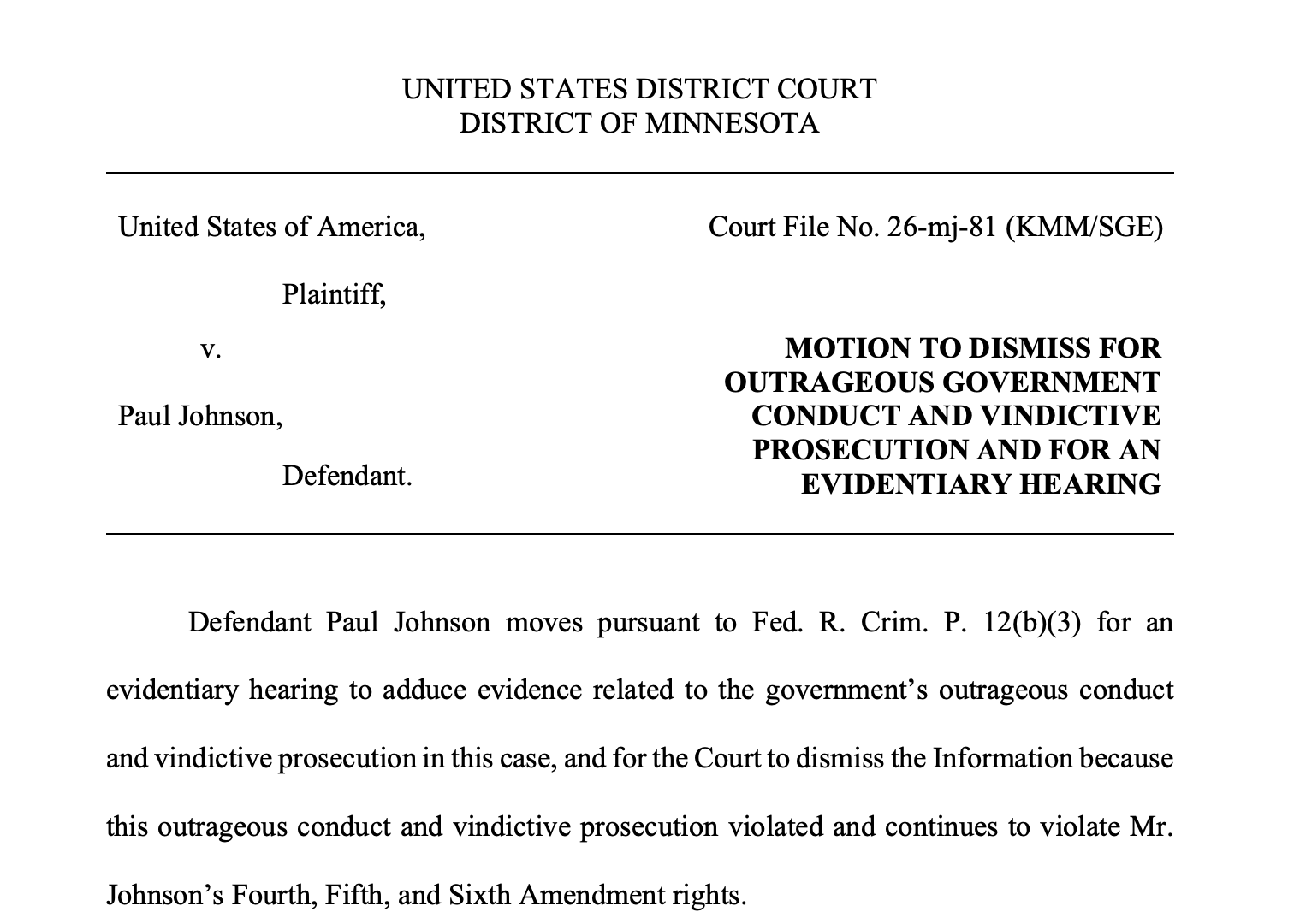
Johnson alleged agents violated his Fourth Amendment rights when they first stopped him, subsequently assaulted and permanently injured him, held him in the hospital without access to counsel in violation of the Fifth and Sixth Amendments, and perp walked him after his release from the hospital in violation of the Fifth Amendment. Six days later, “federal prosecutors suddenly moved to dismiss the charges he faced of assaulting federal officers during the protest. In a one-page filing in Federal District Court in Minneapolis, the prosecutors also said they would investigate the allegations of misconduct he had raised.”
These cold written words seem wholly inadequate to convey how outrageous the government’s conduct is here. Charges of assaulting agents are serious, and the idea that they would suddenly be dismissed without explanation is exceptionally unusual. When he was charged, prosecutors alleged Johnson “approached ICE agents with a baseball bat” and “later sprayed them with a chemical irritant.” If the evidence backed that up, there would be no reason to reduce the charges to a misdemeanor, let alone dismiss them.
Johnson’s lawyer told the Times that “almost half of the 36 cases filed in Minnesota accusing protesters of assaulting agents during Operation Metro Surge have been dismissed in the past few months.” It’s not just Minneapolis of course. In Chicago, prosecutors were forced to dismiss charges against defendants accused of interfering with ICE agents at the Broadview facility after Judge April Perry discovered shocking grand jury violations that led her to accuse U.S. Attorney Andrew Boutrous of violating the court’s trust.
To put this into context, just one case where a case was brought on the basis of bad evidence would have led to major internal investigations in any other administration. A whole slew of them points to a broken system. The Times points out that, “Some have pointed out that accusations made in criminal complaints were later contradicted by video footage.” In other words, there is no question that agents knowingly used false information to arrest and charge defendants. If this happened just once, agents involved would lose their jobs. Their supervisors as well as prosecutors who charged a case in this situation would, at a minimum, be reprimanded for negligence. But now, this abuse of the public trust is a regular occurrence.
Todd Blanche has a lot to answer for already in his brief tenure. These abuses are among the most shocking. The government may have dismissed the case in hopes its problems would go away, but that seems unlikely here. Look for the judge in this case to ask the government for an explanation, or for the defendant to begin proceedings against the government, or both.
After so many years of Trump getting away with it, it’s nice to see the courts no longer bending over backward to confer dignity on the presidency while Trump makes a mockery of the office.
Wednesday will be the anniversary of the Dobbs decision, which stripped women of their right to access reproductive health care. Protecting women’s rights is most definitely not on the table for this administration. We have to continue to fight for a seat at it. Speaking of which, on Friday, Leon Black testifies before the House Oversight Committee about his financial dealings with Jeffrey Epstein. That matter is far from over.
These headlines are all moving fast, but the real stories are buried in court filings, hearing transcripts, and the details that don’t usually make it into news alerts. That’s why we go into them here. It’s the work we do together: following the facts, reading the documents, and analyzing them in light of my 25 years of experience at DOJ as both a line prosecutor and a political appointee during the Obama administration. Paid subscribers help to make that possible, and as a result of that support, we’ve built a community committed to understanding what’s happening, not just reacting to it. Thank you for being a part of that.
We’re in this together,
Joyce
Bravo, Joyce. Thanks again for lifting the veil this criminal administration uses in attempts to mask their illegal activity. Here's to Monday, as trump has already torpedoed the initial Iran talks because he has no one to take his computer or phone away from him. I wish someone would designate his daily/nightly keeper to give trump a strong sleeping pill to keep him from shit-posting about world events where he flip flops on decisions already made. He's OUR worst enemy, not the Iranians! I yield back my time.
Thank you, Joyce, for staying on top of these cases. You are right; they don't make it to the news. Your analysis gives me hope!