
The Week Ahead
February 8, 2026

It’s another long Sunday Night Version of the newsletter, but there’s a lot going on. Stick it out to the bottom so you can read about what our Olympic athletes are doing and feel proud. Here’s what you need to know, heading into the week:
Monday morning, Ghislaine Maxwell is scheduled to appear virtually before the House Oversight Committee, chaired by Kentucky Republican James Comer, as part of the Committee’s investigation into Jeffrey Epstein. Her lawyers have send she will assert her Fifth Amendment rights and decline to testify.
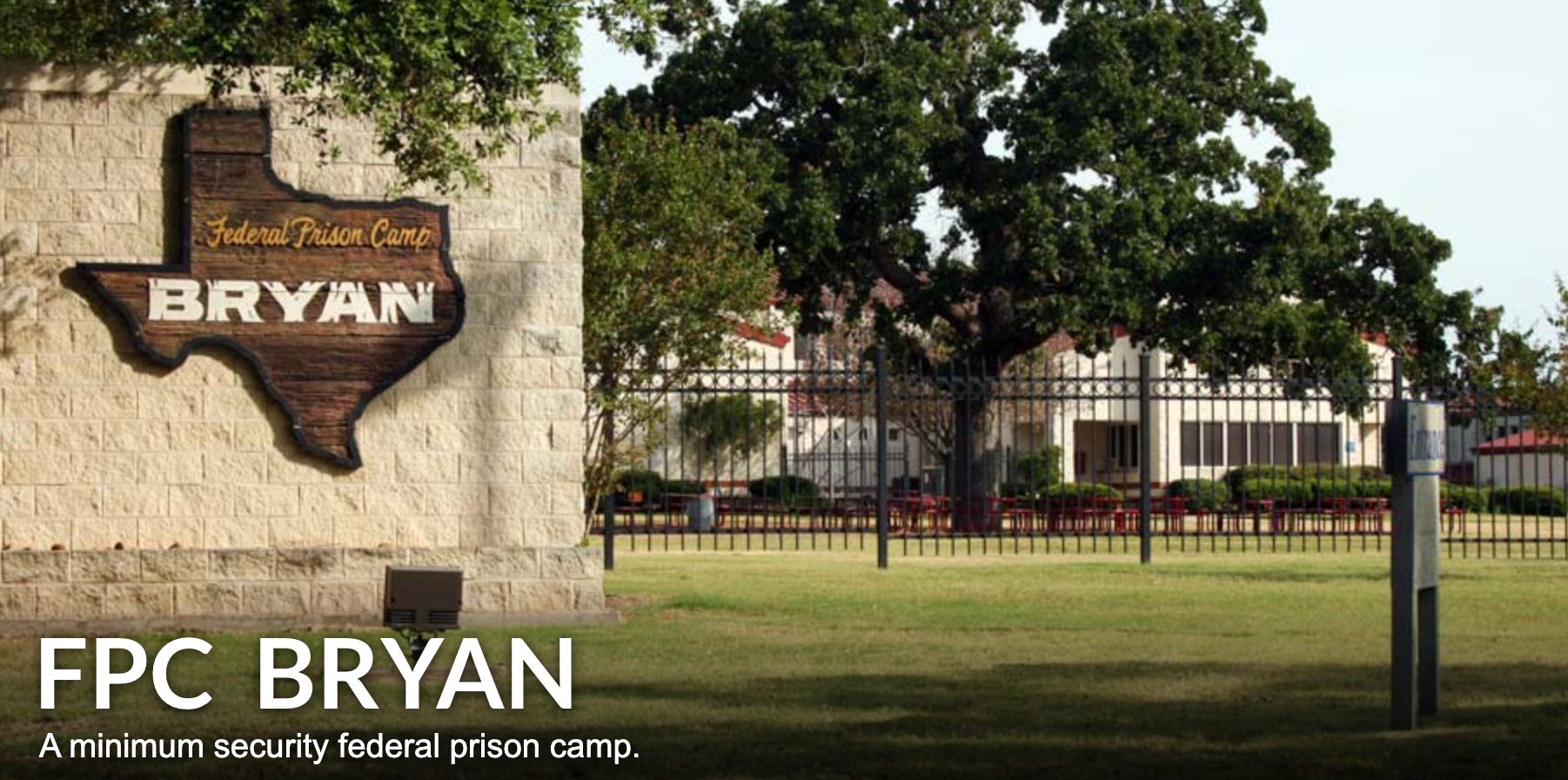
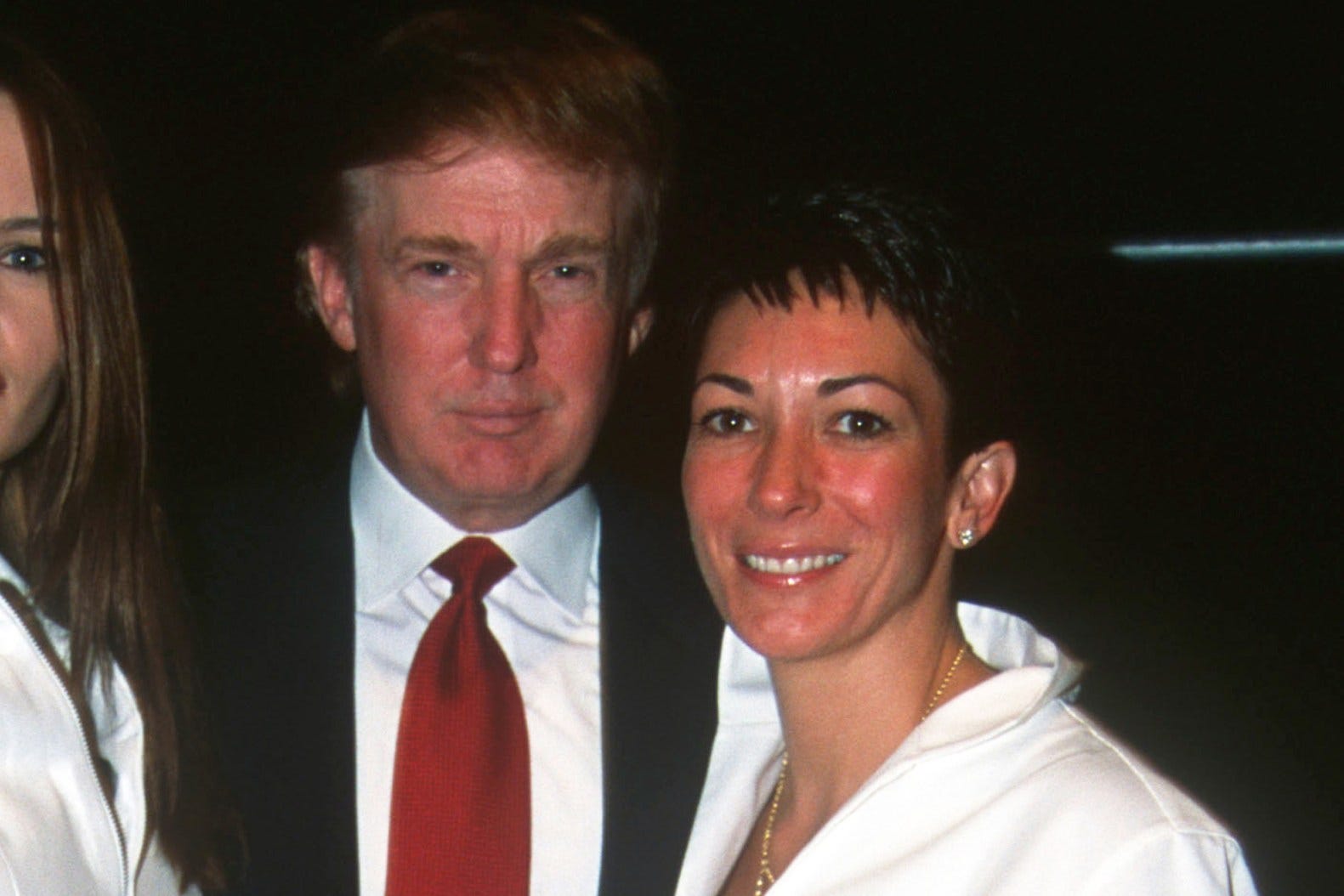
Maxwell is housed in Federal Prison Camp (FPC) Bryan in Texas, after a controversial transfer that conflicted with longstanding rules regarding treatment of convicted sex offenders. It’s a minimum security facility that houses 621 female inmates. Following a report last August that she would not be permitted to participate in a service dog training program at Bryan—“We do not allow anyone whose crime involves abuse towards minors or animals — including any crime of a sexual nature,” to participate, the program’s CEO said—there was reporting she had a puppy with her after all, along with special meals and other perks. The transfer and privileges unfolded after Maxwell’s most unusual interview with Deputy Attorney General Todd Blanche, Donald Trump’s former criminal defense lawyer, in which Maxwell didn’t have a negative thing to say about the President.
Maxwell’s attorney advised the Committee she intends to “invoke her privilege against self-incrimination and decline to answer questions” tomorrow. There is also reporting that her lawyer says she will read a statement at the outset of her testimony, claiming a blanket invocation of the Fifth Amendment. Although technically, she should have to assert it in answer to each question, Congressional Committees have accepted this sort of move in other depositions. Her lawyer claims that invoking the privilege isn’t a tactic, but rather a “legal necessity,” because her appeals are not yet over.
Maxwell’s direct appeal was terminated when the Supreme Court declined to hear it last year. But she still has a habeas corpus petition, often referred to as a collateral appeal, that is pending. She filed it pro se—on her own, without a lawyer—which happens because there is no right to assistance of a lawyer for habeas, so the courts don’t foot the bill. Most issues get resolved on direct appeal, and it’s very rare for a habeas to succeed, but when a defendant has a solid issue, the appellate court will often ask a lawyer to take the case. That does not appear to have happened here.
Maxwell’s brief, filed in December, argues that “substantial new evidence has emerged from related civil actions, Government disclosures, investigative reports, and documents demonstrating constitutional violations that undermined the fairness of her proceedings.” Although I have not read every document in the Epstein files, I’ve seen nothing new suggesting her conviction was invalid, nor have I seen any reporting to that effect, which you’d expect would have happened if that were the case. Instead, document after document seems to confirm the jury’s verdict in her case.
Maxwell makes arguments about things like pretrial delay and juror misconduct, which have mostly been litigated and aren’t going to get any traction here. Any claims that could have been raised on the direct appeal but weren’t are waived at this stage, which means that Maxwell’s arguments have either been previously raised and rejected or she can no longer make them. So yes, technically she can take the Fifth. But it’s an awfully weak assertion.
California Democrat Ro Khanna, who is also on the Oversight committee, wrote a letter to Comer on Sunday pointing out that Maxwell’s position now “appears inconsistent with Ms. Maxwell’s prior conduct, as she did not invoke the Fifth Amendment when she previously met with Deputy Attorney General Todd Blanche to discuss substantially similar subject matter.” Khanna included a series of questions he wrote that he intends to ask Maxwell and asked for specific confirmation that she intended to assert the privilege as to each of them.
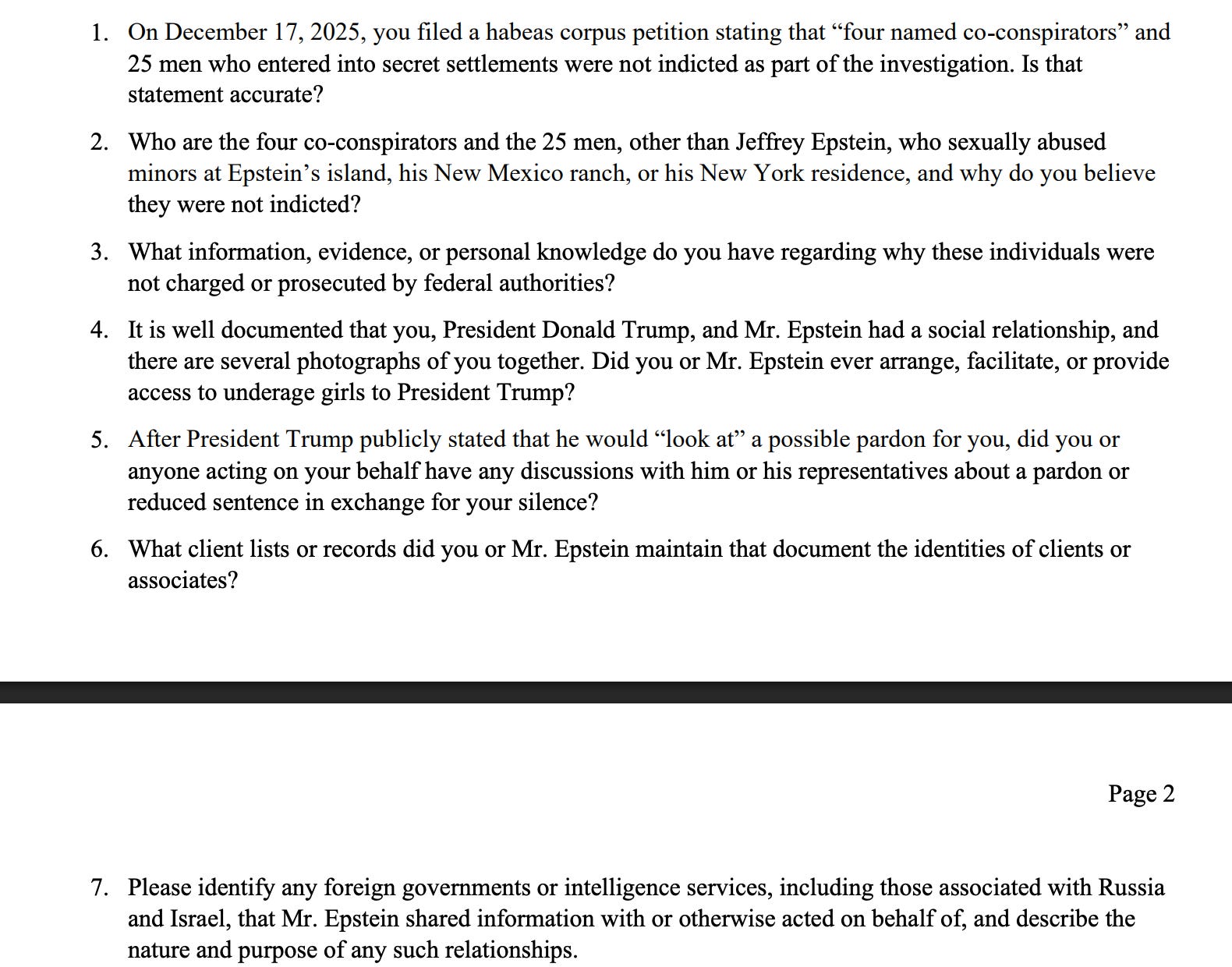
Khanna’s letter establishes how much information Maxwell has to offer, and should have had to offer the Deputy Attorney General, although he did not push her on any of these points, including co-conspirators who were not indicted, Trump’s relationship with Epstein, Epstein client lists, Epstein’s possible involvement with foreign governments, and her own negotiations for a pardon with her former friend who is now the President of the United States.
Although a series of 2019 emails between DOJ prosecutors working on the case, released by the Justice Department previously, reveal that 10 unnamed “co-conspirators” of Epstein and Maxwell were under investigation, none of them were ever charged. Deputy Attorney General Todd Blanche told CNN there was no evidence in the Epstein Files that supported additional charges.
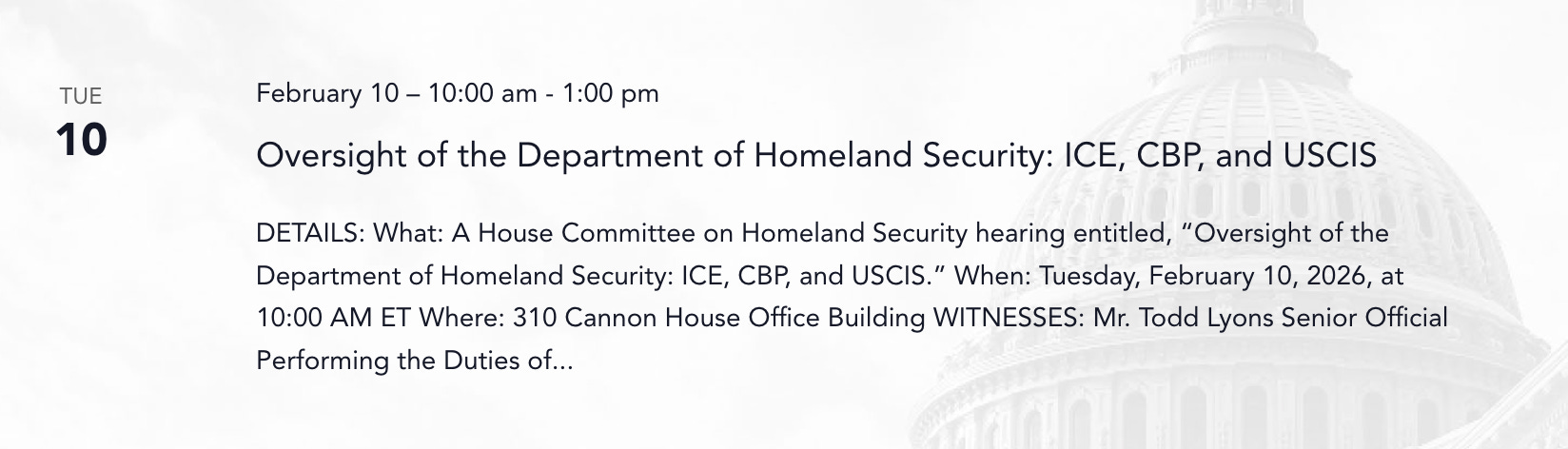
That’s Monday. On Tuesday, the House Homeland Security Committee has an oversight hearing set for ICE, Customs and Border Protection (CBP), and U.S. Citizenship and Immigration Service (USCIS). The three-hour hearing will involve testimony from Todd Lyons, the acting Director of ICE, Rodney Scott, the CBP Commissioner, and Joseph Edlow, the Director of USCIS. All of the agencies are a part of DHS, but Secretary Noem is not slated to testify along with the witnesses.
The Committee is chaired by Republican Andrew Garbarino from New York. He won with 60% of the vote in NY-02, a district that has leaned conservative in recent years. Democrats on the Committee include Mississippi’s Bennie Thompson, who co-chaired the January 6 Committee, Californian Eric Swalwell, New Yorker Dan Goldman, New Jersey’s Monica McIver (who the Trump administration indicted in connection with attempted oversight of an ICE facility), and Al Green from Texas. The hearing could get spicy.
Then on Wednesday, Attorney General Pam Bondi is scheduled to testify in a House Judiciary Committee oversight hearing. The Committee is chaired by Jim Jordan, from Ohio, who attended law school but never passed the bar exam. Maryland’s Jamie Raskin, a constitutional scholar, is the ranking member. All of the Committee members are listed here.
No Attorney General looks forward to going up Pennsylvania Avenue to the Hill to face congressional scrutiny. Pam Bondi, in particular, has a lot to answer for, and she will now have to do it under oath. The Department’s failure to investigate the deaths of Renee Good and Alex Pretti in Minneapolis and the multitude of other allegations of civil rights violations by agents executing Trump’s mass deportation plans is uppermost. But she should also be challenged on the gross incompetence that has been the hallmark of the Epstein Files release, which is still not in compliance with the Transparency Act Congress passed last year. At a minimum, she should be asked about the sudden removal of certain files after they’ve been uploaded, like a prosecution memo that was on the site yesterday but disappeared today. The Department has also redacted perpetrators’ identities, while victim information has been made public.
There are also obvious omissions in the public release. Virtually none of the communications between Bondi, Blanche, Top FBI leaders, and U.S. Attorney personnel are included, but there has obviously been a great deal of back and forth about items, like the release of the files themselves, that should have been included.
Julie Brown, the reporter who is largely responsible for putting Epstein on the public’s radar, made a critical point last night. She referenced emails in the Epstein files that included comments like, “There are little girls, they have good bodies…” Then she asked, “To all those people, including some in our own Government, trying to minimize what Epstein was doing by saying ‘it’s not a crime to party with Epstein’ — I ask, do these countless emails referring to little girls and people recruiting girls from all over the world not trouble you? Does it not seem relevant that Epstein and his associates referred to them as ‘girls’ and not ‘women’?” There can be no answer but yes for anyone who is being honest. (It was Deputy Attorney General Todd Blanche who made the “not a crime to party” comment.)
Norm Eisen and Jen Rubin asked me about how DOJ was handling the release when I joined them for Coffee with the Contrarians last week. My view is that at some point (and we are well past it), DOJ’s repeated mistakes start to look intentional. Click below to hear my analysis on that point.
This week, we have more of the Winter Olympics to look forward to. U.S. Olympic athletes are showing that they are true Americans with their words and deeds. “It’s a confusing time to be wearing the Stars and Stripes,” U.S. cross-country skier Ben Ogden said last Thursday. He acknowledged that there “are aspects of being American I’m not proud of.”
"For me it's obviously confusing," Zak Ketterson, a cross-country skier who grew up in the suburbs of Minneapolis said. "I'm not representing all those bad people, I'm representing all the good people.”
Figure skater Amber Glenn has spoken out about being the first openly queer figure skater on the U.S. women’s team. During a group interview last week, she said, “I hope I can use my platform and my voice throughout these Games to try and encourage people to stay strong in these hard times…I know that a lot of people say you’re just an athlete, like, stick to your job, shut up about politics, but politics affect us all. It is something that I will not just be quiet about because it is something that affects us in our everyday lives. So of course, there are things that I disagree with, but as a community, we are strong and we support each other.”
It would have been easy for these athletes to sidestep any controversy. Knowing there could be consequences from a temperamental, vindictive president, they chose to speak out nonetheless. Although it’s not unusual for DHS to have a presence at major international sporting events, the announcement that ICE would be there felt inflammatory. In the face of everything that is going on, the athletes’ bravery and courage are what’s called for right now.
Hopefully, it will be contagious for all of us. If you have a big platform, use it. If you have a little one, use it. If you can donate, do, and if you can volunteer, sign up. My heart is warmed every week by the stories Civil Discourse readers share about what they are doing to make a difference. I’m proud of our community. We are not sitting on the sidelines.
These are not times for people who don’t like anything that challenges their comfortable existence. The days of comfortable existence are over for anyone who’s paying attention.
We’re in this together,
Joyce
There must be lots of frantic men furious that their secrets are likely to be revealed, sooner or later: their sexual abuse of girls, their corrupt financial links with the Trump family, their profiting off the ICE and CPB terror campaigns, their support for anti-democratic right-wing extremist groups, and more. Perhaps secrets explain why many institutional leaders are eager to cave to the regime.
In the meantime, the rest of us must do as Joyce repeatedly urges: get active, stay in the fight, be part of a larger democracy community, locally or nationally. Find good people to run for office, perhaps run for office yourself. There are more of us than them. We can do this.
When public opinion is STRONG, Trump knows he has to back down. It's time to call Congress (202 224 3121) and the White House (202 456 1414) about ICE reform. The next 10 days are critical. Read about the 10 Democratic proposals to curb ICE.
https://kathleenweber.substack.com/p/the-most-important-thing-you-can