
The Week Ahead
August 2, 2026

The most important issue we’ll be following this week involves our ability to exercise our right to vote. We know it’s under fire from the Trump administration. This is going to be a key moment.
Last Monday, the Solicitor General asked the Supreme Court to let the Trump administration implement Trump’s executive order that would allow, among other things, federal control over who can and can’t receive a ballot in the mail. A district judge in Massachusetts enjoined the EO from going into effect for now. The Solicitor General is asking the Supreme Court to stay that injunction, which would permit the Trump administration to move forward with the EO while the cases challenging it move through the courts.
So, here we are again on the Court’s shadow docket.
On Tuesday, 12 states added their voices to the administration’s request in an application to SCOTUS of their own. Alabama, Florida, Indiana, Kansas, Louisiana, Missouri, Montana, Nebraska, Oklahoma, South Carolina, South Dakota, and Texas join the Trump administration.
A response is due from the states that oppose the EO by 4 p.m. ET on Monday. They are: California, Massachusetts, Nevada, Washington, Arizona, Colorado, Connecticut, Delaware, the District of Columbia, Illinois, Maine, Maryland, Michigan, Minnesota, New Jersey, New Mexico, New York, North Carolina, Oregon, Rhode Island, Vermont, Virginia, Wisconsin, and Pennsylvania (through its governor, Josh Shapiro). The formal issue before the Court is whether it should stay the lower court’s injunction barring federal agencies from fully implementing Trump’s executive order on mail-in voting.
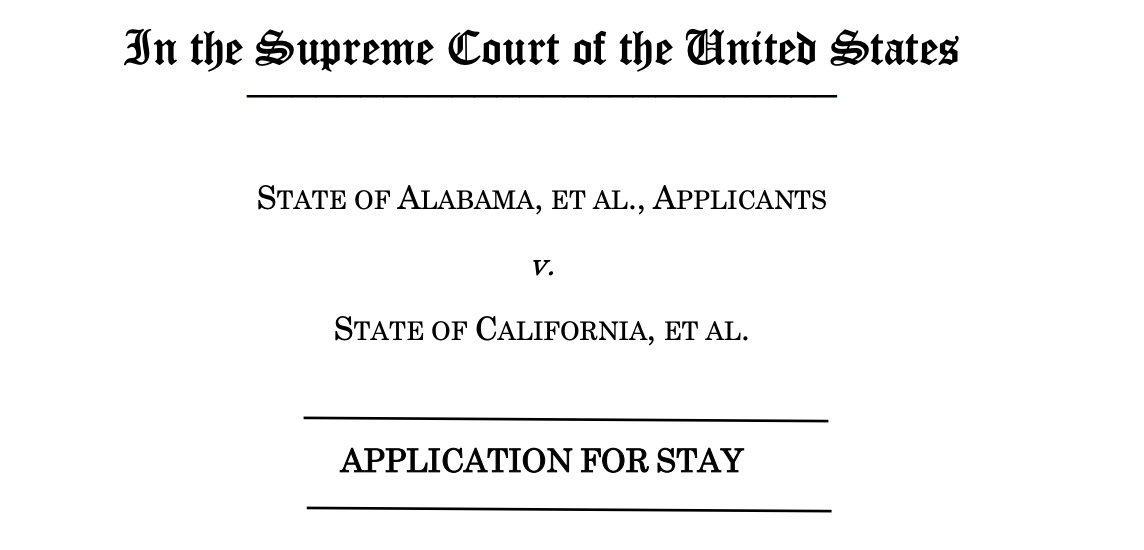
One important issue when a party seeks an injunction, like the blue states did in the lower court, is showing the irreparable injury is imminent without one. Here that was challenging. The EO was in place, but the question was whether the federal government was taking sufficiently malicious steps towards implementing it to merit an injunction. Not what might happen in the future, but what was happening now. So the administration, and the red states, present everything in the most benign terms possible and the government has made careful efforts to hold off on steps that would clearly trigger court action for now. The concern is that they will act as we get closer to the midterm elections, that they are preparing now to take steps, perhaps too close to the election for state AGs and the courts to effectively counter them. Illustratively, the red states start their brief in support of the Trump administration like this:
“The District Court issued a bizarre injunction prohibiting federal agencies from implementing Executive Order No. 14399, Ensuring Citizenship Verification and Integrity in Federal Elections … The EO imposes no direct obligations on States or the public—but merely instructs federal agencies to consider potential reforms furthering the President’s policy goal of bolstering election integrity. Nevertheless, the District Court enjoined the EO based on rampant speculation about potential future federal policies that continue to evolve before they are finalized and put into effect.”
Here is the outline of the argument the red states are making in support of a Trump takeover of their constitutional authority. The EO would effectively divest them of control over who can and can’t vote in their elections, a power clearly reserved by the Constitution to the states. If the Court goes along, it could become a dangerous precedent and a slippery slope. But the red states don’t seem concerned. The troubling question is, where will the Supreme Court land? Will it yet again contort itself with some sort of pretzel logic to transfer still more power to Donald Trump, setting a precedent that gives the man who proved himself unworthy on January 6 a legal peg for exercising control over election outcomes and eligible citizens’ ability to exercise their right to vote?
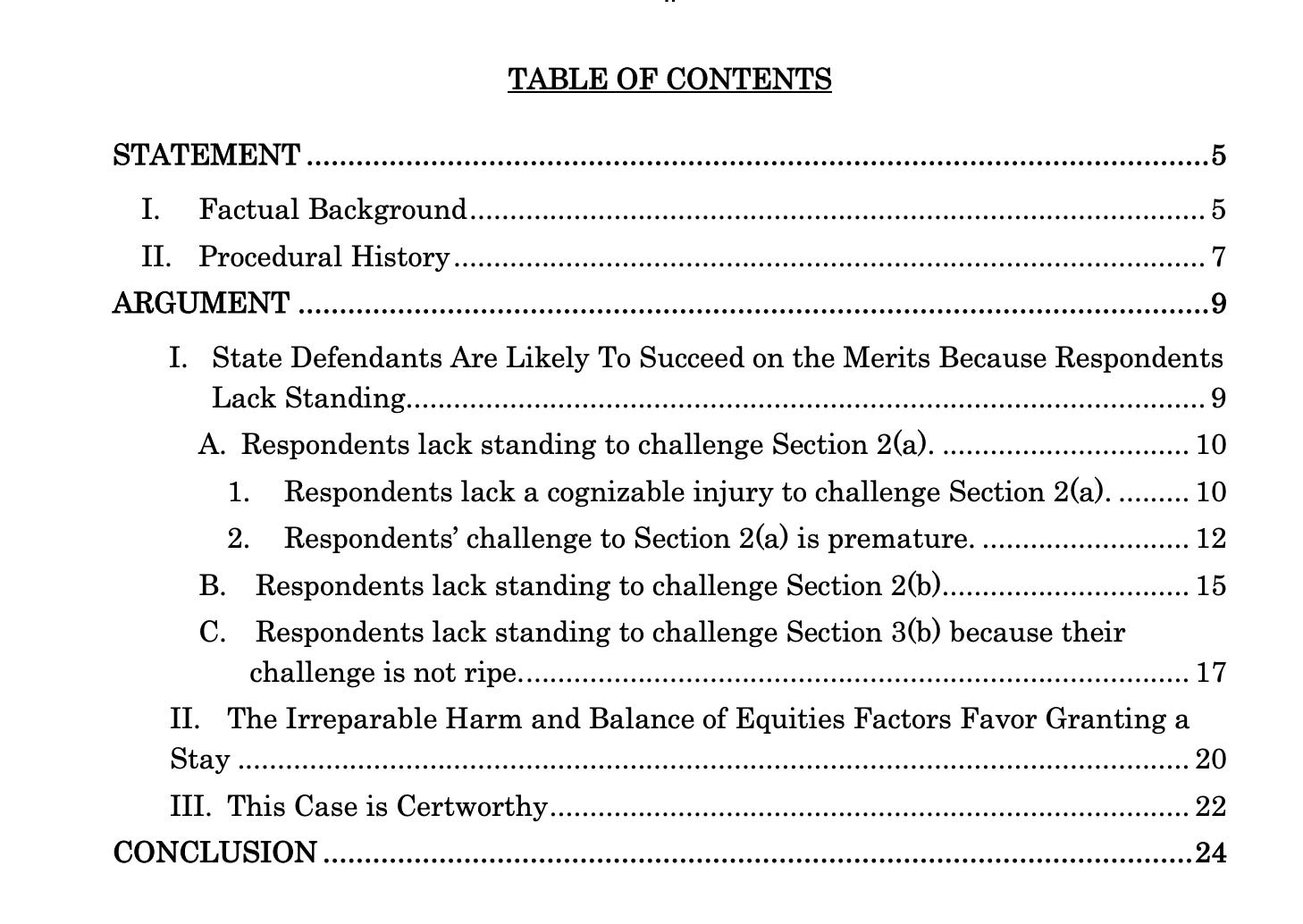
The red states make the case that the administration hasn’t taken sufficient steps toward implementing three provisions for the courts to enjoin the EO:
“Section 2(a), which instructs federal agencies to consider whether and how to create lists of voting-age-eligible citizens in each State—and to transmit these lists to each State, which would retain the option whether to use them…The District Court speculated that these lists will be inaccurate and potentially cause States to remove eligible voters from the registration rolls…But at the time Respondents sued, important details about the policy were not set…That is true even now; for example, the parties still do not know which databases federal agencies will use, whether those databases will be inaccurate, and whether and how each individual State would use the lists.”
“Section 2(b) directs the Attorney General to ‘prioritize the investigation’ and ‘prosecution of State and local officials or any others involved in the administration of Federal elections who issue Federal ballots to individuals not eligible to vote in a Federal election.’ In other words, it simply prioritizes the enforcement of longstanding federal election laws…they [the opposing states] cannot show any actual or imminent injury from the enforcement of unchallenged election laws—especially given that Respondents do not allege any intent to violate any election statute or that any individual has been investigated or prosecuted pursuant to the EO.”
Section 3(b) directs “the U.S. Postal Service (USPS) to engage in rulemaking on potential reforms designed to strengthen the security of mail-in voting…the proposed rule does not ‘grant[] federal agencies decisive control of th[e] [USPS] list, preventing States from ensuring accuracy.’… On the contrary, the proposed rule provides that ‘states’—not USPS or any agency of the federal government—’would retain full control over who would (or would not) be able to vote by mail in federal elections within each state, as states would control enrollment with the Postal Service for inclusion on the state’s Mail-In and Absentee Participation List.’…Even now, the parties are jousting over potential policies in a proposed rule— and it is black-letter law that challenges to proposed rules are not ripe.”
So, it’s essentially a shell game involving timing. As the red states write, “only after USPS finalizes its rule can Respondents challenge it, because only then will they actually know what they are challenging.” And here’s the contortion of the law: “the federal government is irreparably harmed when courts do not give it a chance to lawfully implement the President’s policy agenda.” Never mind that since the Trump administration controls the timing, they call delay for just long enough to strike when it’s too late for blue states’ attorneys general to do anything about it and voters are disenfranchised.
All of that to say, the red states are acting like willing lambs heading to the slaughter, perhaps incentivized by the prospect that Trump’s EO will make it more difficult for people they believe will vote Democratic or at least against the administration this go-round to exercise their right to vote. There is, of course, the prospect that Americans will be so outraged by the transparent effort to circumvent their right to choose their officials that they will flock to the polls in record numbers to, as they say, vote the bums out. But even if that blue wave materializes, voting is a right, not a privilege, and we shouldn’t have to work as hard as we are about to in order to decide who our elected officials will be.
There is superficial legalistic appeal in the argument that it’s premature for the courts to enjoin the EO before rules are more firmly in place. That’s what the Trump administration is counting on at the Supreme Court, which has often put on blinders when it comes to Trump. Because although they will argue this as an issue of presidential power, it’s clearly about one man, the only president in history to try and override the will of the voters and interfere with the transfer of power. There is one additional issue the Court might use to permit the administration to move forward without explicitly ruling that it can: the administration has challenged the standing of blue state attorneys general to challenge the EO, a question that the D.C. Circuit and the First Circuit Courts of Appeals have split on, so the Court could take the easy way out and dismiss based on standing.
Incidentally, last week, Gallup released its most recent polling on the Supreme Court’s favorability with the public: “Americans' approval of the job the U.S. Supreme Court is doing has fallen to a record low of 33%, driven by a steep drop in Republicans’ backing of the court since last year. The prior low approval rating was 39% measured a year ago.” Data released by Pew last week showed that “[t]he court’s favorable rating is 20 percentage points lower today than in April 2021, when 65% of Americans held a positive view.”
However the Court rules, the fact that we are even here is the ultimate criticism of this administration. Under the Constitution, the choice of elected officials belongs to the people. Donald Trump is deathly afraid of what that means. Efforts to circumvent the vote are inherently undemocratic and this shouldn’t be treated like just another routine court case. The EO is not business as usual, and we should not treat it as though it is. It is a maneuver designed to wrest control from the people and place it in the hands of Trump and the privileged few powerful conservatives and wealthy oligarchs who have slid into (or written checks into) his favor, in hopes of controlling our future. Truth to power: Let’s call this what it is. It’s not just another case on the Supreme Court’s shadow docket. It is so much more than that. We’ll be watching carefully to see what comes next.
We’re in this together,
Joyce
I admire and respect you so much, Joyce. I’m glad you’re in our corner.
In Alabama if you have a disability and cannot stand for long periods of time you’re allowed to go to the front of the line. Tell a poll worker and go to the front of the line, not sure about your states.