
The Week Ahead

Happy almost New Year! I’ve already got a bottle of champagne cooling in the fridge. But before we get there, a little news and analysis.
National Guard Ruling
The Supreme Court weighed in on a National Guard case last week, and not in Trump’s favor. The Court’s unsigned three-page order keeps in place a district judge’s decision that the Trump administration may not deploy Illinois National Guard troops while the litigation proceeds.
But before you get too excited about that, this is still the same Supreme Court. And as I’ve repeatedly suggested, these cases were a logical place for them to draw a line in the sand, because Trump has been arguing the courts have no ability to review his decisions about when federalizing and deploying the Guard was appropriate. In other words, ruling in Trump’s favor here would make the courts irrelevant. The Court wasn’t ready to let Trump go quite that far, at least for now. They get there, however, in an interesting fashion, writing that “We need not and do not address the reviewability of findings made by the President under §12406(3) or any other statute,” because of an interesting legal argument that they apply.
The decision was 6-3, with Justice Gorsuch joining Justices Alito and Thomas in dissent. The decision reads, “At this preliminary stage, the Government has failed to identify a source of authority that would allow the military to execute the laws in Illinois.” The statute Trump used, §12406(3), permits him to act when “the President is unable with the regular forces to execute the laws of the United States.”
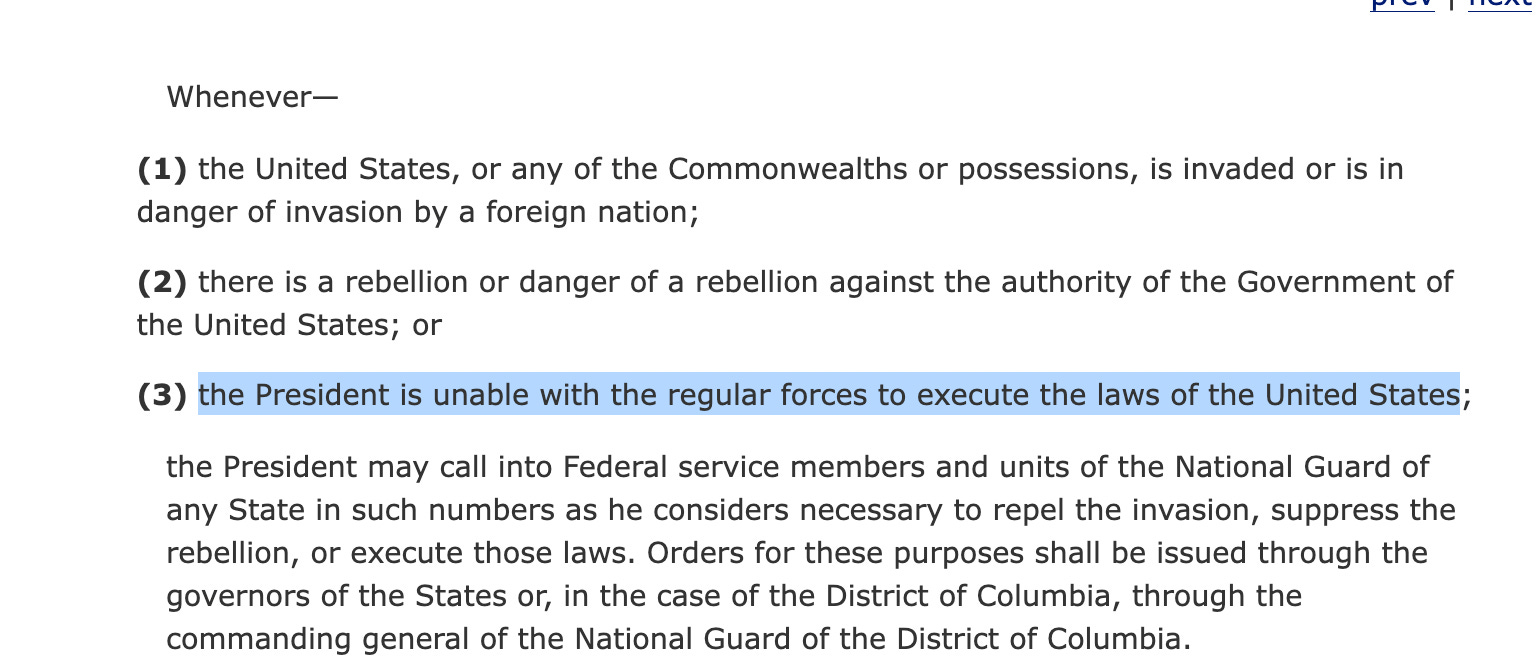
The Court asked the parties to brief the issue of what the term “regular forces” means. They explain in their decision:
“the Government argues that the term refers to civilian law enforcement officers, such as those employed by Immigration and Customs Enforcement or the Federal Protective Service. Respondents, echoing the District Court, maintain that the term refers to the regular forces of the United States military. We conclude that the term “regular forces” in §12406(3) likely refers to the regular forces of the United States military.”
“This interpretation means that to call the Guard into active federal service under §12406(3), the President must be ‘unable’ with the regular military ‘to execute the laws of the United States.’ Because the statute requires an assessment of the military’s ability to execute the laws, it likely applies only where the military could legally execute the laws. Such circumstances are exceptional: Under the Posse Comitatus Act, the military is prohibited from ‘execut[ing] the laws’ ‘except in cases and under circumstances expressly authorized by the Constitution or Act of Congress.’ … So before the President can federalize the Guard under §12406(3), he likely must have statutory or constitutional authority to execute the laws with the regular military and must be ‘unable’ with those forces to perform that function.”
“The President has not invoked a statute that provides an exception to the Posse Comitatus Act. Instead, he relies on inherent constitutional authority that, according to the Government, allows him to use the military to protect federal personnel and property. The Government has not carried its burden to show that §12406(3) permits the President to federalize the Guard in the exercise of inherent authority to protect federal personnel and property in Illinois.”
One concern after this decision is that Trump, who so far has not tried to use the Insurrection Act to militarize American streets, may decide to attempt it. Whether he can do that is a complicated question involving the Posse Comitatus Act and exceptions to it, like the Insurrection Act. In his concurring opinion, Justice Kavanaugh wrote that “the court’s opinion does not address the president’s authority under the Insurrection Act.” Although he sided with the majority here, his comment, “one apparent ramification of the court’s opinion is that it could cause the president to use the U.S. military more than the National Guard to protect federal personnel and property in the United States,” reads like an attempt to straddle the political divide here.
Take the win for now. It keeps the president in check, at least for the time being.
Abrego Garcia
On December 23, the judge presiding over the criminal case against Kilmar Abrego Garcia issued a ruling under seal. It’s scheduled to become public on December 30. The ruling came from federal District Judge Waverly D. Crenshaw, Jr. in the Middle District of Tennessee. Judge Crenshaw is overseeing the government’s criminal case against Abrego Garcia, which we discussed here (and also the fact that the longtime criminal chief in the U.S. Attorney’s office resigned when it was indicted, here).
The timing and the nature of the case have given rise to serious concerns, credited by the court, that it could be a vindictive prosecution. If the evidence that the defendant is now entitled to discover from the government bears that out, it could lead to dismissal of the charges. In context, it makes sense. This has the appearance of a prosecution meant to mollify the president after the administration was forced to return the Abrego Garcia to the U.S. from CECOT prison in El Salvador, despite lots of tough talk about how he would never set foot on US soil again. The U.S. Attorney has said he made an independent decision to indict based on the evidence.
Whether the vindictive prosecution issue might be involved in the sealed order isn’t clear, but last week, Judge Crenshaw canceled the previously scheduled trial in the case, instead setting a hearing on the vindictive prosecution motion for January 28. The criminal case is based on a 2022 traffic stop. There were nine people in the car when Abrego Garcia, the driver, was pulled over, but he was permitted to leave at the time with only a warning. No case was ever pursued. Previously, a DHS agent testified he only began investigating the matter as a criminal case after the government was forced to bring Abrego Garcia back to the U.S.
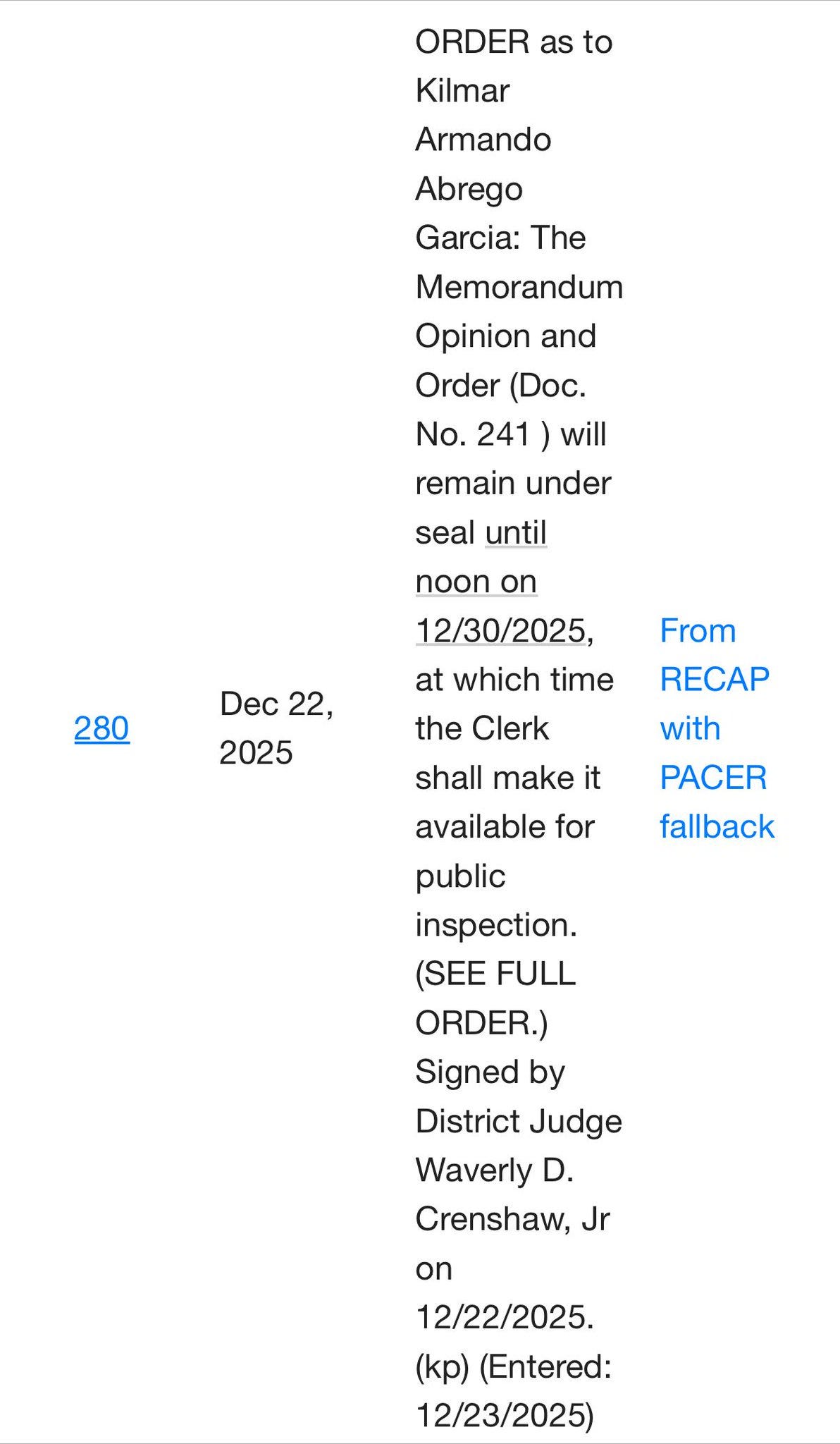
The Judge’s decision to hold a hearing on the vindictiveness motion came in a decision on the government’s motion to quash subpoenas the defendant’s attorneys issued for testimony from Deputy Attorney General Todd Blanche and others in his office on that question. The Judge denied the motion and scheduled the hearing. DOJ is likely to fight tooth and nail to keep its senior leaders from testifying under oath, but under the circumstances, the Judge may well have them boxed.
Epstein
Later this week, DOJ owes Congress an explanation of its compliance (some would say lack thereof) with the Epstein Files Transparency Act. That should be interesting, since DOJ has made no pretense that it complied with the deadline for release, which it treated more like a starting gate than a finish line.
Add to that the fact that the redactions appear to be protecting people involved with Epstein, potentially including individuals who were involved in criminal conduct or in aiding and abetting it. As Republican Representative Thomas Massie points out, that’s a still more serious violation of the Act.


The ball will be in Congress’ court after this to decide whether and how to enforce the law it passed. There has been talk of using inherent contempt, a measure that hasn’t been successfully employed since the 1930s, but which would allow the House, without any contribution from the Senate, to issue daily fines against Attorney General Pam Bondi for as long as DOJ remains noncompliant.
I’m so tired of this guy
Looking ahead to 2026, the year democracy strikes back.
We’re in this together,
Joyce
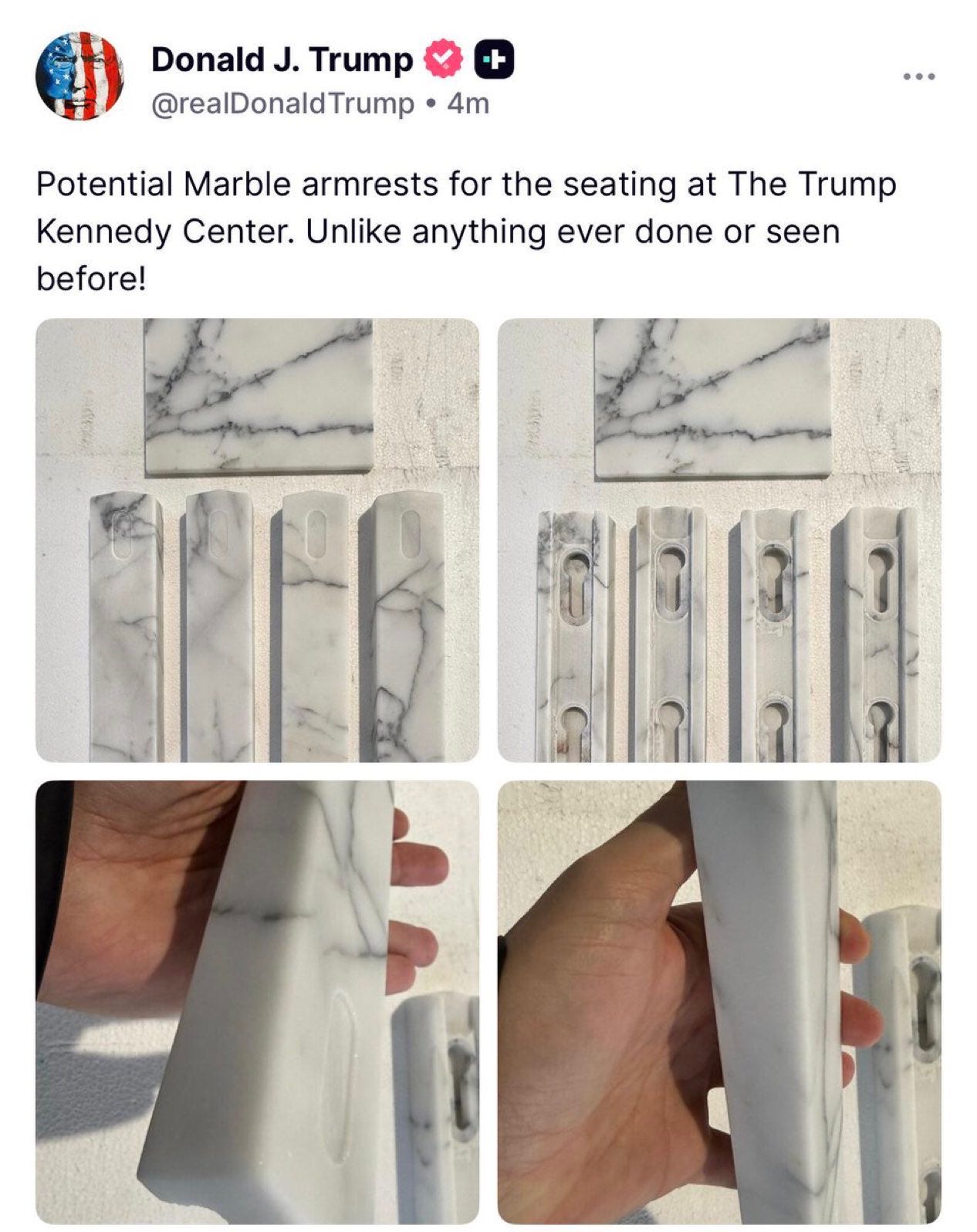
Since Trump is losing his marbles, he has to find marble somewhere.
I’m tired of him, too, but we can’t let him wear us down.