
The Week Ahead
August 16, 2026

Here are the stories we’ll be tracking this week:
Patel’s Defamation Suit
The Judge in Kash Patel’s defamation lawsuit against The Atlantic has given the FBI Director a Monday deadline to respond to the magazine’s motion to dismiss the case. Patel’s lawsuit against them stems from an article titled “The FBI director is MIA.” The Atlantic has said it stands by its reporting. The story characterizes Patel as an incompetent drunk who is jeopardizing national security. We’ll be tracking Patel’s responsive pleading when he files it. We went through the complaint back in April, if you want a refresher.
Ballroom or Military Complex?
Last night I flagged that the Solicitor General is appealing the D.C. Circuit’s 2-1 decision halting construction on Trump’s ballroom. The Circuit Court stayed its order to give the high court 14 days to decide whether it should go into effect.
The Washington Post is reporting Trump now plans to put gold seating in the space. Because why not when you’re playing with house money, I guess. The government says the facility is 65% complete and that means it’s too late for any court to stop it. Perhaps they don’t understand what a judicial order telling the government to stop construction means? Here’s hoping the Supreme Court will make it stick.
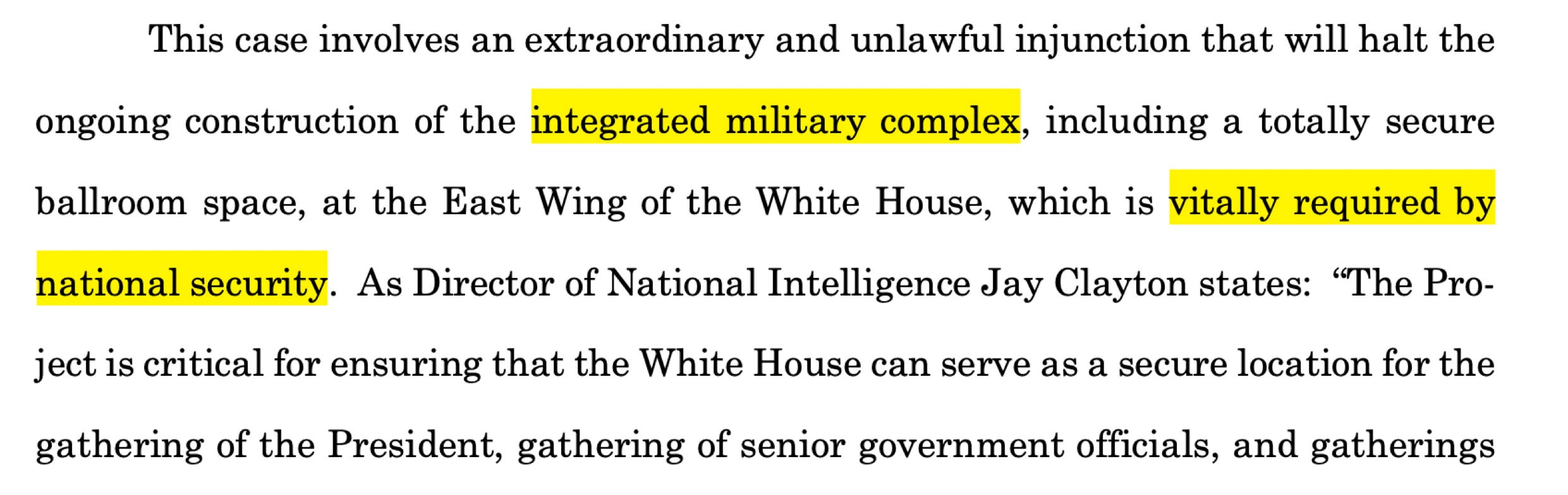
The focus in the government’s most recent submission to the Court is on the facility as an “integrated military complex.” The government claims that “This case involves an extraordinary and unlawful injunction that will halt the ongoing construction of the integrated military complex, including a totally secure ballroom space, at the East Wing of the White House, which is vitally required by national security.” That characterization feels disingenuous given Trump’s long-term obsessions with building a ballroom, claiming Americans want it. As The Wall Street Journal put it today, “President Trump’s vision for a White House ballroom stretches back more than a decade. His argument that it is ‘vital to our national security,’ which culminated Friday in an appeal to the Supreme Court, is far more recent.” As his chief of staff, Susie Wiles, put it last year when the project was first announced, “The President and the Trump White House are fully committed to working with the appropriate organizations to preserving the special history of the White House while building a beautiful ballroom that can be enjoyed by future Administrations and generations of Americans to come."
Courts considering the matter have always ruled that national security-related construction is not included in injunctions against building. In other words, legitimate work, already funded by Congress, can proceed.
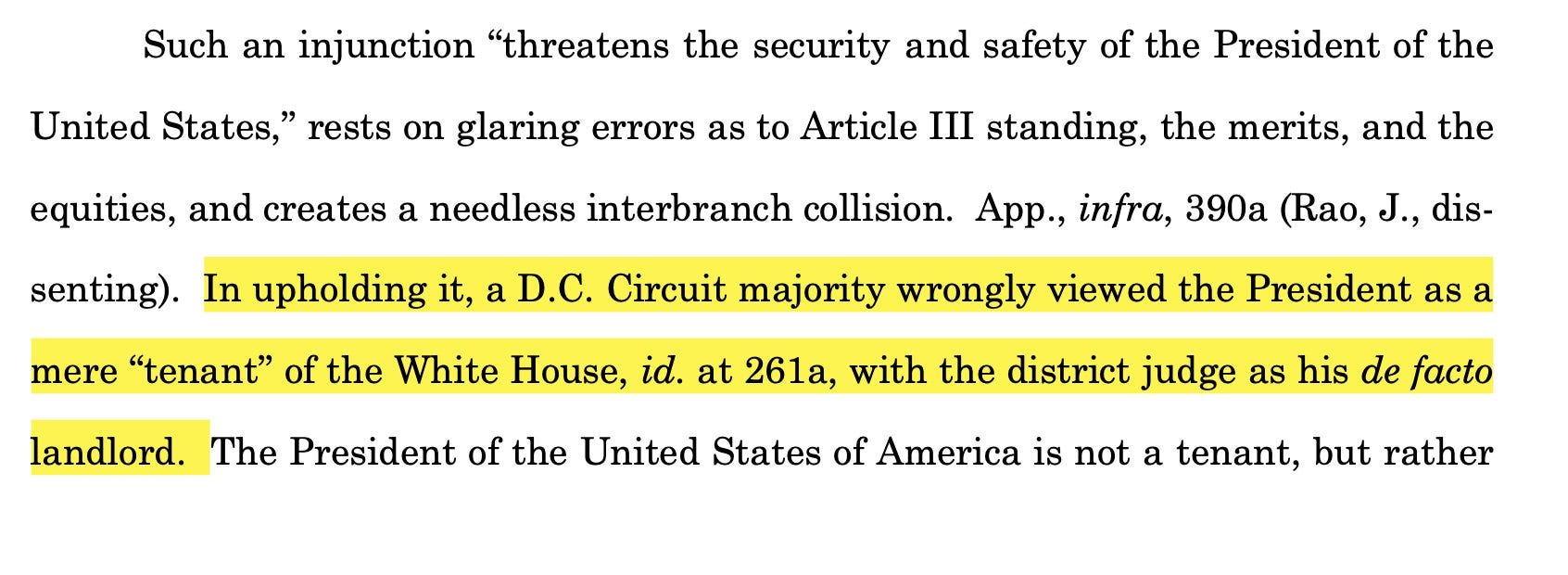
The Solicitor General takes issue with the court’s characterization of Trump as a “mere ‘tenant’” of the White House. That ties up neatly with Steve Bannon’s promise to find a way for Trump to run for and serve a third term, but is inconsistent with the law and the Constitution, which one hopes the conservative majority on the Supreme Court still believes in. Believe them when they tell you who they are. I recall people laughing at the suggestion Trump was serious when he refused to commit to accepting the results of the 2020 election if he lost, only to live through the horror of January 6, 2021. The threat here is no less serious, and perhaps more so, given Trump will undoubtedly face consequences and accountability for his personal conduct during his second term after leaving office, especially under an administration that isn’t interested in currying favor with him.
This is all happening as Trump dismisses military concerns over conditions on the over-deployed USS Abraham Lincoln. Senator Richard Blumenthal says they include “shortages of basic supplies, water contamination, plumbing issues, deteriorating mental health, deck safety concerns, and disruptions in the mail system.” Other concerns include being at sea for months with broken toilets and being served undercooked chicken. But when Trump was asked about whether the families, who have brought the situation to light, were concerned, his flippant response to a reporter was “No, they're not.” There are also reports of unsanitary conditions at other military facilities, like the filthy showers reported on here. Apparently, when spending money, more gilt and glitz at the White House is the priority, not the health and well-being of Americans serving in the military.
It’s likely the Court will act (or, still better, decline to act and let the stay on further construction go into effect) this week, so we will be watching closely.
Trump’s Administration Rolls Back Protection Against Financial Crimes
Using the excuse that it is too burdensome for small businesses to file a form that takes about five minutes to fill out once a year, the Trump administration has shut down, and authorized destruction of, a database used by federal, state, and tribal prosecutors to track down who is behind illegal conduct committed by shell corporations. The Financial Crimes Enforcement Network (FinCEN) database in question was designed for tracking the people behind the shells, the humans—called “beneficial owners”—of private corporate entities like shell companies and LLCs that may have legitimate business purposes, but other times, are used to anonymously conduct crime. Michael Cohen used one to pay off Stormy Daniels.
The government published the final rule in the Federal Register on Friday (proving that they know how to get something into the Federal Register quickly when they want to, even though the DOJ representative in Court on Katie Phang’s lawsuit was unable to provide the Judge with a timeline for publishing information about required redaction in court last week) after proposing it in March. The urgent question for this week is who has standing to sue.
It’s likely we’ll see some combination of state AGs and tribal authorities enter the fray, because they have access to the database of beneficial owners, along with their federal counterparts, and will now be denied it. That should give them standing to sue. Until now, they could ask Treasury for information about actual owners if they ran into shell companies during an investigation. The first order of legal business will be getting an injunction in place to prevent/stop destruction of the database, which could already be underway.
Even if non-federal users are able to step in and obtain an injunction, Congress should take steps to shore up the database as quickly as possible. When it was passed in 2021, it enjoyed bipartisan support and went into effect over Trump’s veto. Marco Rubio proposed the legislation during his time as a Florida Senator. “My ‘Corporate Transparency Act’, the most significant anti-corruption & money laundering law in decades & which forces anonymous shell companies to disclose their true owners is going to pass as part of the end of year defense bill,” Rubio wrote on Twitter in December 2020.
Who wants to end efforts to fight back against crime and corruption? Who is pro-money laundering? It’s shocking that an American president would do this and still more shocking how little attention it has gotten, possibly because it’s complicated and inside (prosecutors’) baseball. But the outlines here are enough to understand this; this was supposed to make it harder for bad actors to hide their crimes. Now, it will be easier. Senator Elizabeth Warren hit the nail on the head: “This is a gift to cartels, criminals, and U.S. adversaries that exploit shell companies to move millions through our financial system.”
Luigi Mangione’s Federal Plea
Luigi Mangione pled guilty to federal stalking charges this week in connection with his attack on United Health Care’s president, Brian Thompson. He is still facing state murder and other charges. Mangione acknowledged that he shot Thompson with a gun he printed using a 3-D printer.
There has been speculation that the federal plea may give rise to a double jeopardy defense in the state, because New York has an unusual law in that regard. Expect the state to argue that because it is a separate sovereign from the federal government, there is no double jeopardy. But under the state law, when a prior prosecution for the same conduct results in conviction by either plea or trial, jeopardy acts as a bar to a second prosecution
It’s curious that the federal government would risk even a risk of impairing the state case. That may suggest that despite the New York double jeopardy variant, the law is still clear enough. The two charges, stalking and murder, are different conduct and have different elements, and that may be enough for the state case to survive. But this is no longer earth one where DOJ worked with state partners. Karen Friedman Agnifilo, Mangione’s lawyer, called the dual charges a “highly unusual situation.” She told The New York Times “that the two cases are a sign that her client is a pawn between the two powerful prosecutors’ offices and that having to prepare for two trials simultaneously violates Mr. Mangione’s due process rights.”
ICE Ramping Up Arrests
There have been rumors of ICE getting back into first gear. I’ve heard them in both Maine and Alabama firsthand, and from other places as well. So when Congressman Greg Casar reported it was happening in Austin, Texas, too, I looked into his concerns. Casar says people are being detained regardless of citizenship status and that ICE arrests have increased three to four times the usual number in the last few days. His office has submitted a formal inquiry to the Department of Homeland Security.
According to Casar, ICE isn’t going after the worst of the worst. “They're not going after criminals. If they're trying to patrol working-class neighborhoods, retirement communities, and this stretch of road between two elementary schools, a food bank, and a church.” It’s consistent with the pattern of relentlessly seeking numbers of people to deport without caring who they are and whether deporting them makes communities better off—or worse off, as has frequently been the case.
We all understand by now how law and politics intersect. As James Talarico's Senate candidacy looks better and better, an obvious strategy for the Trump administration, desperate to hold onto the Senate, will be to depress voter turnout in blue parts of the state and intimidate voters into staying away. And no part of Texas is bluer than Austin. So normalizing the use of federal law enforcement on city streets could amount to more than just amped up immigration enforcement. This too bears careful watching.
That’s our roadmap for the week. One of the things I try to do with the Week Ahead column is flag the stories that matter before they turn into breaking news, so we know what to watch for and why it matters when it happens. It’s a good change to feel prepared for developments instead of being swamped as they come at us during the week. Paid subscribers make it possible for me to do that work and still keep Civil Discourse free for everyone who wants to read it. If you’re not already a paid subscriber and you’re able to become one, I hope you’ll join us. And if you already are, thank you for making it possible for all of us to be better informed about what’s coming next.
We’re in this together,
Joyce
I live in Austin, tx. We have been hearing about ICE’s ramped up arrests. I was a technology facilitator for our public school district and am very aware of the possible locations of this increased “enforcement.” The fear that these hardworking families must feel is enormous and scary. It feels like the gestapo has invaded and we are back to Nazi Germany of the 1930’s and 1940’s. How could we have fallen so far into this horrifying abyss?
What’s the deal? Does this administration - and its DoJ - only follow court orders when it suits them? The rule of law is not arbitrary.