

Jeff Bezos’ newspaper, The Washington Post, went all in on the unitary executive theory today. Ironic that the newspaper that revealed the Watergate scandal is willing to vest such absolute authority in the presidency, even as this administration’s corruption of power plays out in front of us every day.
“Todd Blanche is right about DOJ ‘independence,’ like it or not,” the paper headlined its offering from the editorial board today. Someone seems to have decided that Blanche’s Sunday outing on Meet the Press merited cleanup on Aisle 9.
KRISTEN WELKER: Can you pledge that the Justice Department will always act independently of the White House?
TODD BLANCHE: Well there’s a big difference between saying we will always do our job and investigate any case and act independently of the White House. No, I’m not going to pledge that and no Attorney General should ever pledge that. If I were to pledge I would be independent of the White House, what that means is that if President Trump says, “I want the Department of Justice to go after every violent criminal in this country,” which is what he has said, what you’re saying to me is I just say no sir, not gonna do it. So I will act with integrity, our prosecutors will act with integrity, we will prosecute without fear or any sort of favor, and that’s exactly what we’ve been doing and that’s what every Department of Justice should do.
WELKER: Well I guess big picture, if the president asks you to do something you feel crosses an ethical or legal line, would you do it?
BLANCHE: The president will never ask me to do something unethical or illegal. He never has, he never will, and no, I swore to the Constitution of the United States like every Cabinet secretary has done and like every Attorney General before me has done and so this narrative, that’s mostly pushed by the left and pushed by the media, that the president’s going to pull me aside and ask me to do something illegal is completely a false narrative, not true, will not happen, and hasn’t happened.
Sure, Todd.
The editorial board at The Post starts with this proposition: “Attorney General Todd Blanche made headlines Sunday for stating the obvious: The Justice Department is part of the Trump administration. That means the president has a say in what it does.” Of course the president has a say in how the Justice Department conducts business on his watch. But that’s not what Blanche is talking about here—or how he is doing business as the attorney general.
Presidents set priorities and chart a policy course for their administration. They may direct the attorney general to focus on anti-terrorism efforts, or criminal justice reform, or civil rights. They may, as Trump has, ask the Justice Department to stack up its resources against immigrants who are in this country without legal status. Americans elect a president, and that person decides how DOJ can best protect Americans and keep our communities safe. Citizens deliver a report card on the president’s approach in subsequent elections.
But presidents don’t direct individual criminal cases or civil suits. We leave that up to professional prosecutors, led by the president’s choice for attorney general, and we direct them to base their decisions about who gets prosecuted and who doesn’t on the law and the facts. Not presidential whim. Not a presidential desire for revenge. Not the president’s need to look like he didn’t whiff a vanity project that left the Reflecting Pool with peeling paint and a mess of algae. The ability to lock people up and take away their liberty is a power that, in a democracy, must be exercised in the name of the people or not at all. It is not meant to arm a dictator with political tools to use against his enemies or citizens who simply have the misfortune to wander across his path at the wrong time. It is not meant to turn a blind eye when federal law enforcement officers kill American citizens who are exercising their First Amendment rights. It is not meant to be exercised in a way that leaves courts across the country questioning the Justice Department’s integrity.
After advocating for presidential control of the Justice Department (without acknowledging the nuances and the difference between policy and individual cases), The Post writes, “Blanche’s Justice Department (he was initially deputy attorney general) has launched a series of flimsy investigations and prosecutions of the president’s purported enemies, most of which have failed in court. Vindictive prosecution is despicable whether the prosecutors responsible claim to be acting ‘independently’ or not.” The editorial board authors seem to miss the point that this supports the essential need for DOJ independence from the White House regarding prosecution decisions—namely, that Trump’s directives, which Blanche should be ignoring, have led to a spate of vindictive, failed cases that tarnish the department’s reputation. Despicable is exactly the correct choice of word for it.
As my friend Barb McQuade wrote tonight for MSNOW, in the post-Watergate era, “presidents have directed attorneys general to prioritize particular categories of enforcement — such as financial crimes, drug trafficking or even immigration offenses — and not specific cases.” She contrasts that with the second Trump administration, writing, “This is a far cry from a president who complains to his attorney general via a social media message that indictments have not yet materialized against his political enemies, like the Truth Social post Trump directed to Pam Bondi when she was attorney general regarding Trump rivals James Comey, Letitia James and Adam Schiff.”
Blanche would do well to remember the caution issued by Attorney General Robert Jackson, who later became Justice Jackson. Addressing an assembly of U.S. Attorneys on April 1, 1940, Jackson told them, “While the prosecutor at his best is one of the most beneficent forces in our society, when he acts from malice or other base motives, he is one of the worst.”
Jackson’s speech to his U.S. Attorneys is well worth your time to read in full. He could just as easily be speaking to Todd Blanche and the U.S. Attorneys who currently serve under him when he admonishes, “There can also be no doubt that to be closely identified with the [political] intrigue, the money raising, and the machinery of a particular party or faction may present a prosecuting officer with embarrassing alignments and associations.”
Jackson also instructed, “There is a most important reason why the prosecutor should have, as nearly as possible, a detached and impartial view of all groups in his community. Law enforcement is not automatic. It isn't blind. One of the greatest difficulties of the position of prosecutor is that he must pick his cases … If the prosecutor is obliged to choose his cases, it follows that he can choose his defendants. Therein is the most dangerous power of the prosecutor: that he will pick people that he thinks he should get, rather than pick cases that need to be prosecuted.” Jackson cautions against a system of prosecution where “the real crime becomes that of being unpopular with the predominant or governing group, being attached to the wrong political views, or being personally obnoxious to or in the way of the prosecutor himself.”
In a May interview, Jeff Bezos praised Trump, calling him “more disciplined” than he was during his first term. “I think he is a more mature, more disciplined version of himself,” The Washington Post’s owner said. In February 2025, Bezos announced The Post would end airing opinions across a broad spectrum of beliefs and focus its editorials on views that favored “personal liberties and free markets.” The Post was out of the business of being a purveyor of the marketplace of ideas. Bezos explained his thinking in a note he wrote to “the Washington Post team” and shared on Twitter: “There was a time when a newspaper, especially one that was a local monopoly, might have seen it as a service to bring to the reader’s doorstep every morning a broad-based opinion section that sought to cover all views. Today, the internet does that job.”
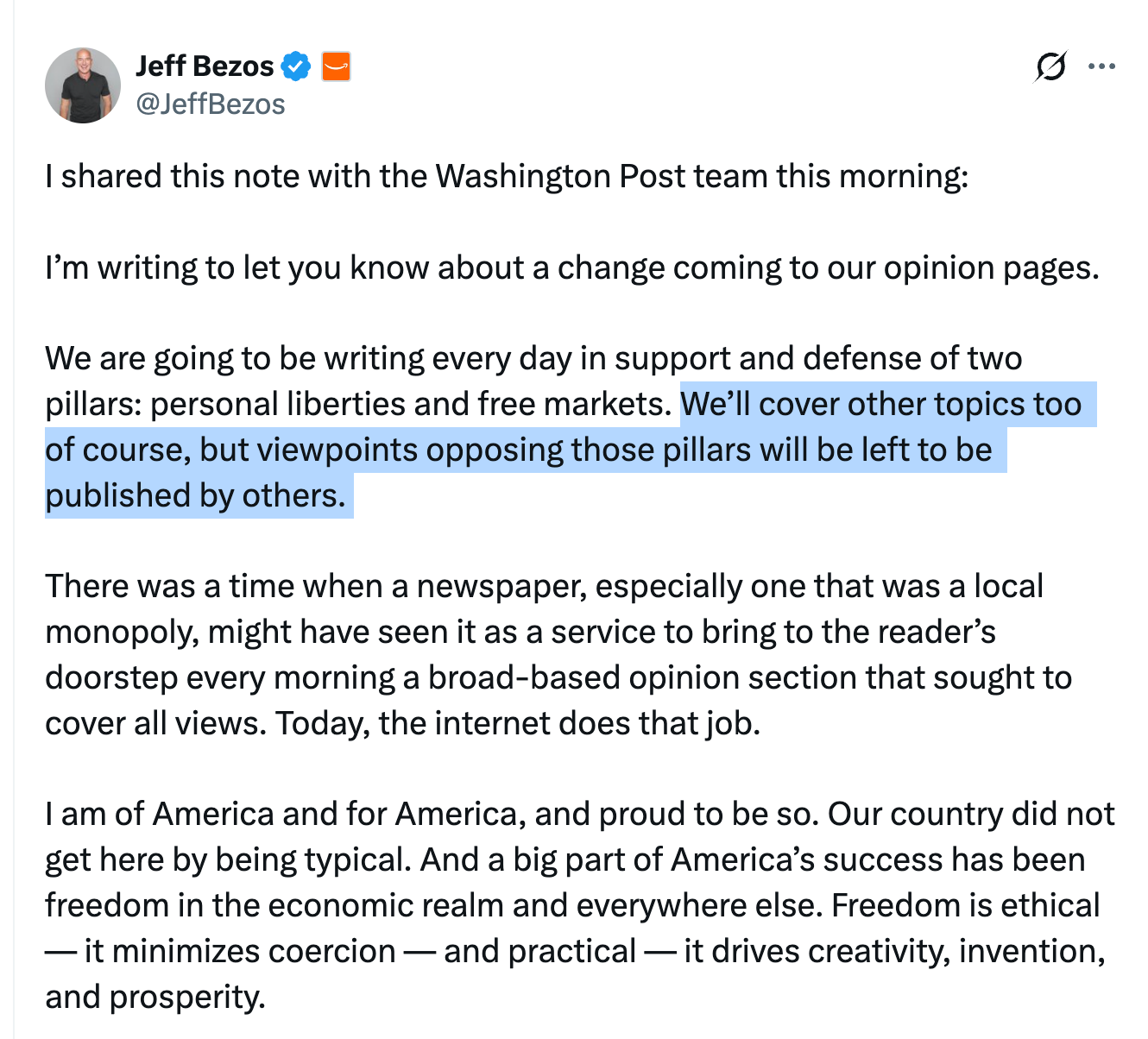
We do not know the names of the people on The Washington Post’s editorial board, or why they believe vouching for an expansion of presidential power supports “personal liberties and free markets.” But today’s offering sheds more light on what Bezos means to support. And it’s not the Founding Fathers’ vision of checks and balances—of a president, but no King.
It’s hard to believe there are still people willing to do Donald Trump’s bidding. It’s hard to understand why an attorney general who used to be a highly regarded federal prosecutor would adopt an unduly expansive view of presidential power—the “I have an Article II” power grab a president who doesn’t seem to have read the Constitution through likes to espouse. Just a few years ago, a president who claimed to be untethered from constitutional oversight would have been brought to heel by Congress and the Supreme Court. Now, even the Fourth Estate is willing to bend the knee.
Instead of advocating for the time-honored view of shared power among the three branches of government, The Post seems to be arguing that it’s up to the attorney general to exert beneficent control over the president he serves. They write, “Ideally, senior officials including the attorney general have enough standing to tell the president ‘no,’ and are willing to resign if they are overridden on a matter of significant importance.” Have they met Donald Trump? Did they listen to what Todd Blanche told Kristen Welker? They explain that Blanche suggested to senators during his confirmation process that once he was permanently in place, “he would have more ability to push back on bad ideas emanating from the White House.” They offer weak sauce: “His legacy will be defined in part by how willing an instrument he will be in the White House’s revenge campaign.”
It is a dangerous time for our democracy. All of this makes it more important than ever to understand what is happening. We cannot become numb; we cannot normalize it. Most importantly, we must not lose sight of the lines that matter when important people start erasing them. That’s what we do here at Civil Discourse every day. If you’re not already a subscriber, I hope you’ll join us. And as always, I’m deeply grateful to the paid subscribers whose support makes it possible for Civil Discourse to remain available to everyone.
We’re in this together,
Joyce
It’s all about the Benjamins. Maybe Bezos and Blanche were once decent people, but they’re not now.
If this is what wealth does to you, I’d rather be poor. At least I’d have my dignity.
I dropped my WaPo subscription when Bezos decimated the staff and bowed down to Trump . Washington is no longer a swamp, it's a cesspit.