
The New Jim Crow
What happened in Alabama today

In the wake of the Supreme Court’s decision effectively endorsing gerrymanders that disenfranchise Black voters, an outbreak of racism has spread through Southern state legislatures. Tennessee Republicans are pretending Black voters in Memphis don’t exist. Florida Republicans seem to have forgotten that Floridians voted to adopt a constitutional amendment banning both political and racial gerrymanders. And then, there’s Alabama.
Alabama has been at the center of the gerrymandering wars for years. In a surprise victory for Black voters, the Supreme Court ruled in their favor in a case known as Milligan. That case reached the Court after a three-judge panel in Birmingham unanimously concluded that it was not a “close” call whether the maps drawn by the legislature violated Section 2 of the Voting Rights Act, and barred the maps from being used.
The initial decision striking down the maps was authored by District Judge Anna Manasco, a Trump appointee. She was joined by another Trump appointee from Alabama, District Judge Terry Moorer, as well as Judge Stanley Marcus, a Reagan appointee to the Eleventh Circuit. You get the point: the maps were bad. They went beyond politics. They were about race.
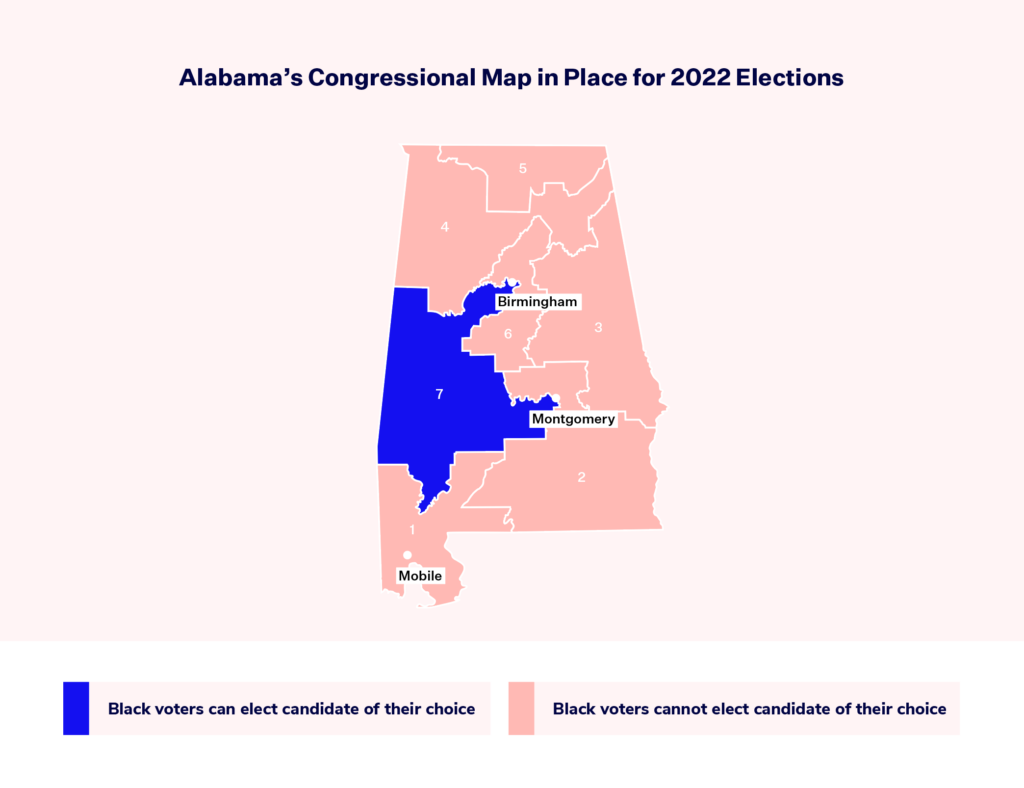
You can see it in the map itself: a little starfish with skinny arms reaching out to pull Black voters from Birmingham, Montgomery, and just north of Mobile into a single “packed” district, while the rest of Alabama’s Black population was “cracked” across the remaining six districts, leaving them with no meaningful opportunity to elect candidates of their choice. It was classic illegal gerrymandering. The Supreme Court agreed in an opinion authored by Chief Justice Roberts, who was joined by Justices Sotomayor, Kagan, and Jackson, and, on the key portion of the ruling that secured the victory for Black voters, by Justice Kavanaugh. The discriminatory map was struck down.
As you know from our discussion earlier this week, the Court previously delayed implementation of the new maps under Purcell, concluding that it was “too close” to the next election by the time it considered Alabama’s arguments. Alabama has seen the ups and the downs.
When the legislature finally began drawing new maps, it disregarded the Supreme Court’s order. Lawmakers produced a map that largely preserved the status quo, maintaining only a single Black opportunity district. The three-judge panel in Birmingham was not amused. “We are deeply troubled that the State enacted a map that the State readily admits does not provide the remedy we said federal law requires,” they wrote. The court removed the legislature from the mapmaking process and, after appointing a special master, assumed responsibility for drawing new maps that complied with the Voting Rights Act.
That is the history here. That is how Alabama finally ended up with maps containing a second Black opportunity district out of seven in a state where, according to the 2024 census, 26.5% of adults are Black. Another 4.7% percent of the population is multiracial or composed of other people of color, and 6% is Hispanic or Latino. The legislature refused to comply with the Supreme Court’s order, forcing the courts to do the job themselves.
What happened next, following the Callais decision, which effectively gave a green light to even the most racially discriminatory “political gerrymanders,” was entirely unsurprising: Alabama asked a federal court to allow it to return to the illegal racial gerrymander of its 2023 congressional maps. It took the state only a few days to get back into court.
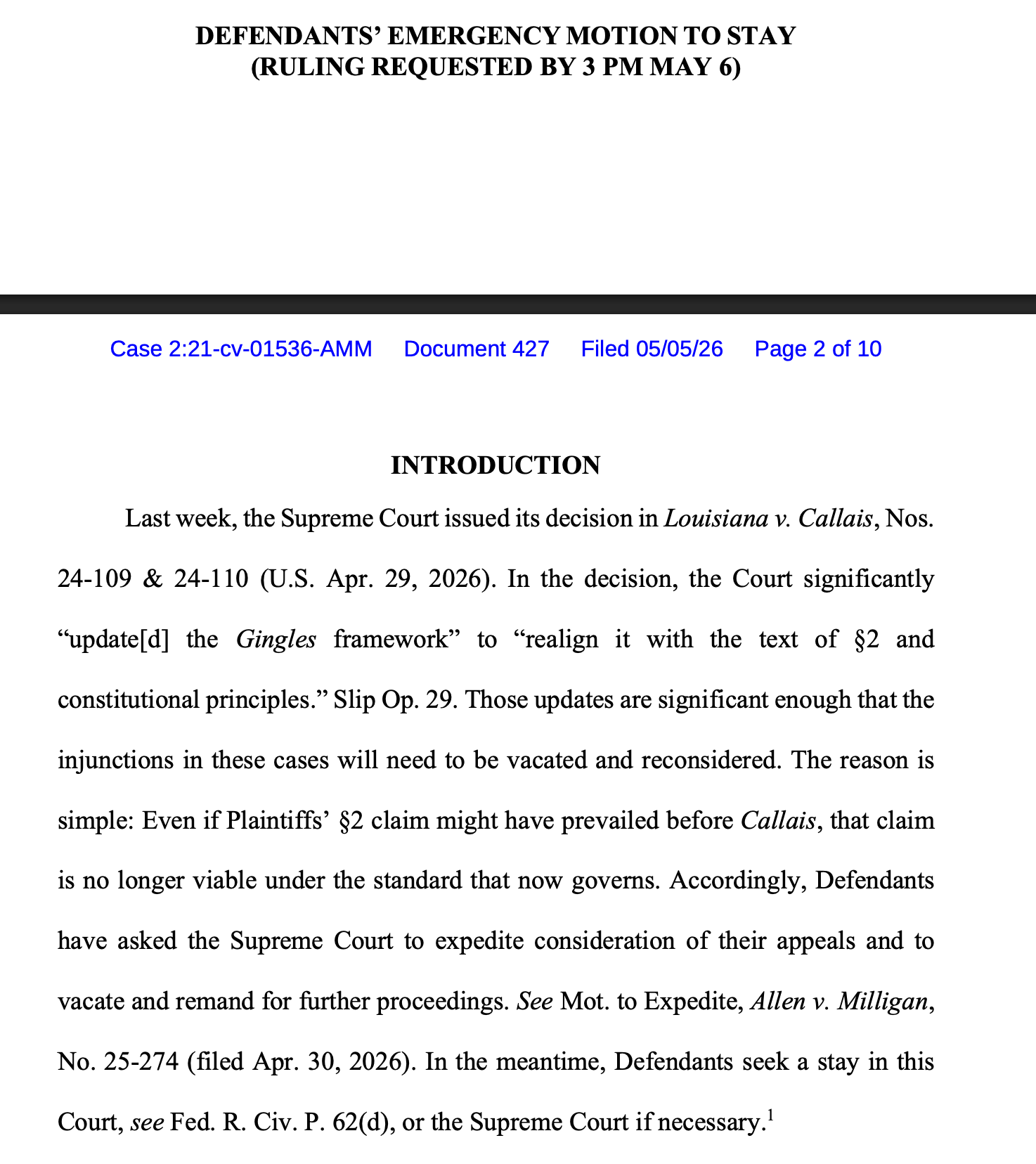
Alabama Attorney General Steve Marshall explained, “Defendants respectfully request a ruling quickly. Alabama is set to hold primary elections on May 19, and Governor Ivey has called the Alabama Legislature into a special session this week ‘to consider legislation to provide for a special primary election for electing members of the United States House of Representatives.’” Yet neither Purcell nor the principle underlying it—that courts should not change election rules too close to an election—was mentioned even once in Alabama’s 10-page motion. Not once.
Justices Kavanaugh and Alito relied on Purcell in 2022 when the Court required Alabama to use the same racist maps that the three-judge panel had already ruled illegal because it was supposedly too close to the election to change them. As Kavanaugh wrote:
That principle—known as the Purcell principle—reflects a bedrock tenet of election law: When an election is close at hand, the rules of the road must be clear and settled. Late judicial tinkering with election laws can lead to disruption and to unanticipated and unfair consequences for candidates, political parties, and voters, among others. It is one thing for a State on its own to toy with its election laws close to a State’s elections. But it is quite another thing for a federal court to swoop in and re-do a State’s election laws in the period close to an election.
Explaining his filing, Alabama’s Attorney General, who is running for the U.S. Senate, said, “It’s not our responsibility to create a minority party district so that somehow or another their voices can be heard,” he said. He said that Alabama’s legacy of slavery and racial discrimination, the issues that made it necessary to have a Voting Rights Act in the first place, are “no longer in play.”
The MAGA hivemind got to work quickly. They too ignored the history that necessitated the Voting Rights Act, equating Alabama’s current maps, the ones the Supreme Court said were required by law, with discrimination against the white, Republican Voters, who currently hold five of Alabama's seven seats in the House of Representatives.
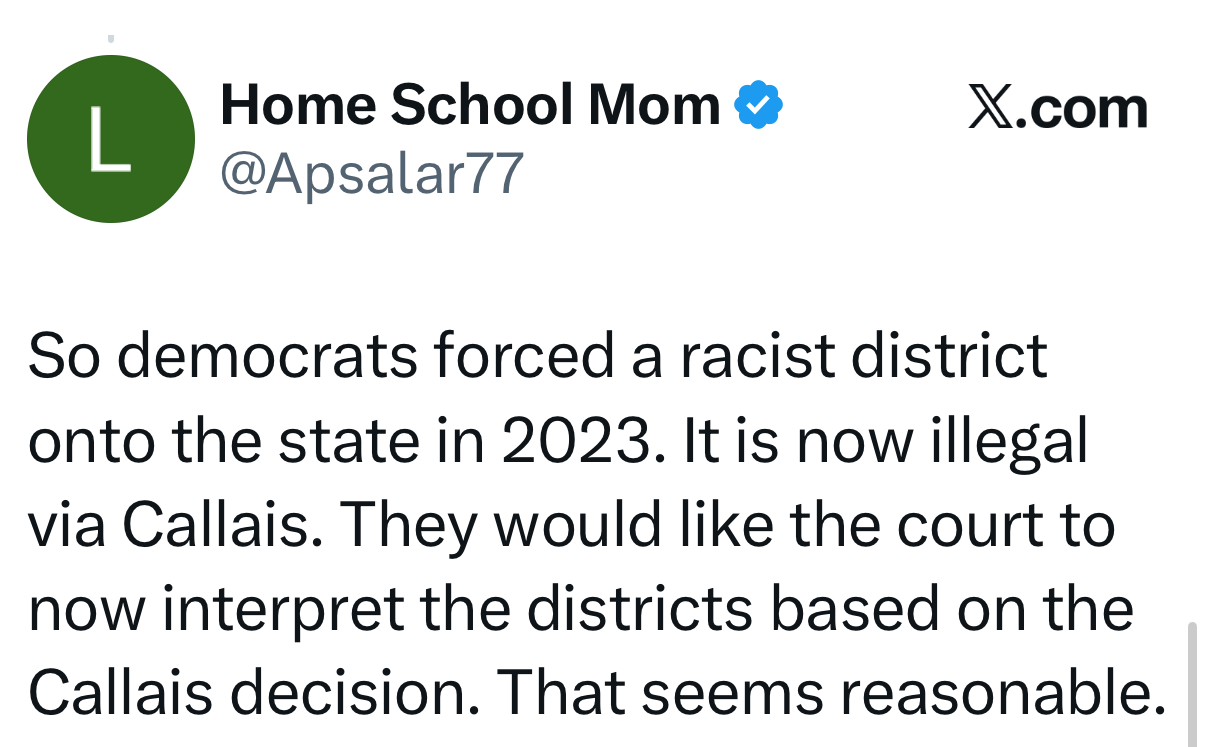
HomeSchoolMom on X explained that “democrats forced a racist district onto the state in 2023.”
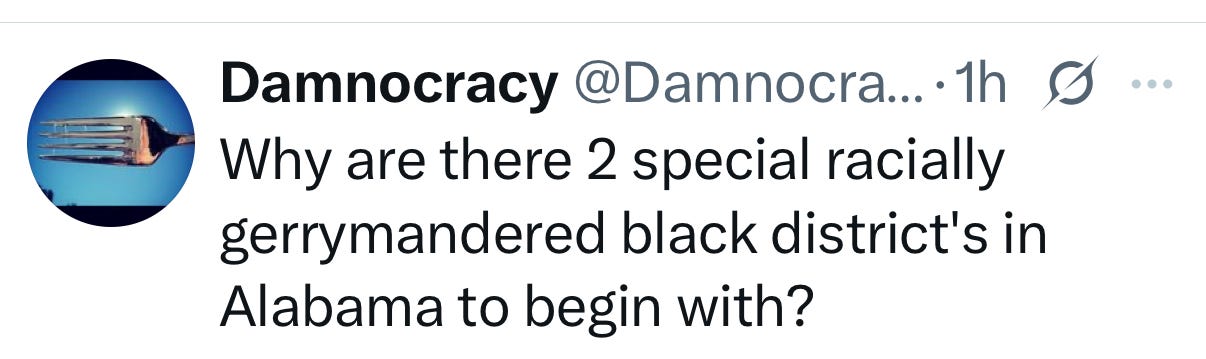
Damnocracy argued against the existence of the two Black opportunity districts the Supreme Court required Alabama to create, calling them “special racially gerrymandered black district’s [sic].”
The Alabama House wasted no time passing a bill designed to roll back Black representation. HB1 requires the governor to call a special primary this summer if the courts lift the injunction barring the state from using the discriminatory maps that had previously been struck down. Alabama’s regular primaries are currently scheduled for May 19. HB1 would require the state to hold a second set of primaries instead.
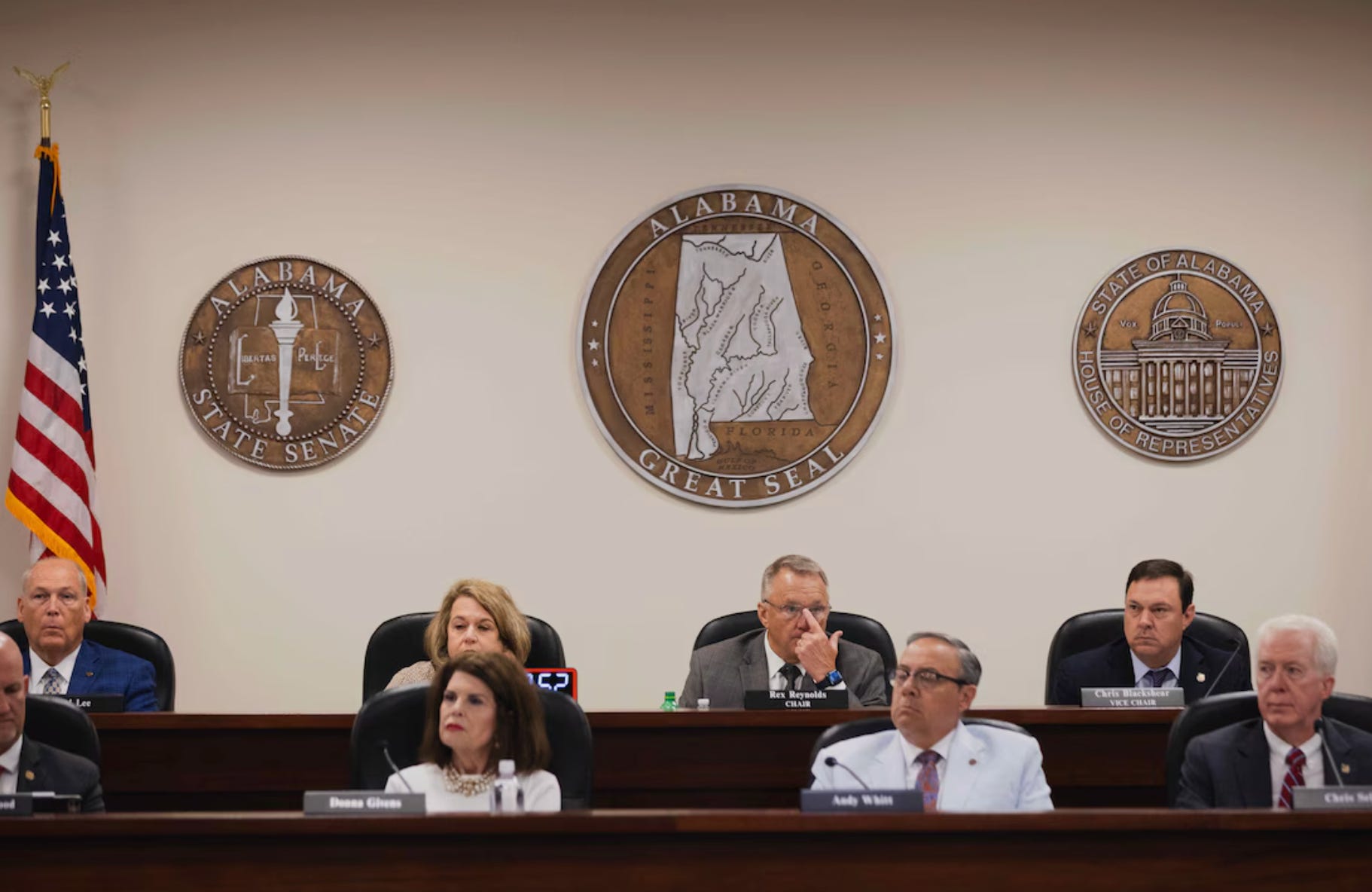
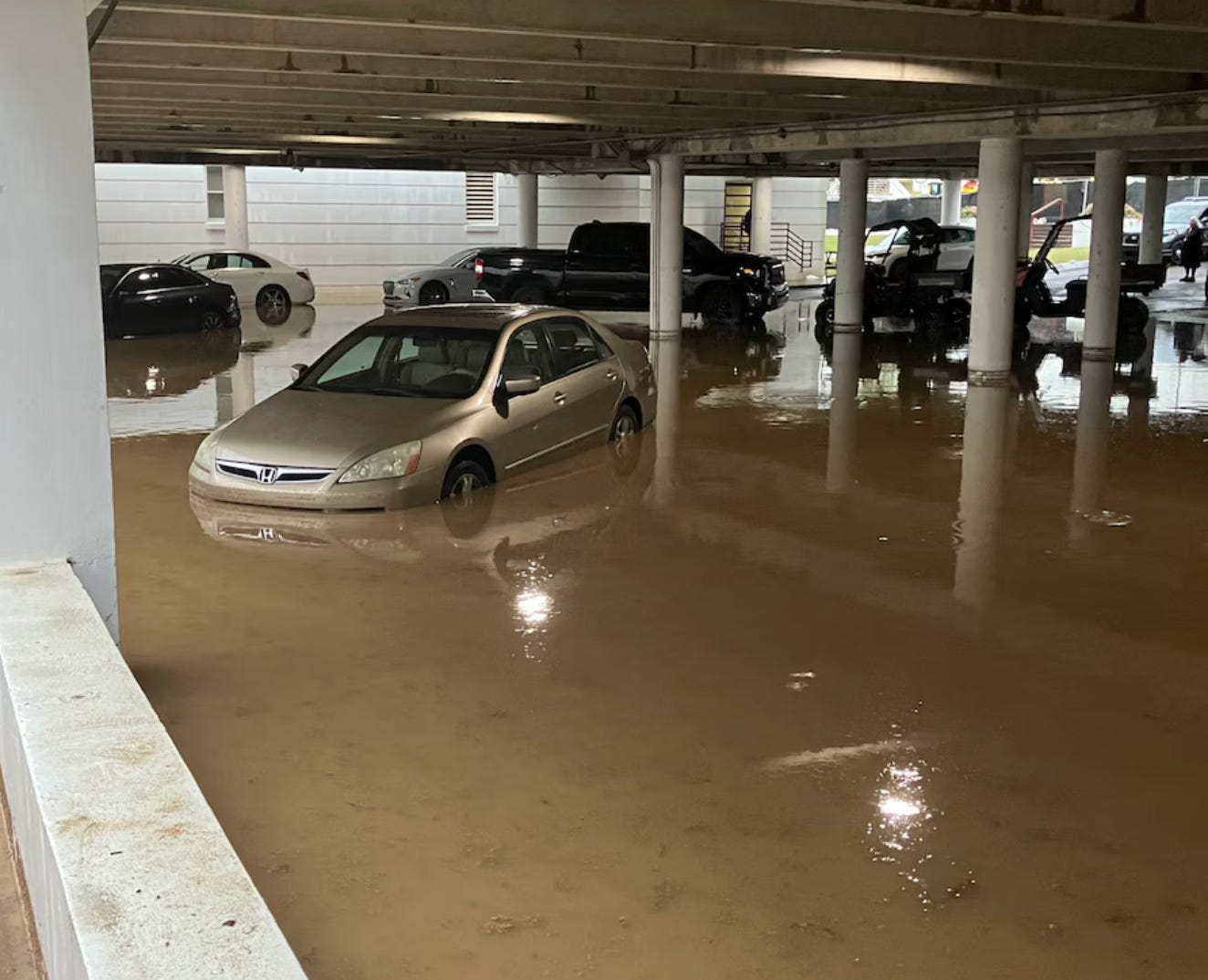
The Alabama Senate followed suit, despite severe weather warnings in Montgomery this afternoon. Flooding actually forced an evacuation of the building while the Senate was debating the companion measure to HB1. But before evacuating, with alarms ringing after flooding overtook the parking lot and the lower part of the building, the Senate passed the first of two measures under consideration during the special session. Senators answered the roll call over the sound of the alarms. The Republican majority passed SB1 along party lines, 26–7, cutting off both debate and amendments.
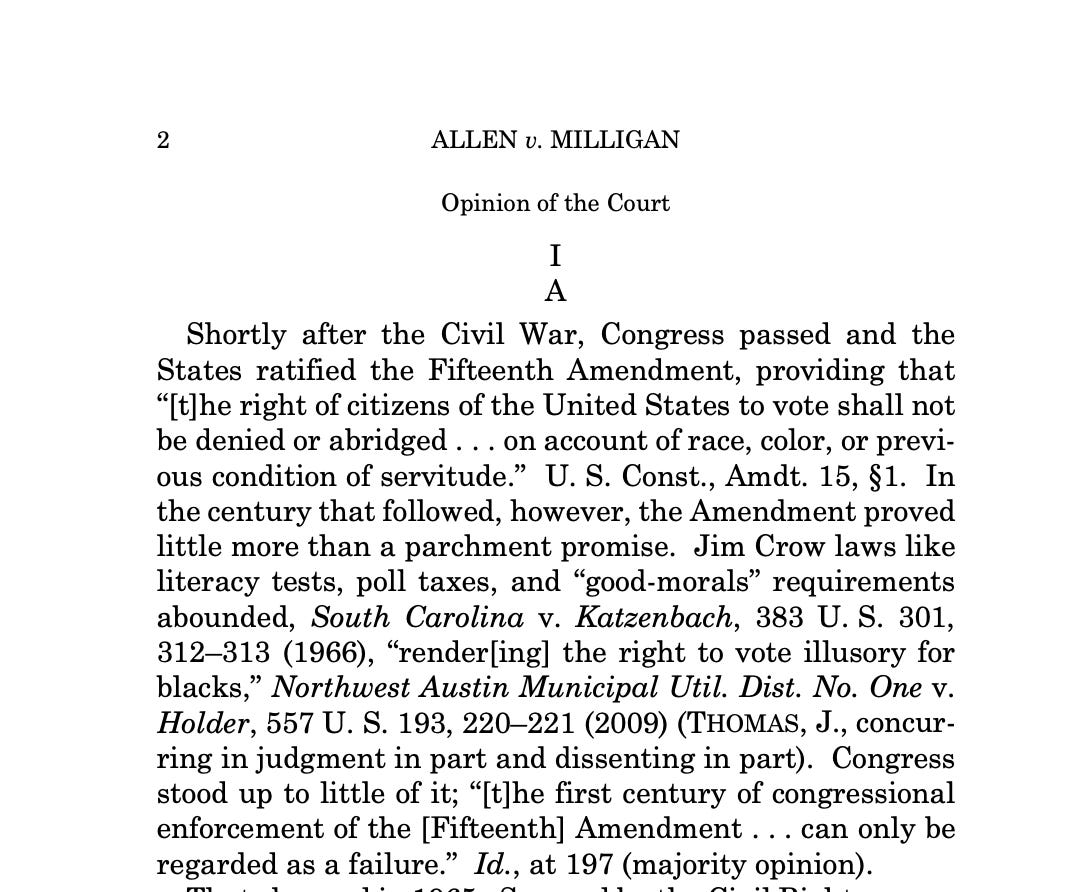
Jim Crow was the system of state and local segregation laws, customs, and social norms that governed much of the South from roughly 1877 through the mid-1960s. Black Americans were segregated into to inferior facilities, while their voting rights and other civil rights were systematically denied. Now, the Supreme Court has made a sudden about-face, permitting conduct it only recently described as unlawful.
In Milligan, Chief Justice Roberts wrote about that period of time and the mere “parchment promise” that the Fifteenth Amendment, which provides that “[t]he right of citizens of the United States to vote shall not be denied or abridged . . . on account of race, color, or previous condition of servitude,” was reduced to. He wrote that things changed in 1965, with passage of the Voting Rights Act.
As we know all too well, progress in this country is not linear. Gains that are won can also be reversed. That is what the Court set in motion last week in Callais. It will now fall to the Court to tell Alabama and other states no, unless it intends to continue eroding the hard-won progress this country has made on race and civil rights.
The Court could invoke the Purcell principle to do so for this election cycle, and failing to do so would be plainly hypocritical. But it must also take the longer view. While Callais revised the test used to determine whether maps are lawful by rejecting evidence of racially discriminatory effects in how they are drawn, what we are now seeing from legislatures across the South goes beyond mere partisanship and toward intentional discrimination.
In fact, the court has already found exactly that in Alabama’s case. Milligan was still at the preliminary injunction stage when the Supreme Court issued the decision we discussed earlier. But after a full trial, the three-judge panel again ruled against Alabama in 2025. The court found not only that the maps violated Section 2, but also that the Alabama Legislature had acted with racially discriminatory intent when it drew them.
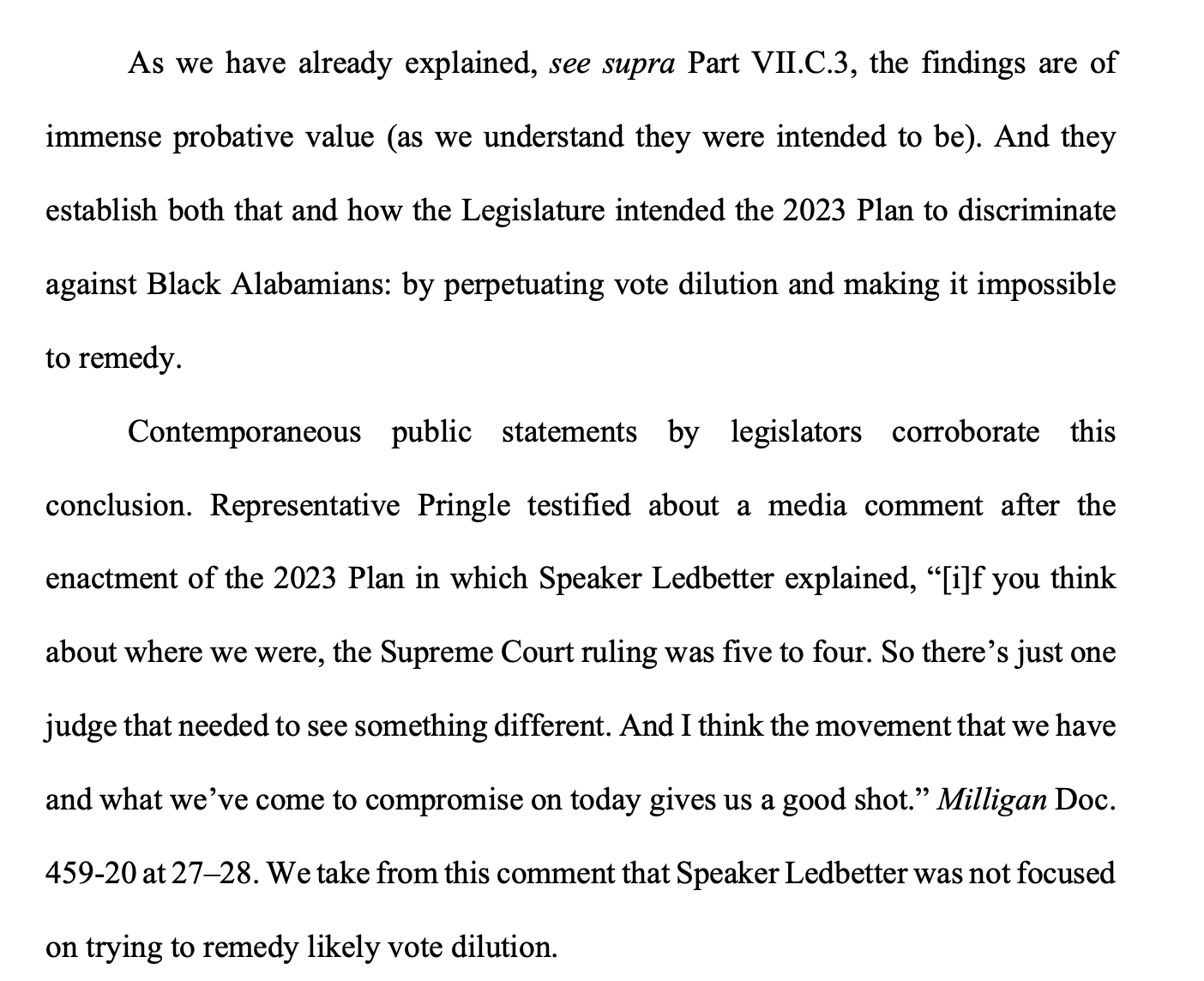
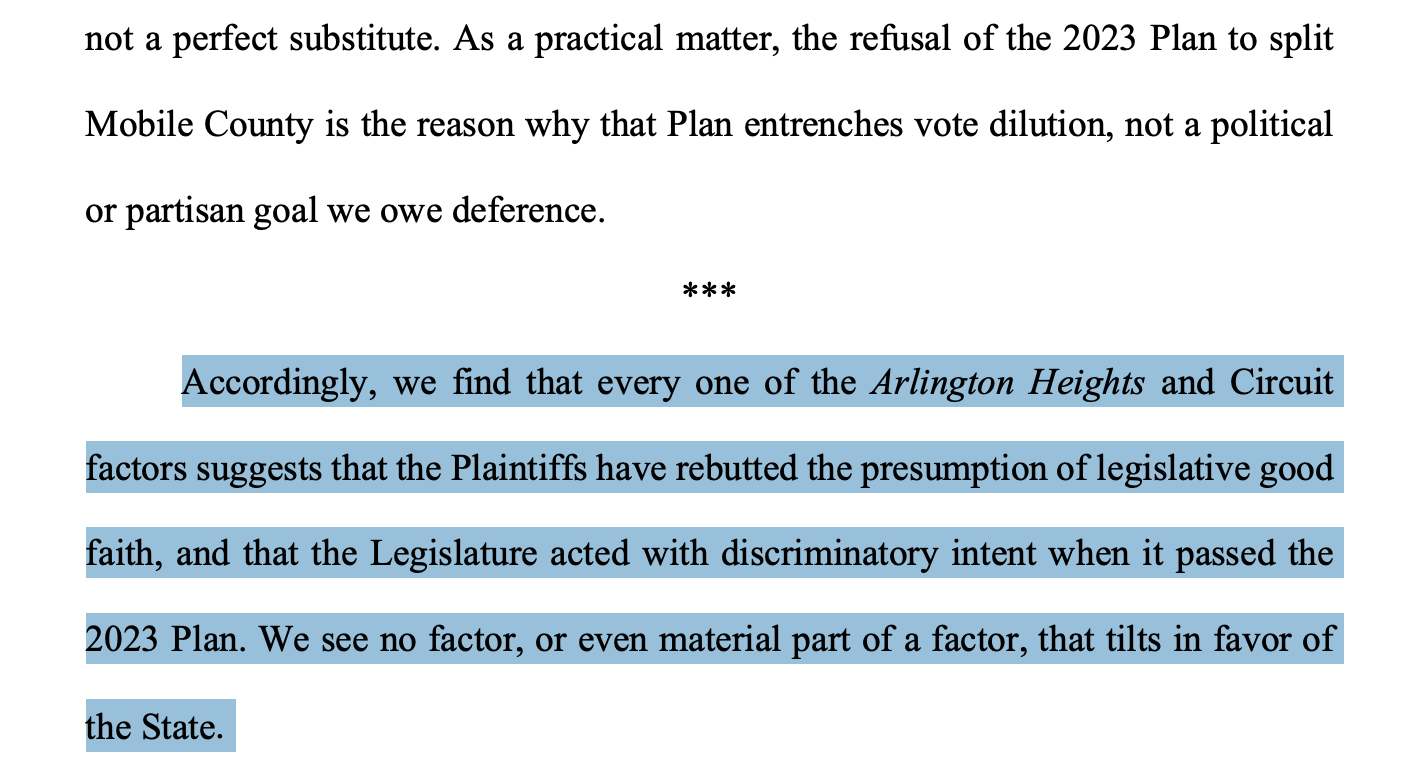
The panel concluded: “Accordingly, we find that…the Legislature acted with discriminatory intent when it passed the 2023 Plan. We see no factor, or even material part of a factor, that tilts in favor of the State.”
It’s a ringing condemnation and certainly gives the courts every reason to refuse Attorney General Marshall’s motion to permit the state to restore its old, discriminatory maps. The courts might even choose to make an example of Alabama to draw some of the sting out of Callais, an acknowledgment that even in its wake, some conduct by state actors still goes too far.
But the problem is that it is not just Alabama. The last decade has shown how easy it is to lose progress. It is far too easy to go backward.
If you live in a more enlightened part of the country, in a state where lawmakers are not rushing back into session to make sure politicians get to pick their voters instead of allowing voters to choose their representatives, please do not ignore what is happening in the South. The threat to the entire country is real. It may be more obvious down here right now, but in the hands of a wannabe dictator, a president once again openly floating an unconstitutional third term, it could spread very quickly.
The issue, as with gerrymandering, is what Republicans will try to do, and what courts will allow.
Last week in a Senate confirmation hearing, four Trump judicial nominees, one each from Florida and Ohio, and two from Texas, declined to agree with Delaware Democratic Senator Chris Coons that Trump, having already served two terms in office, was ineligible to be elected to a third term. That’s four people who believe they are qualified to serve as impartial federal judicial officers. That’s what it looks like when a party is captive to its cult leader. That’s what it looks like when one branch of government curbs the independence of another. That’s how it starts. But that’s not how it ends. Gerrymandering is about seizing political control.
So, as you look at Alabama and other Southern states reintroducing racist gerrymanders, don’t think it can’t happen anywhere else. The Supreme Court has changed course. States can too. Trump isn’t building a ballroom for the next guy. It’s up to us to hold the line.
Thanks for being here with me at Civil Discourse. Your support makes it possible to invest the time and resources it takes to research and write the newsletter.
We’re in this together,
Joyce
The glee with which SC Republicans are anticipating booting Rep. Jim Clyburn from his seat through redistricting makes my head spin. The lust for power is an ugly thing. Yep, these folks really luv our country.
What keeps going through my head is all the Alabama suffering to get the Voting Rights Act passed—those little girls in the Sixteenth Street church, John Lewis along with many others getting his head bashed in, James Reeb and Viola Liuzzo losing their lives. The list, of course, is much longer than I can conjure at 3 a.m., but it should be obvious that blood was shed, and the price was high. Shame on the Supreme Court majority.