
It’s Our House

You could skim the headlines—but they won’t tell you what this ruling actually does or why it matters. I’ve read the decision line by line and translated it into plain English, so you can see exactly how a federal judge just stopped Trump in his tracks. If you value this kind of understanding, paid subscriptions to Civil Discourse make this work possible.
In an important win for people who understand that the Constitution establishes a president, not a king, as the leader of the United States, a federal judge ordered the Trump administration to stop construction on the ballroom Trump destroyed the East Wing of the White House to build. The Judge pointed out it’s not Donald Trump’s house and held that without approval from Congress, no dice.
Read the full opinion here.
Senior Judge Richard Leon in the District of Columbia did the honors. He was appointed by George W. Bush in 2002, so, not exactly a liberal. The issue comes down to whether Trump has the legal authority to tear down the East Wing and build a ballroom. “Because Congress holds the keys to the Nation's property, the President must have some statutory basis to build the ballroom,” Judge Leon explains.
After analyzing the issues, he entered a preliminary injunction, calling a halt to further work on the ballroom. He wrote of his ruling: “Where does this leave us? Unfortunately for Defendants, unless and until Congress blesses this project through statutory authorization, construction has to stop! But here is the good news. It is not too late for Congress to authorize the continued construction of the ballroom project. The President may at any time go to Congress to obtain express authority to construct a ballroom and to do so with private funds. Indeed, Congress may even choose to appropriate funds for the ballroom, or at least decide that some other funding scheme is acceptable. Either way, Congress will thereby retain its authority over the nation’s property and its oversight over the Government’s spending. The National Trust’s interests in a constitutional and lawful process will be vindicated. And the American people will benefit from the branches of Government exercising their constitutionally prescribed roles. Not a bad outcome, that!”
It’s hard to tell if that’s a touch of sarcasm or a sincere effort to save the president’s pet project. The Judge has a bit of a reputation for being a “vivid writer” who has never hesitated to criticize the government when he thought it deserved it. Either way, the Judge struck a sharp blow for the rule of law today and, not entirely coincidentally, halted construction of a project many Americans strongly oppose. Building a ballroom instead of feeding, educating, and providing basic medical care for Americans feels very “Let them eat cake” at a time when many Americans are struggling to afford the price of gasoline, which has skyrocketed because of another one of the president’s pet projects.
The opinion begins with Judge Leon’s acknowledgment that: “the President of the United States is the steward of the White House for future generations of First Families. He is not, however, the owner!” The Judge proceeds to lay out the position each side in this dispute staked out in court:
Trump, the defendant, “claims” he has the authorization of Congress, in preexisting laws, to build his ballroom using private donor funds.
The plaintiff, the National Trust for Historic Preservation, disputes that Congress has given the president that authority and argues that a preliminary injunction is necessary to avoid irreparable harm.
Judge Leon writes, “I have concluded that the National Trust is likely to succeed on the merits because no statute comes close to giving the President the authority he claims to have. As such, I must therefore GRANT the National Trust’s Motion for a Preliminary Injunction, and the ballroom construction project must stop until Congress authorizes its completion.” It’s a smackdown.
Congress first authorized the creation of a place for the president to live in the Residence Act of 1790, which created a commission to “provide suitable buildings for the accommodation of ... the President,” Judge Leon explains. President Adams moved in before construction was finished and every President since then has lived in the White House. “Congress has continued to authorize and fund construction and maintenance at the White House up until the present day.”
As for Trump’s ballroom, the Judge points out that “without advance notice or apparent approval-President Trump announced on social media that ‘ground ha[ d] been broken on the White House grounds to build the new, big, beautiful White House Ballroom.’” That was October 20, 2025. The next day, there were reports of heavy machinery on the White House grounds. Trump showed the press renderings of what he had in mind, commenting that while other presidents had made changes to the White House, his would be the “biggest one,” the day after that. By October 23, the East Wing had been demolished.
Back in July of 2025, Trump had announced a plan to build a ballroom that would be “approximately 90,000 total square feet.” But he never went to Congress for funding or submitted his plans for approval. He moved straight to tearing down the East Wing.
The Judge writes that Trump lacked the authority to do that, concluding the National Trust is likely to succeed in its claims, and so, is entitled to an injunction. “The Property Clause vests Congress with complete authority over public lands. See U.S. Const. Art. IV, § 3, cl. 2 (‘The Congress shall have Power to dispose of and make all needful Rules and Regulations respecting the Territory or other Property belonging to the United States.’).” Moreover, he writes, “Since the earliest days of our Republic, Congress's 'power over the purse' has been its 'most complete and effectual weapon' to ensure that the other branches do not exceed or abuse their authority.” So, Congress controls public lands, which includes the White House, and the separation of powers includes Congress’ power over the purse, which is a way of keeping other branches of government from exceeding their authority. Congress also has authority over the District of Columbia under the “District Clause,” Art. I, § 8, cl. 17 of the Constitution. Trump struck out on legal authority to act on his own without enlisting Congress.
“[T]he President must identify some law that allows him to demolish the East Wing and construct his planned ballroom with private funds,” Judge Leon writes. But all of the law goes the other way, which leads the Judge to conclude he’s going to lose on the argument raised by the National Trust that Trump acted beyond his authority, or “ultra vires” as the legal doctrine puts it, because “no law comes close to giving the President this authority.”
Trump tried to cobble together an argument based on a law that authorizes “Assistance and Services for the President,” But Judge Leon is quick to point out that the provision, 3 U.S.C. § 105(d)(l), “is a statute authorizing the President to conduct ordinary maintenance and repair of the White House, up to the limits of the congressionally appropriated amount.” No help for Trump there, and the tenuousness of the argument suggests that Trump forged ahead and did something he wanted to do, figuring that once the East Wing was destroyed, there would be little anyone could do. “Defendants' reading of the statute is clearly contrary to its plain meaning,” Judge Leon concludes.
The National Trust also has to establish irreparable injury before it’s entitled to an injunction, meaning it has to show an actual harm that is about to take place and can’t be fixed after the fact. Here, Judge Leon relies on allegations of “aesthetic injury,” referencing a statement by a member of the National Trust, Professor Alison Hoagland, “who regularly visits President's Park to ‘enjoy the historic buildings’ and take in ‘the beauty of the L'Enfant Plan.’” Hoagland believes that construction of “a ballroom of the proposed form and scale” would cause “permanent and irreparable harm to the White House and President's Park,” thereby damaging her own “aesthetic, cultural, and historical interests.” That qualifies as irreparable injury in the Judge’s view because it specifies that her enjoyment of the White House grounds will be irreparably injured if Trump is permitted to go ahead.
Here again, the Trump White House’s argument is a weak one. “Defendants contend that the National Trust faces no imminent aesthetic harm because Hoagland ‘will not be able to see any part of the East Wing for many months,’” Judge Leon writes, before concluding that “Defendants cannot seriously argue that Hoagland has no claim for imminent aesthetic harm until the completed building is fully visible.” Above-ground construction is slated to begin at some point in April 2026.
Before entering an injunction, courts weigh the equities, trying to be fair to both parties and to the public. Here, Judge Leon concludes, “While the National Trust would be deeply harmed in the absence of an injunction, the Government ‘cannot suffer harm from an injunction that merely ends an unlawful practice.’"
The government’s response gets the smackdown from Judge Leon that it deserves: “Defendants predictably object, arguing that any delay to construction would imperil national security and expose the White House to damage. Grasping for straws, Defendants call the construction site a ‘coordinated and managed safety hazard’ that has disrupted existing security procedures. Thus, according to Defendants, any construction delay will undermine national security. Please! While I take seriously the Government's concerns regarding the safety and security of the White House grounds and the President himself, the existence of a ‘large hole’ beside the White House is, of course, a problem of the President's own making!”
Please!
The Judge gives the government 14 days to appeal, and permits it to engage in any work “necessary to ensure the safety and security of the White House.” But he makes plain in a footnote that he’s serious about holding the White House to good faith in this matter: “The Court gives fair notice to Defendants, however, that any above-ground construction over the next fourteen days that is not in compliance with my Order is at risk of being taken down depending on the outcome of this case.”
Trump seems upset about the decision. After all, where is an emperor supposed to show off his clothes, if not in his humongous ballroom?
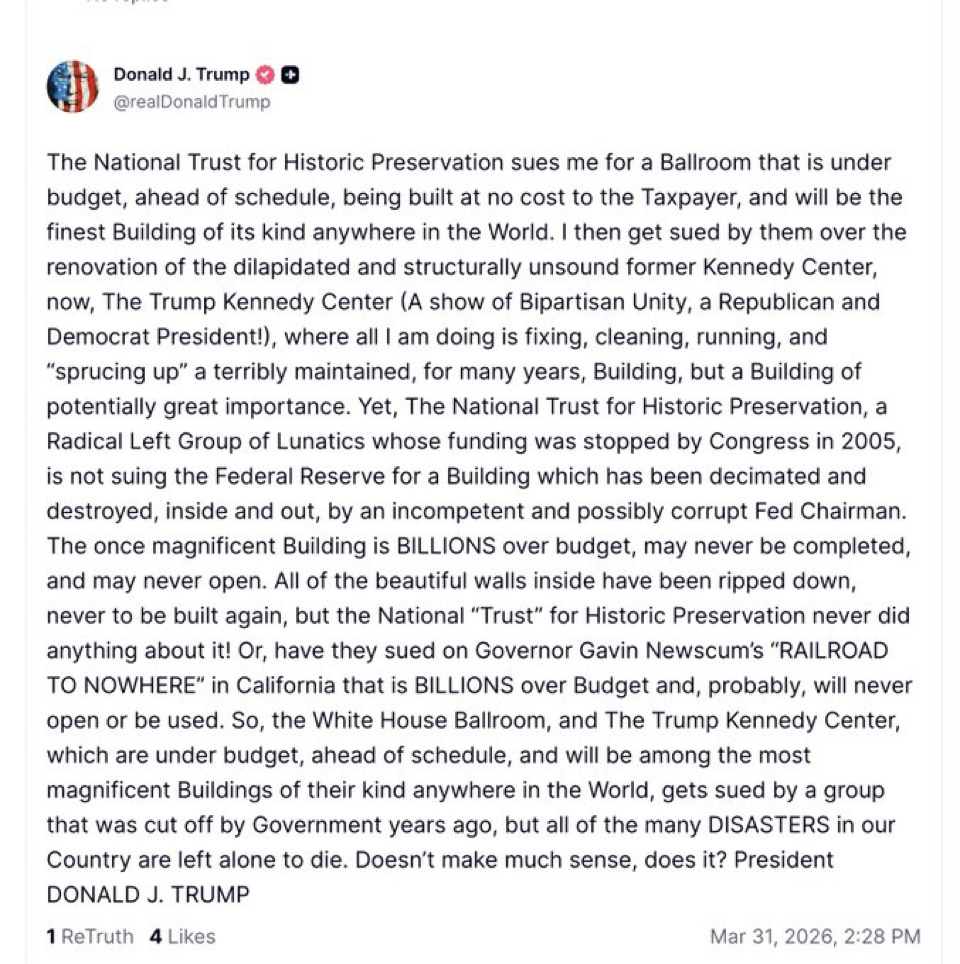
He followed up with this:
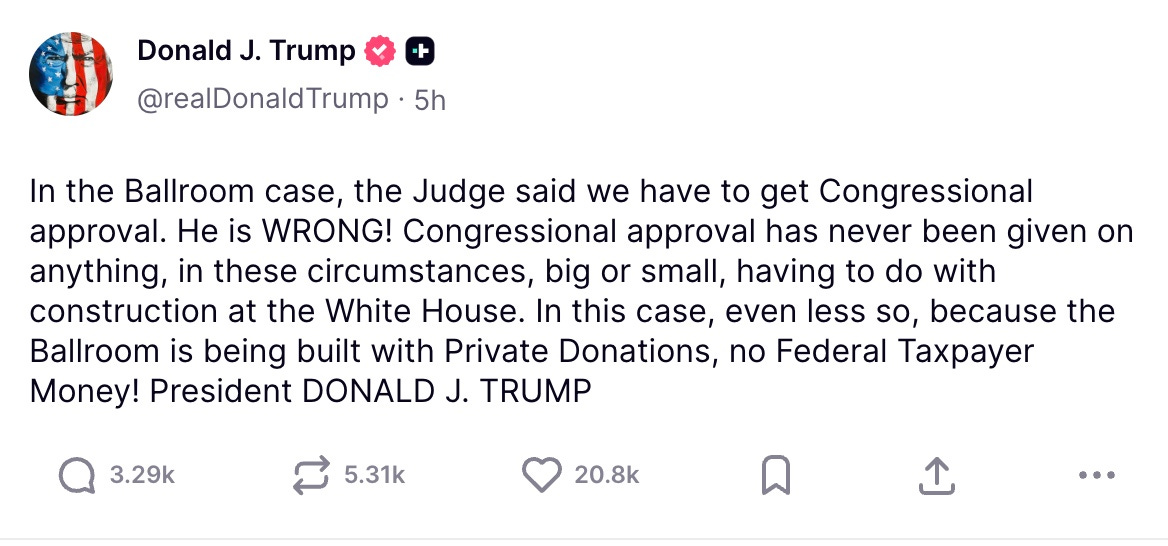
The amazing Aaron Rupar, who has the patience of a saint and posts all the video we need to see of Trump, even when we don’t want to, captured this gem today: “Trump on a judge ruling against his ballroom: ‘It says here very carefully, 'the safety and security have to be protected on the White House grounds.' Well that's what we're doing because everything is bulletproof glass, including the ballroom ... we have a drone-proof roof'.’”
Brilliant logic from the President. What’s next? A strip club with bomb shelter doors?
An appeal from the White House is imminent, and perhaps the prospect of a fight over contempt, given the Judge’s footnote, above. But at least I have a head start on my sign for the next protest.

It’s our house.
We’re in this together,
Joyce
Perhaps Trump can rent the local YMCA to do his patented version of The Twist … or, judging by the language of his screed, the hokey-pokey.
Was the teardown of the "old" East Wing at issue? Could Trump be compelled to rebuild it as it was, with his own money? I've heard that the contractor who did the teardown could be held liable, and they of course could sue Trump.