
Beyond the Headlines: The Supreme Court's Final Decisions

The Supreme Court never really sleeps. Even though today was the last day they will announce decisions from cases that were briefed and argued during the 2025-2026 term, there are still matters pending on the shadow docket and a whole host of cases they must consider to decide whether they will hear them next term. As if to underscore that, when the “cleanup conference” order came out this afternoon, we learned the Justices had agreed to hear a case that asks them to determine whether bans on AR-15s and other semiautomatic rifles are constitutional. That’s the issue in Viramontes v. Cook County, which has been consolidated with a second case, Grant v. Higgins.
It only takes four votes to grant certiorari and hear these cases. It will take a fifth one to end restrictions on casual civilian ownership of these weapons. That’s what's at stake. The Court doesn’t take cases like this just to pat a state on the head and sign off on its ban—it has bigger fish to fry than affirming the status quo.
Last June, the Court declined to take a case called Snopes v. Brown, a challenge to the constitutionality of a Maryland law that banned semiautomatic rifles, including the AR-15. But there were almost four votes to take that case. Justices Alito and Gorsuch would have granted cert. Justice Thomas wrote an eight-page dissent from the denial, in which he explained, “This petition presents the question whether this ban is consistent with the Second Amendment. The Fourth Circuit held that it is, reasoning that AR–15s are not “arms” protected by the Second Amendment … I would grant certiorari to review this surprising conclusion.” That’s not the kind of language you use if you intend to affirm the ban. He concluded, “law-abiding AR–15 owners must rely on the goodwill of a federal agency to retain their means of self-defense. That is ‘no constitutional guarantee at all.’”
It was Justice Kavanaugh who contributed almost a fourth vote for cert. He issued an 11-page “statement respecting the denial.” He wrote: “Given that millions of Americans own AR–15s and that a significant majority of the States allow possession of those rifles, petitioners have a strong argument that AR–15s are in ‘common use’ by law-abiding citizens and therefore are protected by the Second Amendment.” He called the Fourth Circuit decision the Court was being asked to review “questionable.” But he explained his vote against cert in practical terms, noting that “a denial of certiorari does not mean that the Court agrees with a lower-court decision or that the issue is not worthy of review.” Instead, he pointed to similar cases percolating in a number of circuits and expressed an interest in waiting for a number of them, including Viramontes, to arrive at the Court, writing “in my view, this Court should and presumably will address the AR–15 issue soon, in the next Term or two.”
Now, that’s the case. We don’t know if the four Justices picked up a fifth vote along the way that convinced Justice Kavanaugh this was “the right time,” as in a time when they now have enough votes to change the rules.
Earlier today the Court issued its decisions in the four remaining cases. There were few surprises.
Birthright Citizenship, Trump v. Barbara: Read the opinion here. Justices Roberts, Sotomayor, Kagan, Barrett, and Jackson were in the majority. Justice Kavanaugh was sort of in the majority; see below. Justices Thomas, Alito, and Gorsuch dissented.
The Court narrowly managed to find five votes for the proposition that the 14th Amendment, which clearly does this, guarantees birthright citizenship. Although Justice Kavanaugh joined the majority in holding that Trump’s executive order on the matter violated the law, he didn’t base his decision on the 14th Amendment, even though it plainly says “All persons born or naturalized in the United States, and subject to the jurisdiction thereof, are citizens of the United States and of the state wherein they reside,” like the other five Justices in the majority did.
The Chief Justice held that children born in the U.S., even if their parents are unlawfully or temporarily here, are “citizens at birth” under the Constitution. “The Framers of the Fourteenth Amendment,” he wrote, “extended that promise to ‘every free-born person in this land.’ We keep that promise today.”
Justice Kavanaugh concurred in the result because he believed Trump’s executive order ending birthright citizenship violated a federal law—but importantly, not the 14th Amendment to the Constitution. Trump can’t amend the Constitution with an executive order. But Congress can change laws it has passed, and that seems to be precisely what Kavanaugh was encouraging them to do here, laying down a roadmap for ending birthright citizenship with a new law that would let him flip sides. Congress, he wrote, could “enact new legislation” that ends automatic citizenship for babies born to people who are “unlawfully or temporarily in the country.”
Trump was quick to jump on that bandwagon on Truth Social.
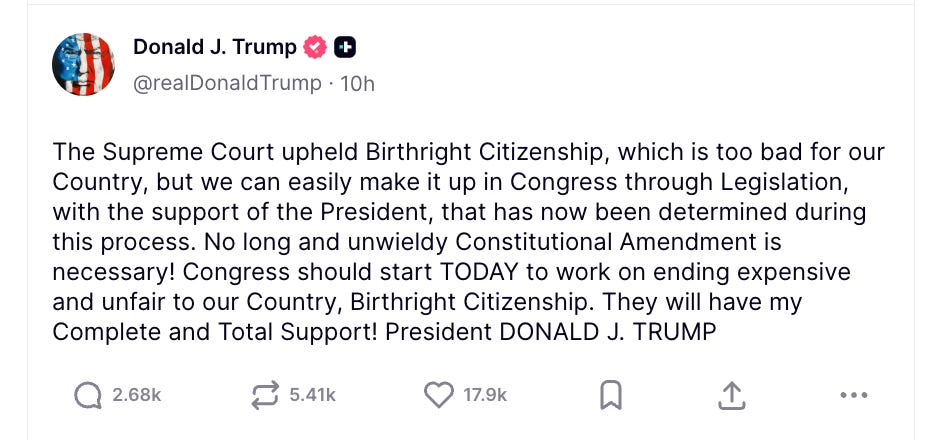
Interestingly, Justice Alito, in dissent, encouraged Congress to “address” the situation of people born in this country to parents who aren’t citizens, but who “have lived here for years, and … have a strong moral claim to be able to remain in the land where they grew up.”
There should have been nine votes for the proposition that presidents can’t change the Constitution with executive orders. The fact that this case was so close is a surprise, as are the “suggestions” from both Kavanaugh and Alito.
Campaign Finance, National Republican Senatorial Committee v. Federal Election Commission: Read the opinion here. Justice Kavanaugh wrote the opinion, joined by the Chief Justice and Justices Thomas, Alito, Gorsuch, and Barrett. Justice Kagan wrote the dissent, which Justices Sotomayor and Jackson joined.
Like Citizens United, this is a First Amendment case. The majority held that a federal law that limits the amount of money political parties can spend in coordination with a candidate for federal office violates the First Amendment. To get there, the Court had to reverse yet another longstanding precedent. That’s becoming commonplace with the Roberts Court.
In 2001, the Court ruled the other way in a Colorado case. Justice Kavanaugh wrote it had been “rejected by subsequent cases and is no longer good law.” And just like that, at the whim of the majority, the law, apparently, can change.
Justice Kagan writes in the dissent that the majority “jettisons a rule needed to protect our democracy's integrity.” She adds later that “To count on disclosure to prevent corruption is as much as to give up on the goal itself. Which is, sad to say, what this Court does today.”
Shortly after Marc Elias argued this case in December, he was our guest on Five Questions, and I asked him about it:
Joyce: You argued a campaign finance case before SCOTUS in December, that we’ve been following here. How, if at all, given that it could be decided as late as the first week in July, are you expecting that case to impact this election, and what about future ones?
Marc: The case, NRSC v. FEC, was brought by Republicans to challenge one of the last remaining limits on money in politics: the restrictions on coordinated spending between political parties and candidates. I represented Democratic committees that intervened to defend the coordinated expenditure limits after Trump’s Department of Justice broke with decades of precedent and refused to defend this cornerstone of our campaign finance system. A law that both Democratic and Republican administrations had long defended was suddenly deemed unconstitutional by the Trump Administration.
If the Court strikes down these limits, wealthy donors could circumvent individual contribution caps by routing massive donations through party committees that can coordinate directly with candidates. Political parties would become mere paymasters to settle invoices from campaign vendors. It would trigger a massive upheaval of our campaign finance system, right as the midterm campaigns are ramping up. It would further empower wealthy donors while threatening to drown out the grassroots activists that often power Democratic campaigns through small-dollar contributions.
As if the world post-Citizens United didn’t already stack the deck in favor of the wealthy and powerful, now it gets worse. None of this benefits everyday Americans who don’t have millions of dollars to throw at candidates.
Transgender Athletes, West Virginia v. B.P.J. and Little v. Hecox: Opinion here. Justice Kavanaugh authored the majority opinion, joined by Justices Roberts, Thomas, Alito, Gorsuch, and Barrett.
Justice Kavanaugh writes for a majority that signs off on excluding trans athletes from sports teams. Schools can determine eligibility for women’s and girls’ sports teams based on biological sex. Doing so doesn’t violate Title IX. Justices Sotomayor, Kagan, and Jackson concur in that part of the judgment, albeit on a “narrower basis than that on which the majority relies.” But they dissent from the conclusion that the Constitution’s equal protection clause doesn’t protect against these practices.
Justice Kavanaugh tried to soften the blow with this salve to trans people: “Most of the biological female and transgender student-athletes who are involved in transgender sports disputes around the country are teenagers or in their early twenties. Those student-athletes want to play sports. Their desire to compete warrants respect. No student-athlete on either side of the issue, whether a biological female or transgender, deserves to be ostracized or vilified.” But it was weak sauce in light of what is inevitably coming next. These cases raised the issue of whether trans athletes can be banned. The next cases are going to be about mandatory bans on trans athletes in women’s sports.
These cases provoke strong emotions on both sides of the issue. The president saw fit to stoke those flames, posting “BIG WIN: The United States Supreme Court just RULED AGAINST MEN PLAYING IN WOMEN’S SPORTS. Wow! That takes that ridiculous situation off the table!!! President DONALD J. TRUMP” on Truth Social.
That’s a wrap on this Supreme Court term. The last few weeks have been fast and furious, and I’m grateful you’ve spent part of them here.
If you’re not yet a paid subscriber, I hope you’ll join us. There’s no shortage of places to read about the Court’s decisions. What I try to do in Civil Discourse is something different: explain what the opinions actually say, separate what matters from what doesn’t, and put each decision in the larger context of how our legal system works. That perspective comes from 25 years at the Department of Justice, including almost a decade of experience in appeals, but its value is simple—I want you to finish reading with a clearer understanding of where the law stands today and where it’s headed next. If that’s been useful to you this term, I’d be honored to have you as part of this community.
We’re in this together,
Joyce
The price we pay these corrupt Roberts Supreme Court decisions are paid in blood. The justices get $30 million for their security paid for with tax payer dollars while they endanger the lives of the pople paying for their safety. Disgusting!
Check this map for how many people were shot across America on the exact day the Roberts Supreme Court struck down public carry restrictions?
https://thedemlabs.org/2026/06/28/shootings-the-day-scotus-allowed-public-guns/
Thanks Joyce for tirelessly laying out these cases so we can clearly understand where is is going. Your attention to the detail of who is voting one way or the other and why is critical to understanding the direction these things are taking.