
Alabama’s Maps

Yesterday, in a per curiam opinion with a vociferous dissent, a majority of the Supreme Court allowed Alabama to move forward with the election maps the Republican supermajority legislature drew up after the Supreme Court decided the Callais case.
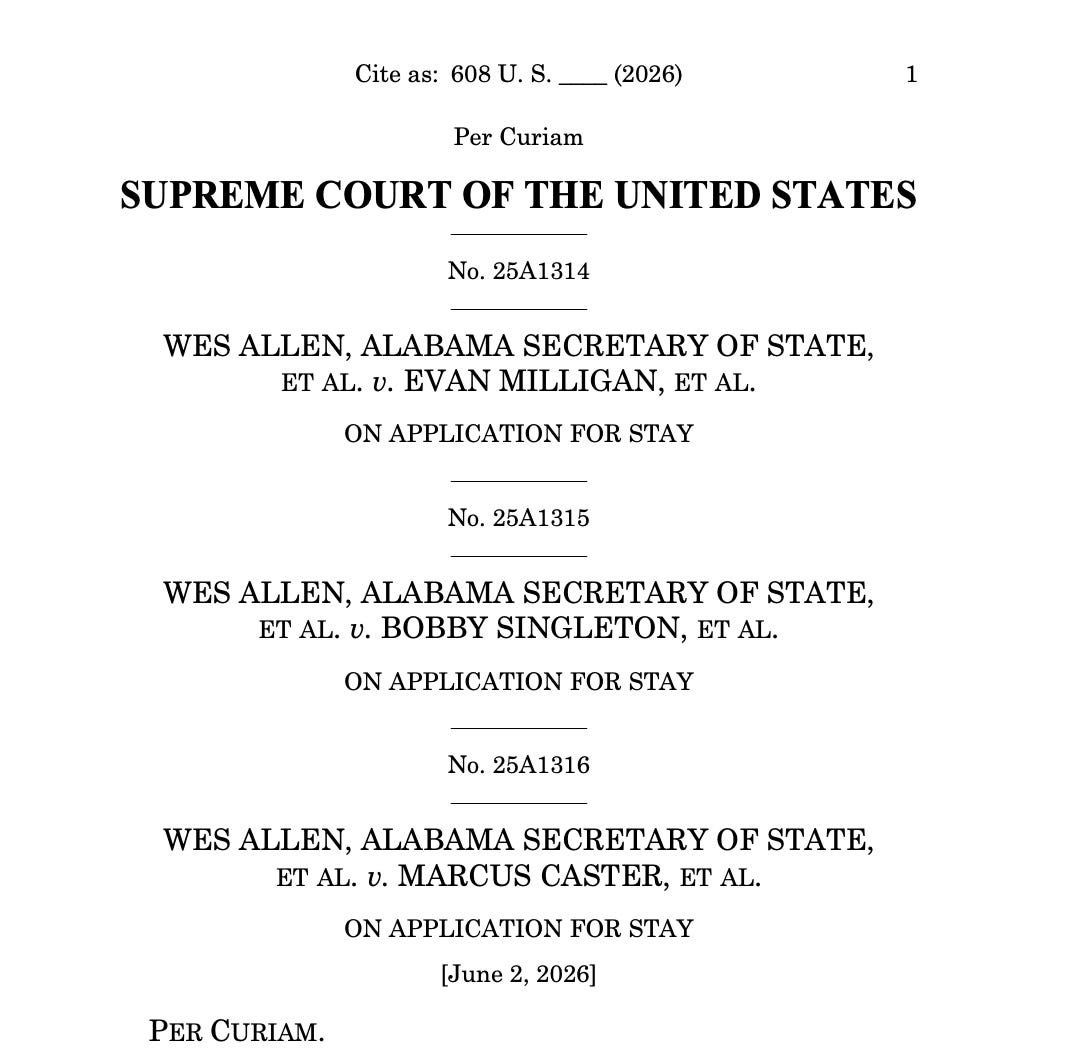
The New York Times headline referred to the decision like this: “Supreme Court Clears the Way for Republican-Friendly Map in Alabama.”
“Republican friendly” is just a sanitized way of saying racist here.
You don’t have to take my word for that. A court actually reached that conclusion. When the Alabama Legislature returned to court to ask for permission to use its post-Callais map, the court concluded, “Ultimately, we cannot see our way clear to requiring Alabamians to cast their votes in the 2026 elections under a districting plan tainted by intentional race-based discrimination.”
This was the first test of what was left of the Voting Rights Act after Callais. The Supreme Court failed it.
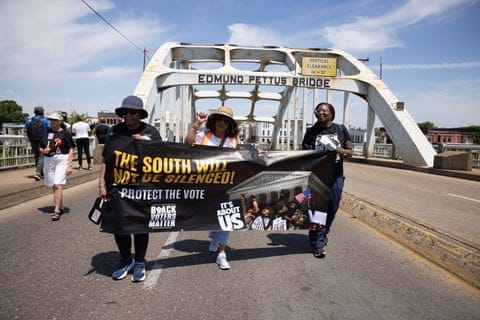
The decision means Alabama can replace the maps currently in use—they create two Black opportunity districts—with a map that has only one. I’ve been hyper-focused on the Alabama case, both because it’s the first test of Callais and because the evidence is so strong. The three-judge panel found evidence of intentional discrimination. That made the post-Callais question especially clear: Would the Supreme Court permit “partisan gerrymanders” to stand, even in the face of evidence that they were the result of racial animus? We now know the answer is yes. If the Court’s conservative majority would not invalidate Alabama’s maps on this evidence, it is hard to imagine what would.
As for Purcell and the rule against interfering too close to an election, the Supreme Court’s majority took the disingenuous way out. “The State has also made a strong showing of irreparable harm and that the equities and public interest favor it. We have repeatedly cautioned that lower federal courts should not ‘alter the election rules on the eve of an election,’” they wrote.
Just to level set, Alabama held its primary on May 19, just after Callais, using its existing maps. The impact of this ruling will be the insertion of new maps and the holding of new primaries this month. It’s hard to imagine a court having greater impact on an election than the Supreme Court has just had in Alabama. How did they get around that? They wrote that it was the district court that “interposed itself into Alabama’s ongoing efforts.” Then, ignoring the rule that appellate courts should defer to lower courts’ findings of fact in the absence of clear error, they concluded, “While federal courts should not impose changes close to an election…States are free to decide for themselves whether last-minute changes to an election are in their best interests.”
The irony is that the current maps in Alabama are only in place because the Supreme Court ruled that they were necessary. In Milligan, decided just three years ago, the Court signed off on the three-judge panel’s decision that Alabama’s maps were unconstitutional. Even then, the Alabama legislature resisted, drawing new maps that failed to create two minority opportunity districts. As we’ve discussed, the panel ultimately had to appoint an expert and draw maps for the recalcitrant legislature. Now, however, the Supreme Court has erased that history and given the legislature its blessing, evidence of racial discrimination and all.
And so goes the rest of the country.
In dissent, Justice Sotomayor wrote that the majority’s decision "disregards both democratic values and the rule of law." One wonders how the Justices in the majority feel about it in private. "Just as Alabama doubled down on racial discrimination,” Justice Sotomayor challenged them, “the Court today doubles down" on permitting it.
Some Supreme Court decisions are historic failures. I talk about two of them in my book, Giving Up Is Unforgivable: A Manual for Keeping a Democracy. One is Dred Scott, which denied Black Americans citizenship and dignity. The other is Korematsu, where the Court shamefully permitted the interment of Japanese Americans during World War II. The Roberts Court’s derogation of Americans’ voting rights, starting with Shelby County v. Holder, working its way up to Callais, and now, putting the final nail in the coffin in Milligan, will go down in history as a shameful failure. That is an especially damning distinction for a Court that already has much to answer for.
The Milligan plaintiffs got it right in their response to the Court’s decision: “When politicians are worried about staying in power, they come for Black voters first.” But where this administration starts out is never where it ends up. There is always worse to come when corruption is given free rein.
Fair Fight’s President, Lauren Groh-Wargo, recently said, “Political parties try to earn your vote; authoritarian movements find ways to win without it.” That’s precisely what Trump will do. He will try it in 2026 and more than likely again in 2028. We must match it with a commitment of our own: a commitment to voter registration, to voter education, to ensuring that everyone can vote no matter how difficult they try to make it, and to ensuring that every vote is counted. This is the ultimate fight, a true gun fight, and Democrats cannot afford to bring a knife to it. Our right to vote, the right that unlocks all other rights, is on the table. It will be up to us to remain committed, passionate, and vocal in its defense.
In the 2022 midterm elections, only 46.8% of eligible Americans voted. Keep that in mind. Talk to the people around you. Encourage them to register, and follow up with them. Help people make a plan to vote. If they need a ride, make sure they have one. Offer to babysit for the single working mom in your neighborhood. It is on each of us to do whatever it takes. Nothing defeats a gerrymander like unexpected turnout. Let’s go.
If you’ve read this far, you already know that understanding what’s happening isn’t optional right now—it’s essential. Civil Discourse exists to help you do exactly that: to cut through the noise, explain what the law actually says, and tell you plainly what’s at stake. If you’re not already a paid subscriber, I’d love for you to join us. For $6 a month or $50 a year, you become part of a community of people who believe that an informed public is democracy’s best defense—and that public education about the rule of law isn’t a luxury, it’s a necessity. Readers like you are what make this work possible. I’m grateful you’re here.
We’re in this together,
Joyce
In Callais, the Supreme Court said that absent clear evidence of racially motivated discrimination, new maps would be allowed, regardless of partisan gerrymandering.
On returning to lower courts, the lower court said there is clear evidence of racially motivated discrimination, and they voided the new maps.
The Supreme Court did not respond to the lower court's finding of fact that racial discrimination was real and determinative. They just said that they should rule in concordance with Callais.
They disregarded their own prior instructions regarding racial discrimination being forbidden.
The playing field is so deeply tilted. Clearly Republicans (including those of the hyper-partisan Republicans of the Supreme Court) feel that their hold on power is so fragile that it cannot tolerate a free and fair election. It will take all of our effort, and with that, our Republic hangs in the balance.